
American Lifestyle
The Republic Of Letters: How To Start A Book Club With Friends And Carry On A Proud American Literary Tradition

Long before our modern book clubs filled our social calendars with lively discussions and shared plates, early Americans gathered in local taverns and the warmth of their homes. They weren’t just passing the time, mind you; they were passionately debating philosophy, science, and, of course, literature. This vibrant tradition found one of its most famous expressions in Benjamin Franklin’s remarkable 1727 ‘Junto’ club, a beacon of intellectual curiosity in colonial Philadelphia. This enduring American passion for shared reading and intellectual fellowship, I believe, remains one of the cornerstones of our social and intellectual life.
In our fast-paced digital age, it’s easy to feel disconnected, to let the noise of the world drown out the quiet joy of a good book and a thoughtful conversation. But starting a book club with friends offers a wonderful antidote, a way to foster deep discussions, enjoy good food and drinks, and truly keep this rich tradition alive. It’s more than just reading; it’s about building community, sharing perspectives, and connecting with the rich tapestry of American thought that has always thrived in these intimate literary circles.
Franklin’s Junto and Beyond: The Rich History of Literary Circles and Book Clubs in America
When I think of the roots of American communal reading, my mind often wanders back to that chilly Philadelphia night in 1727 when Benjamin Franklin, then a young printer, gathered a dozen of his fellow artisans and tradesmen. They called themselves the ‘Junto,’ meaning a ‘council’ or ‘meeting,’ and their purpose was simple yet profound: to improve themselves and their community through shared inquiry. Meeting every Friday evening, usually at a tavern like the Tun Tavern or the Indian King Tavern in Philadelphia, Pennsylvania, they discussed moral questions, political queries, and philosophical dilemmas, often bringing books or papers to share.
This was more than just a social club; it was a cornerstone of colonial intellectual life, a true ‘Republic of Letters’ where ideas were freely exchanged and sharpened. It planted seeds for institutions like the Library Company of Philadelphia and the American Philosophical Society, showing just how deeply *benjamin franklin junto club* influenced the very fabric of American intellectual development. Their gatherings were less about literary analysis of a single novel and more about collective learning and civic engagement, setting a precedent for robust, community-centered intellectual life.
The spirit of the Junto didn’t fade; it evolved. Throughout the 19th century, *literary circles America* saw a proliferation of groups, especially among women, who often found their public voices and intellectual nourishment within these private spheres. Women’s clubs, like the Sorosis Club founded in New York City in 1868, started as literary societies before expanding into broader civic and social reform. These groups were vital, providing education, camaraderie, and a platform for activism at a time when formal education and public roles for women were limited.
By the turn of the 20th century, the Chautauqua Literary and Scientific Circle, established in 1878, brought structured reading courses to hundreds of thousands across the country, democratizing higher education and fostering a shared American cultural literacy. These were truly the forebears of what we recognize as modern *american book clubs history*.
Today, our enthusiasm for shared reading is as strong as ever. Did you know that in 2022, a survey by Statista found that 29% of U.S. adults reported being part of a book club? And a 2019 study published in the ‘Journal of the American Academy of Business, Cambridge’ indicated that book club members report higher levels of social satisfaction and intellectual engagement than non-members. These surprising statistics show that the human desire for connection and learning through literature is not just a historical footnote, but a thriving part of contemporary life. This enduring love for reading together reminds me of the warmth I felt gathered around my grandmother’s kitchen table, sharing stories and recipes. There’s a primal comfort in it.
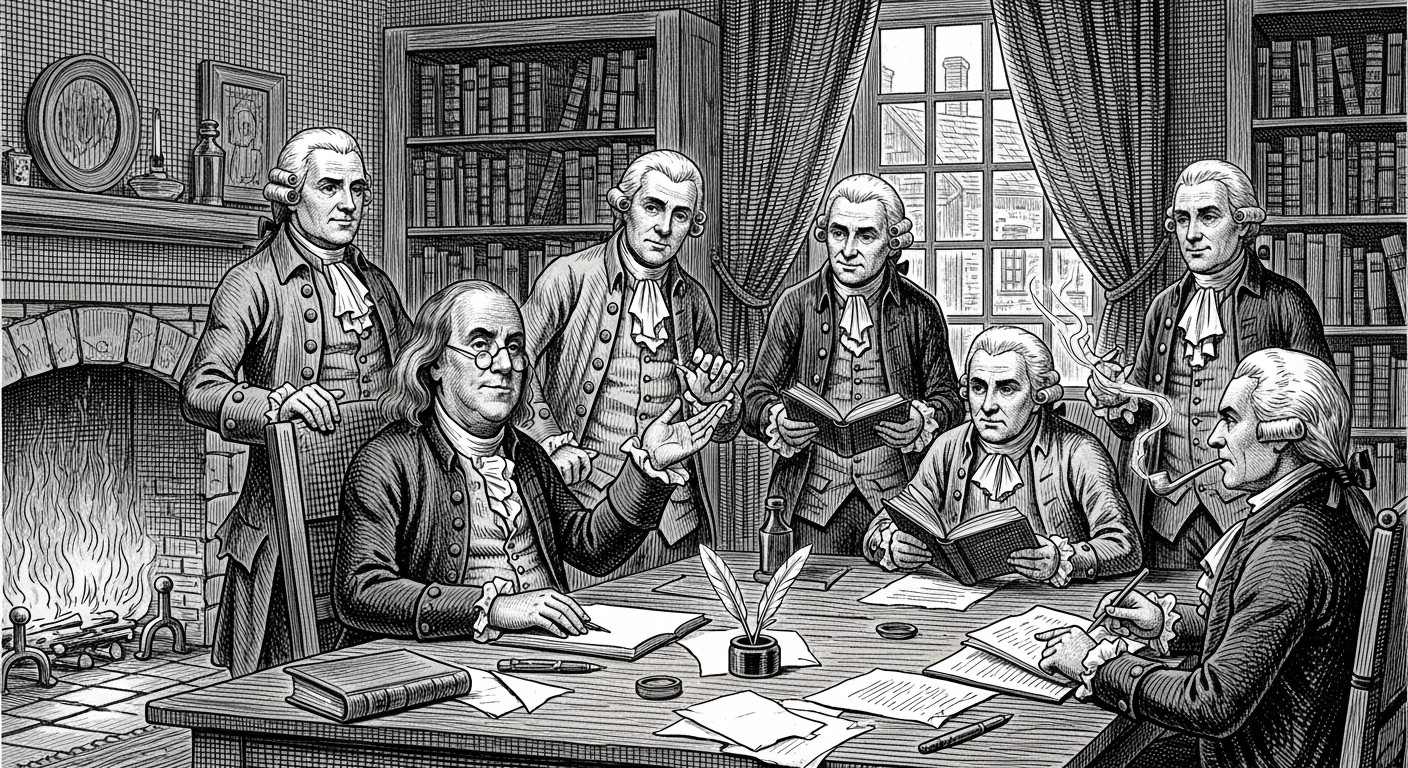 Benjamin Franklin leading a lively discussion in a colonial-era room, surrounded by men holding books and pipes, fire in a hearth.” />
A Timeline of American Literary Gatherings
Understanding this history can inspire us as we think about how to *start a reading group* today. Our roots run deep!
| Year | Movement/Group | Significance | Impact |
|---|---|---|---|
| 1727 | Franklin’s Junto | One of America‘s first self-improvement societies; debated moral, political, and scientific questions. | Laid groundwork for civic institutions like libraries and philosophical societies; fostered intellectual community. |
| Early-Mid 19th Century | Transcendentalist Circles (e.g., The Dial) | Informal groups of writers and thinkers (Emerson, Thoreau) discussing philosophy, literature, and social reform. | Influenced American literature, philosophy, and environmentalism; promoted individualism and intuition. |
| 1868 | Sorosis Club (NYC) | One of the earliest professional women’s clubs, founded to provide intellectual and social opportunities for women. | Pioneered the women’s club movement, which became instrumental in education, suffrage, and social reform. |
| 1878 | Chautauqua Literary and Scientific Circle (CLSC) | Developed a structured, four-year home-study reading program with certificates, often associated with summer assemblies. | Democratized adult education; fostered a shared national literary culture; promoted lifelong learning. |
| Mid-20th Century | Formalized Book Clubs | Emergence of more structured groups focusing on specific books for discussion, often meeting in homes. | Became a popular social and intellectual outlet; contributed to the rise of popular literary criticism and engagement. |
| Late 20th – Early 21st Century | Oprah’s Book Club & Digital Clubs | Mass-market book club (Oprah) ignited a reading craze; online platforms enabled global participation. | Massively increased book sales and public literary discourse; expanded reach and accessibility of book clubs. |
Crafting Your Circle: How to Start a Book Club with Friends and Choose a Theme
Feeling inspired? Good! Because the joy of starting your own literary circle is truly immeasurable. It’s a journey I’ve seen countless times in my travels through local communities, from quaint Ohio towns to bustling city neighborhoods. Here’s a practical *book club guide for beginners* to get you started on *how to start a book club with friends*.
Define Your Vision and Theme
First, consider what kind of club you envision. Do you want to:
- Explore a specific genre? Perhaps classic American literature, historical fiction, contemporary thrillers, or even regional folklore, like some of my own research interests!
- Focus on diverse voices? Dedicate your selections to authors from underrepresented backgrounds or different cultural perspectives.
- Tackle weighty non-fiction? Delve into history, science, philosophy, or current events.
- Simply read what’s popular? Enjoy bestsellers and books generating buzz.
Having a clear theme, even a loose one, can guide your book selections and attract like-minded members. When I helped a friend in Athens, Ohio, organize her ‘Appalachian Voices’ book club, defining that theme upfront made finding members and books so much easier.
Gather Your Founding Members
Think about your closest friends, neighbors, or even colleagues who share a love of reading and open discussion. A good size for a book club is usually 6-12 people. This allows for diverse opinions without becoming unwieldy. Reach out informally, perhaps over a cup of coffee or a casual dinner, to gauge interest. Emphasize the fun, friendship, and intellectual stimulation – not just the reading.
Set Up the Logistics (The Practical Stuff!)
Before your first meeting, discuss some basic ground rules:
- Meeting Frequency: Monthly is common, allowing enough time to read the book without feeling rushed.
- Meeting Location: Rotate homes? Meet at a local coffee shop? A quiet corner of a library? The flexibility is part of the charm.
- Book Selection Process: Will you vote? Create a shared list? Rotate who chooses?
- Communication: A group chat (text or app) or email thread works wonders for reminders and quick questions.
This initial conversation is crucial for setting expectations and ensuring everyone feels heard. It’s about building a shared sense of ownership from the very beginning, just like those early American societies.
The Art of Discussion: Tips for Selecting Books and Guiding Engaging Conversations
Once you’ve decided to *start a reading group*, the real fun begins: choosing your first book and then, the vibrant discussions that follow!
Selecting Your First Few Books
For your initial choices, I recommend books that are:
- Accessible: Not overly long or dense. Start with something manageable to build momentum.
- Thought-Provoking: Look for books with complex characters, moral dilemmas, ambiguous endings, or strong themes that invite debate.
- Varied: Don’t get stuck in a rut. Alternate between genres, authors, and time periods to keep things fresh.
Websites like Goodreads, Book Movement, and publisher sites often have book club recommendations and discussion guides. Don’t be afraid to read reviews, but also trust your group’s collective intuition. Sometimes the most unexpected book can spark the most memorable conversation.

Guiding Engaging Conversations: My Favorite *Book Club Discussion Tips*
A good discussion doesn’t just happen; it’s gently cultivated. Here are some of my tried-and-true methods for *hosting a book club meeting* that truly shines:
- The ‘Opening Round’: Start with a simple, open-ended question that everyone can answer in turn. For example: ‘What was your immediate reaction to this book?’ or ‘What character did you most (or least) connect with and why?’ This ensures everyone speaks early and sets a welcoming tone.
- Prepare a Few Key Questions: Even if discussion flows naturally, having 3-5 deeper questions ready can be a lifesaver. Focus on themes, character motivations, plot choices, or the author’s style. For instance: ‘How does the setting influence the characters’ decisions?’ or ‘Did the ending resonate with you, and why or why not?’
- Listen Actively, Facilitate, Don’t Dominate: As a host, your role is to ensure everyone has a chance to speak and that the conversation stays respectful and on track. Gently redirect if tangents stray too far. Remember, it’s a discussion, not a lecture.
- Embrace Disagreement: Different opinions make discussions rich! Encourage members to articulate their perspectives respectfully, even if they diverge sharply. Some of the best insights come from challenging our own assumptions.
- Connect to Broader Themes: Encourage members to link the book’s ideas to current events, personal experiences (if comfortable), or other works of literature. This is where the magic of the ‘Republic of Letters’ truly comes alive, extending the book’s world into our own.
Beyond the Book: How to Host Memorable Meetings with Cozy Themes, Food, and Drinks
While the book is the heart of your club, the ambiance and fellowship are the soul. *Hosting a book club meeting* is an opportunity to get creative and make each gathering a special event. Just like my grandmother always said, ‘Good company deserves good cheer!’
Themed Snacks and Drinks
This is where you can truly let your folklorist heart sing! Consider pairing your refreshments with the book’s setting, era, or themes:
- For a historical novel set in the South: Think iced tea, pecan shortbread, or a simple cornbread.
- For a book set in Paris: Offer croissants, cheese, and a light sparkling wine.
- For a cozy mystery: Serve warm cider or tea, with classic shortbread cookies.
- For a literary classic: Perhaps a simple, elegant spread of fruit, nuts, and dark chocolate, fitting for a more contemplative mood.
You don’t need to be a gourmet chef. Simple, thoughtfully chosen snacks and beverages can enhance the theme and create a wonderful atmosphere. Rotating who brings refreshments each month also shares the fun and responsibility.
Creating a Welcoming Atmosphere
Think about the physical space. Comfortable seating, good lighting, and perhaps some soft background music (if appropriate for the book’s mood) can make a big difference. I always advocate for making spaces feel inviting, whether it’s setting out a beloved quilt or lighting a few candles. It creates a sense of occasion, transforming a regular evening into something a bit more special.
Consider small touches. If you’re reading a book by a local author, perhaps find a small anecdote about them to share. If the book features a craft, you might even bring an example, or if a specific regional food is mentioned, try a simple version of it. These ‘micro-histories’ tie the reading back to real-world experience, just as the Junto members connected their readings to the civic life of Philadelphia.
Looking Ahead: Planning for Future Success
At the end of each meeting, it’s a good practice to briefly discuss the next book selection. This keeps the momentum going and gives everyone something to look forward to. You might also ask for quick feedback on the meeting itself – what went well, what could be improved? This ensures your club remains vibrant and responsive to its members’ needs.
Starting a book club with friends isn’t just a hobby; it’s an act of cultural preservation, a way to consciously participate in the ongoing ‘Republic of Letters’ that Benjamin Franklin and so many others helped establish. It’s about more than just words on a page; it’s about friendship, discovery, and the shared human experience. So gather your friends, choose your first book, and carry on this proud American literary tradition with warmth, curiosity, and good cheer. I have no doubt you’ll find immense joy in it.