
Geography & the American Landscape
The Mighty Mississippi River: Steamboat Commerce And The Heart Of The Heartland
To touch the waters of the Mississippi River is to touch the main artery of American history. As a geographer and outdoor guide, I’ve stood on countless riverbanks across this magnificent continent, but few waterways hum with the vibrant pulse of the past quite like the Mighty Mississippi. Stretching over 2,300 miles from its humble beginnings in Minnesota to its grand delta in the Gulf of Mexico, this isn’t just a river, it’s a living saga. It has served as the superhighway of native nations, the thundering engine of steamboat commerce, and the expansive canvas of Mark Twain’s boundless imagination. It is the flowing heart of our heartland, and its story is etched into the very soul of America.
Join me as we journey upstream and downstream, through the mists of history and the currents of commerce, to explore how this colossal river shaped the very fabric of our nation. We’ll discover surprising truths, meet legendary figures, and understand why the Mississippi truly is the American river.
Rolling on the Great Waterway: America‘s Lifeline Unfolds
The Natural Highway: From Wilderness Trails to Economic Main Vein
Before the grand paddle-wheelers ever churned its waters, the Mississippi was already a vital artery. Flowing from Lake Itasca, Minnesota, a quiet, pristine lake, it collects water from an immense drainage basin that is the third-largest in the world. Imagine this: a staggering 41% of the contiguous United States, encompassing parts of 31 states and even two Canadian provinces, feeds into this single river system! From the Rocky Mountains to the Appalachian foothills, every raindrop, every trickle, finds its way to the Mississippi.
For millennia, Indigenous peoples relied on the river for sustenance, travel, and trade, establishing complex networks long before European arrival. The Ojibwe, Dakota, Sioux, Chickasaw, and Choctaw are just a few of the many nations whose histories are inextricably linked to the river’s flow. Then came the European explorers, like Louis Jolliet and Jacques Marquette in 1673, followed by René-Robert Cavelier, Sieur de La Salle, who claimed the entire basin for France in 1682. They quickly recognized its unparalleled potential as a central trade route, linking the vast interior of the continent to the global economy via the Gulf of Mexico.
But transport was slow and arduous. Flatboats drifted downstream, only to be broken up for lumber at their destination, their crews walking hundreds of miles back upstream. Keelboats could be ‘poled’ or ‘cordelled’ (pulled by ropes from shore) upstream, but the journey was grueling and took months. The demand for efficient, two-way transport was immense, and the stage was set for a revolution that would transform the entire heartland.
The Golden Steamboat Era: Where Commerce Met Romance
The dawn of the 19th century brought an innovation that would forever change the Mississippi: the steamboat. While Robert Fulton’s ‘Clermont’ famously plied the Hudson River in 1807, it was his partner, Robert R. Livingston, who helped bring steam power to the Mississippi. Their steamboat, the ‘New Orleans,’ completed its maiden voyage from Pittsburgh to New Orleans in 1811, defying skepticism and demonstrating the immense potential of upstream travel. Within decades, the river was bustling.
The period from the 1830s through the 1850s marked the golden age of steamboat commerce. Paddle-wheelers, with their distinctive tall smokestacks and intricate gingerbread trim, became symbols of progress and prosperity. Imagine the scene: hundreds of these floating palaces, their calliopes playing, their paddlewheels churning, puffing smoke as they carried everything imaginable. Cotton from Southern plantations like those around Vicksburg and Natchez flowed south, bound for textile mills in Europe. Grain, timber, and livestock from the burgeoning Midwestern farms in states like Missouri and Illinois moved downstream. In return, manufactured goods, imported luxuries, and eager settlers journeyed upstream, transforming isolated frontier towns into vibrant commercial hubs.
By 1850, it’s estimated that over 1,000 steamboats were active on the Mississippi and its tributaries, a staggering number that underscores the economic boom. The river was a true two-way highway, making possible the rapid expansion of the American economy and facilitating the movement of people and ideas. It wasn’t just about goods, either; passenger travel became a grand affair, with luxurious steamboats offering fine dining, elaborate saloons, and comfortable cabins, bringing a touch of high society to the American frontier. 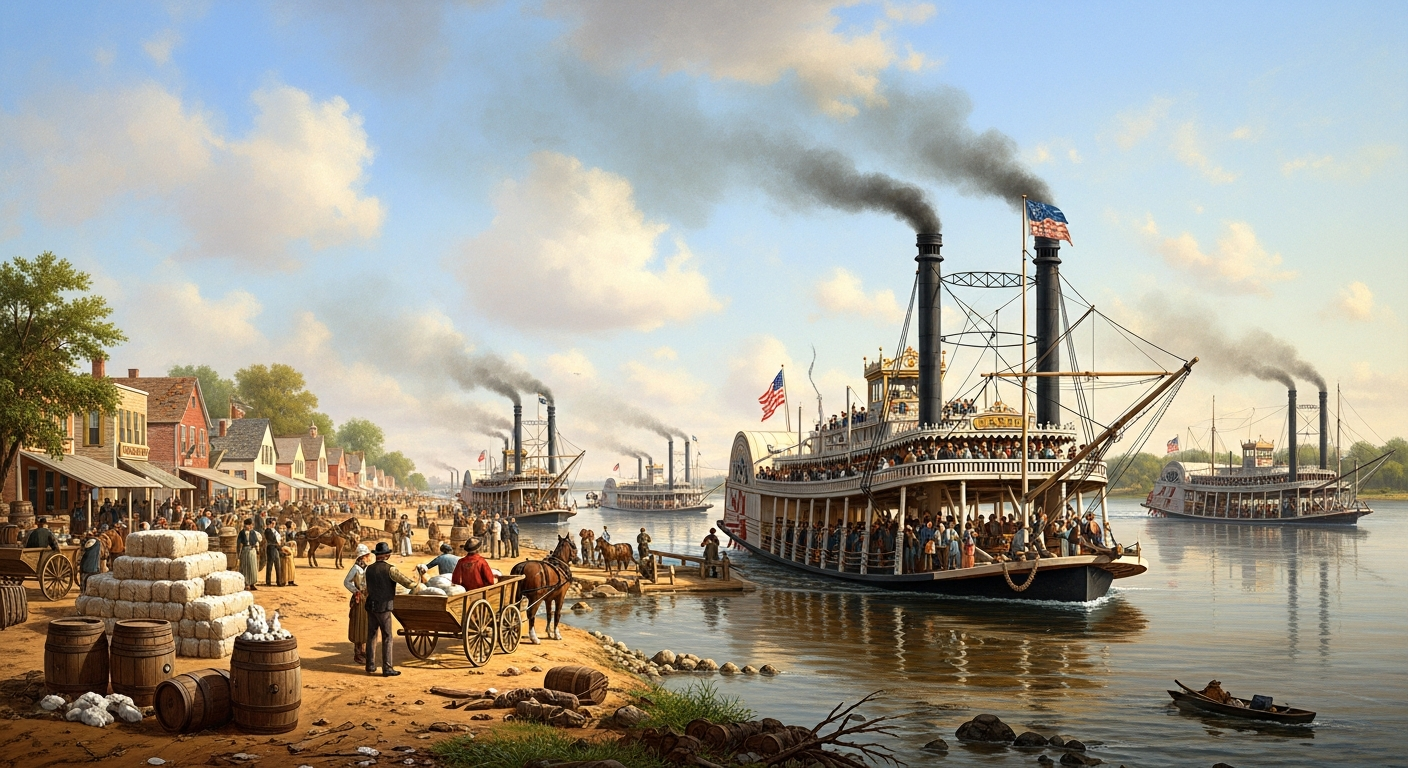
| Year | Event/Innovation | Impact on River Commerce |
|---|---|---|
| 1811 | Fulton & Livingston’s ‘New Orleans’ completes maiden voyage on Mississippi. | Proved viability of steam-powered, two-way river navigation, sparking initial interest. |
| 1815 | Henry Shreve’s ‘Washington’ introduces a safer, more efficient hull design. | Revolutionized steamboat design, making vessels better suited for shallow, snag-filled rivers. |
| 1830s-1850s | Golden Age of Steamboats. | Peak of steamboat operations, connecting goods and people from all corners of the interior. |
| 1853 | Record-setting trip by ‘J.M. White’ from New Orleans to St. Louis in 3 days, 23 hours. | Showcased peak efficiency and speed, although such races were often dangerous. |
| 1870s onwards | Rise of railroads. | Gradual decline of steamboat passenger and high-value cargo dominance, shifting to bulk goods. |
Life on the River: Dangers, Dexterity, and Dedicated Pilots
Life on a Mississippi steamboat was far from a leisurely cruise. The river itself was a formidable opponent, constantly shifting and presenting deadly hazards. Snags, massive submerged tree trunks, could tear through a hull with terrifying speed. Shifting sandbars could ground a vessel for days, weeks, or even permanently. Boiler explosions, often due to aggressive racing and inexperienced engineers pushing engines past their limits, were horrifically common, as were fires that could consume a wooden boat in minutes. It was a perilous existence, demanding courage and unyielding vigilance from every crew member.
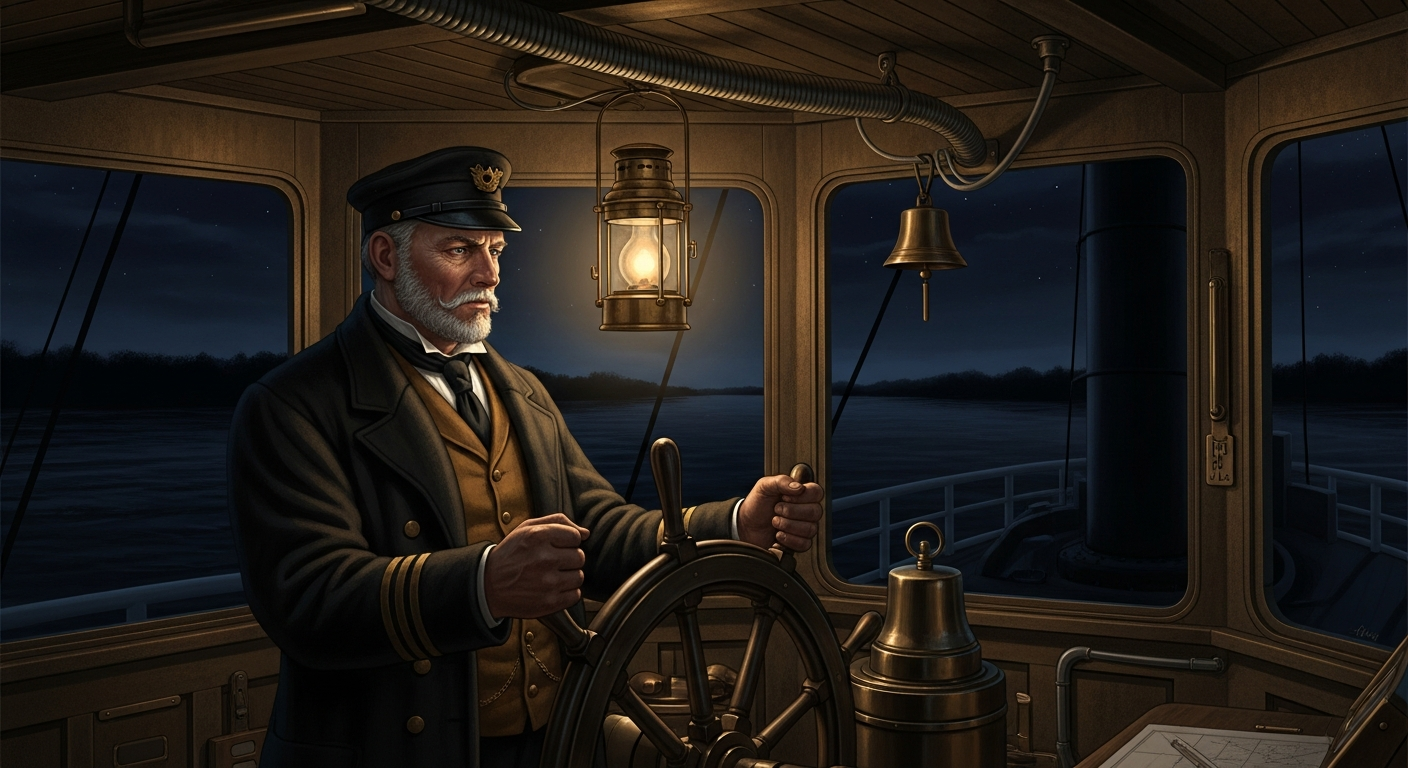
At the heart of every steamboat’s safe passage was the pilot. These weren’t just men with a license; they were living legends. To navigate the Mississippi, especially at night or in fog, meant memorizing every curve, every ripple, every ‘bar’ and ‘towhead’ (small island). The river’s channel constantly changed due to floods and erosion, so a pilot’s knowledge had to be continuously updated, a skill that could only be gained through years of painstaking experience. They were the true masters of the river’s moods.
One of the most famous of these pilots was Samuel Clemens, who adopted the pen name ‘Mark Twain.’ His pseudonym itself is a river term, meaning ‘two fathoms deep’ (or 12 feet), which indicated safe water for a steamboat. Twain’s experiences as a cub pilot and then a full pilot from 1857 to 1861 deeply informed his writing, giving us vivid, authentic glimpses into this lost world in ‘Life on the Mississippi.’ His ability to recall every nuance of the river, even years later, speaks volumes about the immersive, almost spiritual connection these pilots had with their watery domain.
When I lead groups through challenging Colorado river rapids, relying on memory of currents and submerged obstacles, I often think of those steamboat pilots. The stakes were immensely higher for them, but the principle of intimate knowledge of the waterway remains. It’s a humbling thought, the sheer dedication required.
A Steamboat Pilot’s Essential Checklist for Navigating the Mighty Mississippi
While we can’t truly step into a pilot’s shoes from the 1850s, we can appreciate the immense skill and preparation required. Here’s a simplified look at the mental and practical checklist a true river master would constantly be running through:
- Know the River’s Pulse: Before starting, consult the latest ‘river stages’ (water levels) reports. A high river might cover sandbars, but increase current speed and bring down more snags. A low river exposes new hazards.
- Chart Your Memory: Mentally ‘read’ the river ahead for the next 50-100 miles. Recall every bend, every named island, every shoal. What was the channel like last trip? Has there been a recent flood to change it?
- Watch for ‘Bars’ (Sandbars): Look for ‘riffles’ or disturbances on the water’s surface that indicate shallow areas. Use sounding poles and ‘lead-lines’ to verify depth, constantly calling out ‘Mark Twain!’ or ‘Quarter less twain!’
- Spot the Snags: Keep a sharp eye for floating logs, submerged trees, or disturbances that suggest a ‘sawyer’ (a snag partially submerged, moving with the current). Early detection could prevent a catastrophic hull breach.
- Monitor Weather & Current: Is a fog rolling in? Is a storm approaching? How is the wind affecting the vessel? Adjust speed and steering accordingly. A strong upstream current demands more power and fuel.
- Listen to the Engine: An experienced pilot could tell if the engine was struggling or running smoothly just by the sound. Communication with the engineer was paramount.
- Maintain a Lookout: Assign dedicated lookouts, especially at night. Other vessels, small skiffs, or river traffic could appear suddenly.
- Steer with Authority: The river is powerful. Anticipate its movements and make decisive rudder commands. Overcorrecting or hesitation could prove deadly.
- Fuel Management: Always be aware of fuel (wood or coal) levels and plan for replenishment stops at wood yards along the river. Running out meant drifting at the mercy of the current.
The Heart of the Heartland: An Enduring American Symbol
Though the golden age of steamboats eventually gave way to the efficiency of railroads and later highways, the Mississippi River remains an irreplaceable symbol of America‘s vast, flowing geographic identity. It is a unifying force, literally and metaphorically, connecting diverse landscapes and communities. It embodies the pioneering spirit, the ingenuity of those who harnessed its power, and the endurance of those who navigated its unpredictable currents.
Today, the river continues to be a crucial commercial artery, primarily for bulk goods like grain, coal, and petroleum, moved by powerful towboats pushing immense barges. It’s also a vital ecological corridor, home to diverse wildlife and a source of fresh water for millions. But for me, standing at an overlook along its banks, I still hear the faint echo of a calliope, the hiss of steam, and the rhythmic splash of a paddlewheel. I see the vision of a young Mark Twain, memorizing every nuance, shaping the words that would immortalize this grandest of American rivers.
The Mississippi is more than just water; it’s a testament to our nation’s history, a vital economic engine, and a constant reminder of the enduring beauty and power of the American landscape. It reminds us of where we’ve come from, and the strength of the currents that continue to carry us forward.
Celebrate the flowing heart of America. Just like the mighty river it honors, our “Paddle Wheeler Mississippi Steamboat Hoodie” from The50 Store is made with heavy, durable fleece to keep you warm and comfortable on any riverbank, trail, or city street. It’s a piece of history you can wear, a tribute to the ingenuity and spirit that tamed (or at least befriended) the Mississippi. Get yours and carry the spirit of the river with you!