
American Mythos & National Character
The Garage Birthplace Of Startups: Sacred Spaces Of Modern American Innovation
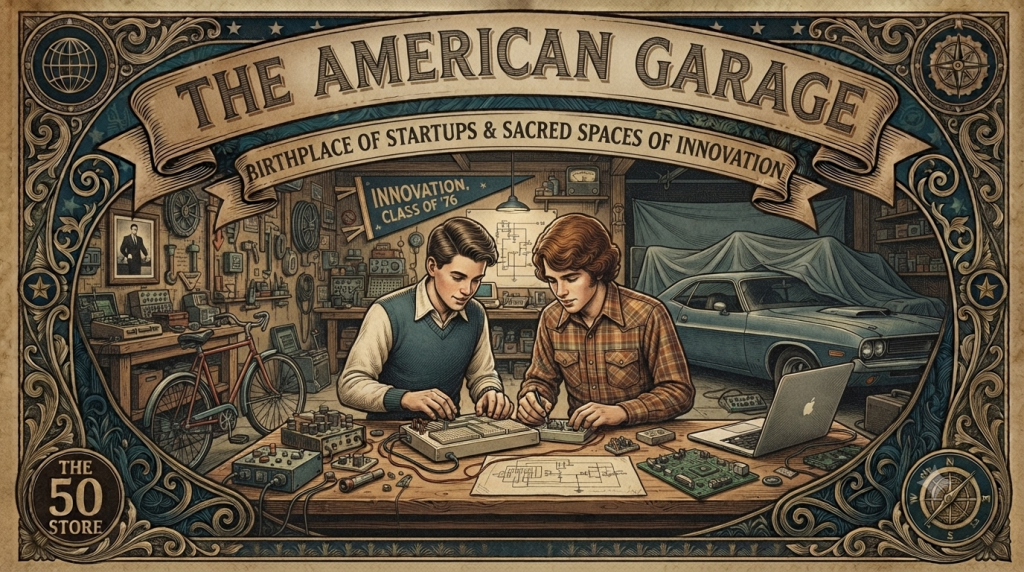
Goodness, what a joy it is to share stories of American ingenuity with you all! As a retired history teacher, I’ve had the distinct pleasure of watching countless young faces light up when they hear tales of our nation’s remarkable spirit. And there’s one particular story, a truly American saga, that I always found resonated deeply, often sparking some of the most engaging discussions in my classroom: the humble garage, the unlikely birthplace of modern innovation.
Think about it for a moment: A cluttered workbench, some extension cords tangled just so, a cold concrete floor underfoot, and the grand, unassuming expanse of a metal garage door. From the very first whisper of Hewlett-Packard in 1938 to the digital revolutions sparked by Apple and Amazon in the latter half of the century, the American garage stands as nothing short of a sacred space. It is a crucible, a launchpad, a quiet sanctuary where audacious dreams were meticulously pieced together, screw by screw, wire by wire, into world-changing realities. It’s where the magic truly happened, out of sight, but never out of mind for those with a vision.
Built on Concrete Floors: The Genesis of Giants
When I taught American history, especially the post-war technological boom, my students often asked, ‘Mr. Vance, why a garage? Why not a fancy office or a lab?’ And that, my friends, is where the story gets really interesting. It’s a tale woven with practicality, perseverance, and that undeniable spark of American self-reliance.
The Packard Garage: A Humble Beginning
Let’s cast our minds back to a crisp autumn in 1938, in Palo Alto, California. Here, in an unassuming 11-by-18 foot wooden garage at 367 Addison Avenue, two bright, determined young men, Bill Hewlett and Dave Packard, began to build something extraordinary. Armed with just $538 in capital and an abundance of brilliant ideas, they started assembling audio oscillators. Their first big break? Selling eight of these innovative devices to Walt Disney for use in the production of the cinematic masterpiece ‘Fantasia.’ This small garage, with its modest dimensions, eventually became the very foundation of what we know today as Hewlett-Packard (HP), a global technology titan. It’s no wonder it’s now officially recognized as the ‘Birthplace of Silicon Valley’ and stands as a historic landmark.
Low Rent, High Ambition: Why the Garage?
My students often found it hard to imagine titans of industry starting in such humble surroundings, but the reasons were always clear. For young inventors, the garage wasn’t just about cheap rent (though that certainly helped stretch those shoestring budgets!). It was about freedom. It was a space where you could make a mess, work through the night, iterate, fail, and try again without the scrutiny or overhead of a traditional office. It offered a rare blend of privacy and flexibility, a canvas for unbridled creativity and relentless tinkering. This was a safe haven for ambition, away from prying eyes and the pressures of corporate expectations, allowing ideas to ferment and evolve organically.
And these ‘garage startups’ aren’t just a relic of the past! According to the U.S. Small Business Administration, approximately 50% of all small businesses are home-based. While not all are in a literal garage, this statistic underscores a persistent trend: entrepreneurship often begins not in gleaming corporate towers, but in the intimate, accessible spaces of our homes. It’s a testament to the enduring spirit of self-starting Americans.
The Spark of Apple: A Suburban Revolution
Fast forward to the mid-1970s, to another suburban garage in Los Altos, California. Here, the legendary Steve Jobs and Steve Wozniak, two visionaries barely out of their teens, meticulously hand-assembled the first 50 Apple I computers. I remember telling my class how Wozniak once said the garage was ‘where we could feel comfortable working.’ That comfort, that freedom, allowed them to lay the groundwork for what would become Apple Inc., a company that has, quite literally, put powerful technology into the hands of billions. It wasn’t about fancy equipment; it was about raw intellect, shared passion, and a concrete floor that could handle the weight of their dreams.
More Than Just Garages: A Pantheon of Innovation
The stories don’t stop there. The pattern repeats itself like a comforting echo through the decades:
- In 1994, Jeff Bezos started Amazon.com from his garage in Bellevue, Washington, fulfilling orders for books from a modest home office.
- Just a few years later, in 1998, Larry Page and Sergey Brin rented a garage in Menlo Park, California, giving birth to what we now call Google.
- Even earlier, in the 1920s, Walt Disney and his brother Roy started the Disney Brothers Studio in a garage in Los Angeles, proving that the ‘garage effect’ isn’t just about tech.
These are more than just anecdotes; they are foundational chapters in the story of modern America. The garage became, and remains, an enduring symbol of American ingenuity, self-reliance, and tech ambition.
Chronicles of the Garage Innovators
To truly appreciate the breadth of this phenomenon, here’s a quick glance at some of these legendary beginnings:
| Company | Founders | Year Founded | Location (Initial Garage) | Original Product/Service |
|---|---|---|---|---|
| Hewlett-Packard | Bill Hewlett, Dave Packard | 1938 | Palo Alto, CA | Audio Oscillators |
| Apple Inc. | Steve Jobs, Steve Wozniak | 1976 | Los Altos, CA | Apple I Computer |
| Amazon.com | Jeff Bezos | 1994 | Bellevue, WA | Online Bookseller |
| Larry Page, Sergey Brin | 1998 | Menlo Park, CA | Search Engine |
The Enduring Value of the Tinkering Spirit
What all these stories highlight, what I always emphasized to my young scholars, is the profound ‘tinkering spirit’ at the heart of American innovation. It’s the belief that simple ideas, when nurtured with passion and elbow grease, can transform into world-changing industries. It’s a spirit that doesn’t wait for permission or perfect conditions. It just starts. It builds, it tests, it fails, it learns, and it builds again. It’s a testament to the power of hands-on work and relentless curiosity.
I often find myself reflecting on these stories when I drive through my own quiet Virginia neighborhood. Every garage door I pass holds the potential for another big idea, another inventor toiling away, unaware that they might be shaping the next chapter of American enterprise. This isn’t just about technology; it’s about a mindset, a foundational belief in the power of the individual to create, to improve, and to make a difference.
How to Cultivate Your Inner Tinkerer: A Modern Garage Inventor’s Mindset
You don’t need a Silicon Valley garage to tap into this spirit. Here’s a practical guide, inspired by the great garage innovators, for fostering your own innovative mindset:
- Embrace Curiosity: Ask ‘Why?’ and ‘What if?’. Don’t accept things at face value. Dig deeper, explore possibilities. The best inventions often come from questioning the status quo.
- Learn by Doing: Reading is wonderful, but hands-on experience is invaluable. Get your hands dirty. Build something, fix something, take something apart just to see how it works. This direct engagement often sparks unforeseen connections and solutions.
- Accept Failure as Feedback: Every great inventor, from Thomas Edison to Steve Wozniak, understood that failure isn’t the end, but a crucial step in the process. It’s an opportunity to refine, adapt, and grow. Don’t be afraid to experiment, even if the first (or fifth) attempt doesn’t work.
- Find Your ‘Garage’: This doesn’t have to be a literal garage. It could be a corner of your home, a shed, a small workshop. It’s any dedicated space where you feel comfortable to experiment, make a mess, and pursue your passions without interruption.
- Solve Real Problems: Many successful startups emerged from founders trying to solve a problem they personally faced. Look around your life, your community. What irritates you? What could be better? These frustrations are often the seeds of innovation.
Join the Legacy: The Garage Startup Founders Club
For those who understand this spirit, who find joy in building things with their own hands, who believe in the power of a simple idea born in a humble space, we’ve got something special for you. The ‘Garage Startup Founders Club Vintage Tee’ celebrates this very heritage. Printed with retro blueprints that harken back to those foundational moments, this tee is made from our buttery-soft, premium combed cotton. It’s more than just a shirt; it’s a statement, a badge of honor for the dreamers and the doers.
It’s a way to wear your appreciation for the American spirit of ingenuity, a spirit that continues to shape our world, one garage, one invention, one tireless effort at a time. Thank you for letting this old history teacher share a story close to his heart. Keep those dreams alive!