
American History & Origins
Why the Gold Rush Changed America Forever
A Quiet Nation Before the Storm
Have you ever stopped to look at a rushing river and thought about what secrets it holds? The water just keeps moving. It never stops to tell you where it has been. I spend a lot of time watching rivers these days. They remind me of our history as a nation. We are always flowing forward. Sometimes we move slowly and gently. Other times, we hit a sudden rapid that changes the course of the water forever. This is a story about one of those rapids.
Back in 1848, our country was mostly a quiet collection of farms, plantations, and small towns on the eastern edge of the continent. The West was a vast mystery to most folks. People lived their lives according to the predictable rhythms of the seasons. You worked the soil, traded with neighbors, and rested when the sun went down. News traveled at the speed of a horse or a ship. That was the situation for nearly everyone. It was a hard but predictable life.
A Spark in the Water
Then came a spark in the water.
A carpenter named James W. Marshall (born 1810, died 1885) was building a sawmill for a pioneer named John Sutter (born 1803, died 1880) at a place we now know as Sutter’s Mill in Coloma, California. One cold January morning, Marshall looked down into the tailrace of the mill on the American River. He saw something shining in the dirt. It was gold.
That single shining moment shattered the quiet peace of the young nation. Word eventually leaked out. The whisper of vast wealth carried across the towering mountains and endless plains. Suddenly ordinary folks were gripped by a fever. They packed up everything they owned. They left their plows rusting in the fields and kissed their families goodbye. They walked, rode wagons, and sailed thousands of perilous miles into the unknown wilderness. The complication was clear. How could a country stay the same when everyone was chasing a wild dream of wealth?
How Did We Change Forever?
How did a shiny metal change the fabric of our nation so permanently? What did the Gold Rush really do to us as a people?
The True Cost and Wealth
Let me share a few numbers that always make me shake my head in pure wonder. It is hard to grasp the sheer scale of what happened next without looking at the facts. According to historical records, the sleepy port town of San Francisco had about 1,000 residents in early 1848. It was just a small, quiet settlement by the bay. Within two short years, that population exploded to an astonishing 25,000 people. It became a booming, chaotic metropolis almost overnight.
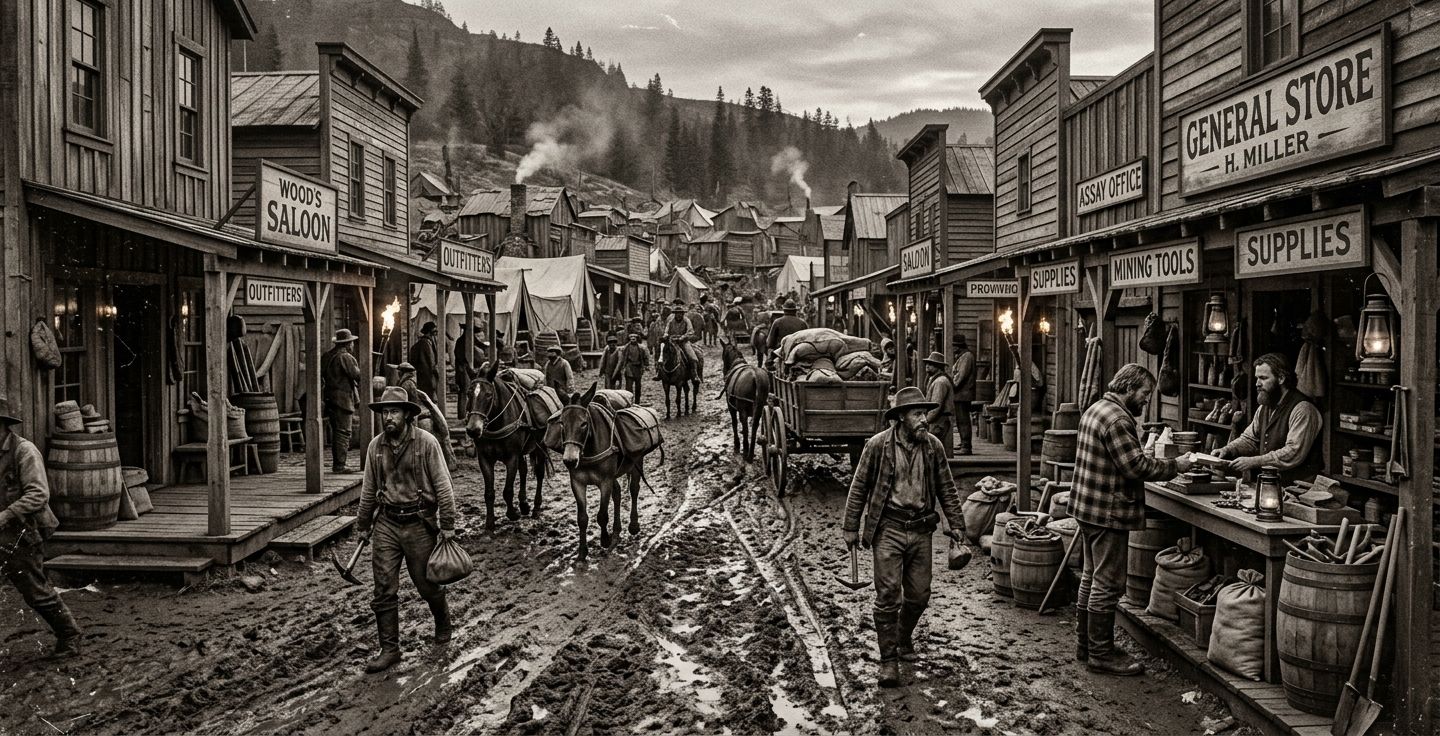
The wealth pulled from the earth was staggering. Records show that prospectors extracted roughly 750,000 pounds of gold during those frantic years. That equals billions of dollars today. But the most surprising statistics come from the local stores. With goods strictly imported, inflation reached comical heights. A single egg in a mining camp could cost the equivalent of 25 dollars today. A simple shovel could cost over 1,000 dollars. Hundreds of ships were abandoned in the harbor because crews jumped ship to head to the goldfields. Those rotting ships were eventually buried in landfill to create the streets of the financial district. The real wealth was not always in the icy river. It was in the general store.
The Birth of the American Dream
This brings me to a story I deeply love to tell. It is the story of ordinary folks who understood where the real opportunity lived. While thousands of forty-niners were breaking their backs in the freezing streams, a young immigrant named Levi Strauss (born 1829, died 1902) arrived in California. He did not come to dig in the dirt. He came to sell dry goods.
Levi noticed a very simple problem. The miners were wearing through their trousers in a matter of days. The harsh rocks, the heavy tools, and the endless kneeling tore standard cotton clothing to absolute shreds. He partnered with a clever tailor named Jacob W. Davis (born 1831, died 1908). Together, they took sturdy cloth, and later durable blue denim, and reinforced the pockets with copper rivets. They created the first pairs of blue jeans.
Think about that for a moment. The men digging for gold mostly went broke or died trying. The man making the pants built a cultural and financial empire that has lasted for centuries. This is the very heart of the American Dream. It is not just about finding a quick fortune or getting lucky. It is about seeing a problem, rolling up your sleeves, and creating a lasting, practical solution. Levi Strauss changed the way the whole world dresses, just by paying attention to the needs of the working man.
Women did the exact same thing. Take Luzena Stanley Wilson (born 1819, died 1902) as a fine example. She arrived in the rough camps and realized that lonely, exhausted men would pay almost anything for a hot, home cooked meal. She literally set up a cookstove under a large tree and started serving biscuits and beef. Within a short time, she built her own hotel and became one of the most successful business owners in the region. She did not need to pan for gold. She baked her way to prosperity.
The real legacy of those turbulent years is not the gold itself. The gold was quickly spent, traded away, or locked deep in bank vaults. The true legacy is the incredible mixing of people from all over the globe. Up until that point in our history, folks mostly stayed with their own kind. But in those muddy mining camps, you had farm boys from Ohio working right next to sailors from China. You had men and women from Mexico, Europe, South America, and Australia all sharing the same crowded streets.
They brought their unique foods, languages, and hopes. They had to learn to live together in a place with no established laws. They had to build rules, courts, and communities completely from scratch. It was terribly messy. It was not always fair, and it certainly was not always peaceful. But it was the hot crucible that forged the modern character of our diverse nation. It firmly established the idea that anyone, from anywhere, could stake a claim to a better life if they were willing to work hard enough.
Looking Forward With Hope
When I look at the younger generations today, I see that exact same bright spark in your eyes. You have your own vast frontiers to explore. You might not be panning in an icy mountain river, but you are building breathtaking new technologies. You are fighting for better, healthier communities. You are striving to build a world that is much kinder and far more connected than the one I grew up in. The fiery spirit of the pioneers is vibrantly alive in you.
Do not let the modern noise make you cynical or bitter. The pure courage it takes to pack up your life, leave your comfort zone, and seek something better is a truly beautiful thing. It takes immense guts to hope in a challenging world. It takes real bravery to try something completely new. We built an entire nation on that specific kind of bravery. I know in my heart that you are going to build a magnificent future with it.
Staking Your Own Claim
So, what is your gold? What is the dream that keeps you awake at night with excitement? Do not wait around for someone else to build the tools you need to succeed. Take a timeless lesson from the folks who made the blue jeans and baked the biscuits. Find a meaningful way to serve the people around you. Support your neighbors and lift each other up. Keep your eyes fixed firmly on the horizon, but make sure you keep your hands busy today. The future always belongs to those who are willing to dig for it. Go out there and stake your claim with pride.
Questions From the Porch
Let me answer a few common questions that often come up when folks ask me about this fascinating time in our history.