
American Sports & Pastimes
Sweet Summer Rivalries: The Nostalgic History Of Watermelon Eating Contests
Ah, summer. Just saying the word conjures up a whole kaleidoscope of memories for me. The long, sun-drenched days, the sound of cicadas buzzing, the smell of fresh-cut grass, and the undeniable, irresistible pull of a good old-fashioned watermelon eating contest. If you’ve ever found yourself under the blazing sun of a classic American July, sticky-sweet juice dripping down your chin, you know exactly the kind of pure, unadulterated joy I’m talking about. Nothing quite matches that sweet excitement. It’s a hallmark of our county fairs, our bustling town festivals, and especially our vibrant 4th of July celebrations, a tradition that has thrived for well over a century. These competitions, as simple as they seem, are a pure expression of small-town Americana, a slice of life that reminds us of what truly matters.
It might seem like a goofy pastime, something just for laughs, but I tell you, there’s a deep, rich `watermelon eating contest history` to explore here. It’s the story of how a humble summer fruit, bursting with color and flavor, became a beloved competitive tradition, weaving itself into the very fabric of our national identity. So pull up a porch swing, grab a glass of sweet tea, and let’s take a stroll down memory lane together, won’t we?
The Roots of Competitive Eating: From Harvest Feasts to Fairgrounds
To truly understand the `history of competitive eating`, especially when it comes to watermelon, we have to look back to the late 19th and early 20th centuries. This was an era of profound change, but also one of deep connection to the land. Farming was the backbone of our nation, and after a long, arduous growing season, folks needed a way to celebrate. That’s where the agricultural fair, the venerable county fair, really took root.
The Rise of Agricultural Fairs: A Community Hub
These fairs weren’t just places to show off the biggest hog or the prettiest quilt. They were social gatherings, a chance for communities, often spread far and wide, to come together. They were showcases of innovation, sure, but also celebrations of abundance and human ingenuity. It was in this fertile ground that `county fair history` began to intersect with the beginnings of organized competitive eating. Think about it: a community coming together, a harvest bounty, and a natural human instinct to playfully test one’s mettle. It was inevitable, really.
In those early days, the contests weren’t just about speed. They were often about sheer capacity, about demonstrating the bounty of the harvest. Pie eating contests, corn husking challenges, and yes, fruit eating contests, emerged as wholesome, family-friendly events. They were a break from the hard work of farm life, a chance for a little harmless rivalry and a lot of laughter. This wasn’t the high-stakes, professional competitive eating we see on television today; this was neighbor against neighbor, all in good fun, a testament to the spirit of cooperation and friendly competition that defined our young nation.
Surprising Scale: America‘s Appetite for Contests
Now, here’s a little something that might surprise you. While we often think of competitive eating as a modern phenomenon, its informal roots run deep. Did you know that in the mid-19th century, events showcasing eating prowess, often involving things like oysters or pies, were already popular? And the scale of these early fairs? By the early 1900s, many major state fairs were drawing tens of thousands of attendees annually, making them massive cultural events where competitive eating could flourish. For instance, the Iowa State Fair, a cornerstone of Midwestern tradition, has been around since 1854 and routinely attracts over a million visitors today. Imagine the crowds, the excitement, and the sheer volume of food available!
Another interesting tidbit: the average American consumes about 15.5 pounds of watermelon annually, according to the USDA. That’s a lot of watermelon! When you combine that kind of national love for a fruit with the burgeoning tradition of community competitions, you’ve got a recipe for a truly iconic event. These weren’t just about winning; they were about participation, about making memories, and about sharing in the collective joy of a summer day. They helped define what `small town Americana` truly meant.
The Watermelon’s Reign: Why This Fruit Became the Ultimate Summer Challenge
So, why watermelon? Why not apples, or peaches, or corn on the cob? Well, my friends, the watermelon possesses a unique set of characteristics that made it absolutely perfect for competitive eating, particularly for those joyous `summer festival traditions` and `classic 4th of July games`.
Messiness is Part of the Charm
First off, let’s be honest: watermelon is inherently messy. It’s juicy, it’s drippy, and it leaves its mark. And that, I believe, is half the fun! There’s something wonderfully liberating about letting go of decorum and just diving face-first into a sweet, red slice, juice running down your forearms, seeds flying. It’s a challenge to eat a `watermelon slice competitive` without making a delightful mess, and that challenge adds to the spectacle. It turns a simple act into a comedic, memorable event for both participants and spectators. No one judges you for being a bit of a slob at a watermelon eating contest; in fact, it’s practically encouraged!
Abundance and Affordability
Watermelons are also abundant, especially in the summer. They grow large, they’re relatively inexpensive, and they’re available across most of the country during peak season. This meant that even in smaller communities, it was easy to source enough fruit for a whole roster of contestants. You could have multiple rounds, maybe even a kids’ contest and an adult one, all without breaking the bank. It democratized the competition, making it accessible to everyone, which is truly the American way, isn’t it?
The Perfect Hydration Station
And let’s not forget the practical side! On a sweltering summer day, there’s nothing quite as refreshing as a cold slice of watermelon. It’s mostly water, after all, making it a natural hydrator. So, while contestants are pushing their limits, they’re also getting a much-needed cooling and rehydrating boost. It’s a delicious win-win.
Memorable Milestones: Tales of Watermelon Champions and Regional Quirks
Throughout the years, these contests have created countless memories and a few legendary figures. Every small town seems to have its own local hero, its very own `watermelon champion` who could out-eat anyone at the annual picnic. These are the micro-histories that truly bring `traditional summer games` to life.
From Local Legends to Festival Mainstays
I remember my Uncle Joe, a quiet man with a booming laugh and an even more booming appetite. Every year at the Cedar Creek Summer Fest, he’d compete. He never won, mind you, but his enthusiasm was infectious. He’d come away covered in seeds, grinning ear to ear, declaring it the best watermelon he’d ever tasted, win or lose. That spirit, that sheer joy in participation, is what makes these events so special. It’s not always about the trophy; it’s about the shared experience.
Many towns have their own unique twists on the classic watermelon challenge. Some focus on speed, others on cleanliness (good luck with that!), and some even have seed-spitting components. In places like Luling, Texas, famous for its annual Watermelon Thump, the contests are serious business, part of a larger celebration of the fruit that includes parades, dances, and, of course, a crowning of the Watermelon Queen. It’s a full-on spectacle, a highlight of their `summer festival traditions`.
The Enduring Appeal
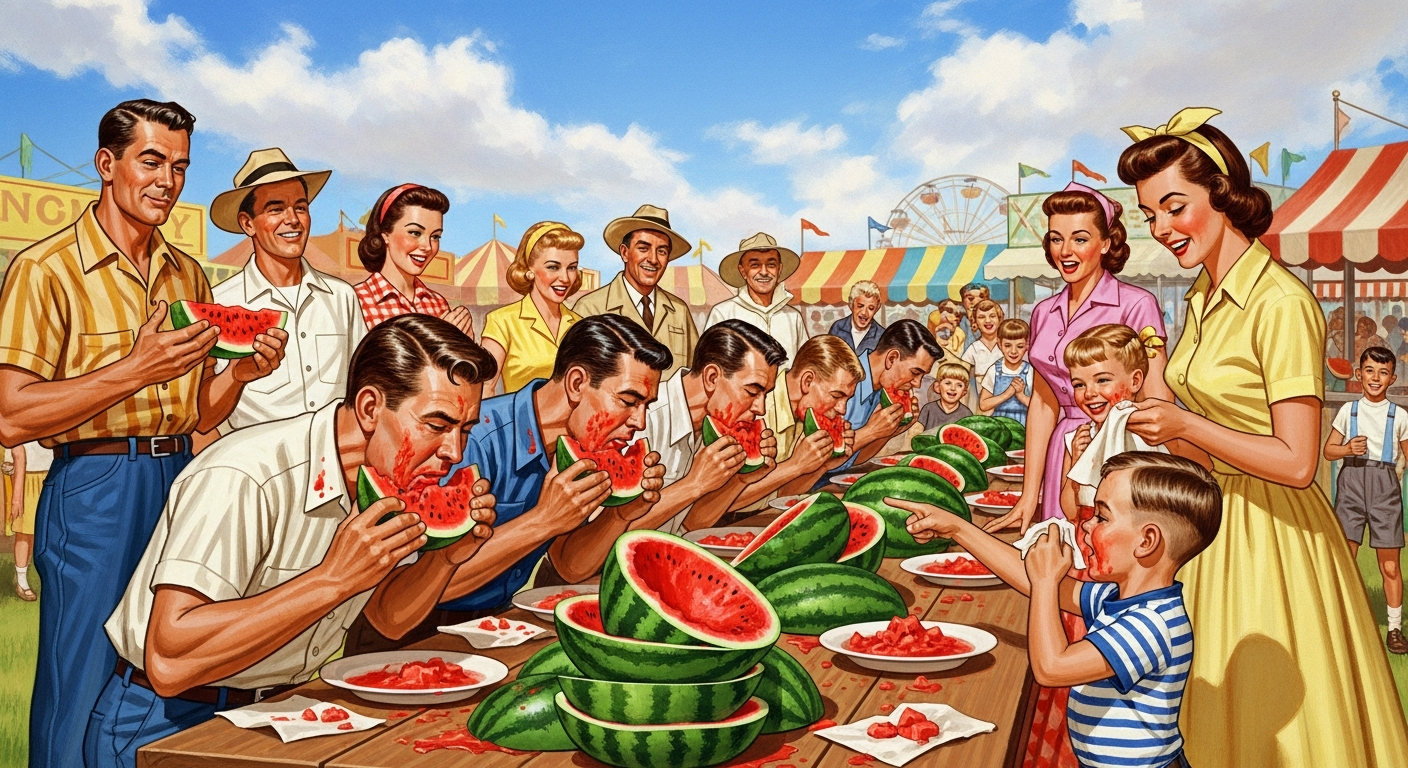
And who can forget the sight of a long row of contestants, elbows flying, faces buried in juicy halves? It’s a scene that plays out across America every summer, a testament to the simple, enduring appeal of these `county fair contests`. It’s a tradition that crosses generations, with grandparents cheering on their grandkids, sharing stories of their own competitive eating glory days. It’s a beautiful thing to witness, a true thread in the fabric of our communities.
A Timeless Tradition: Bringing Communities Together
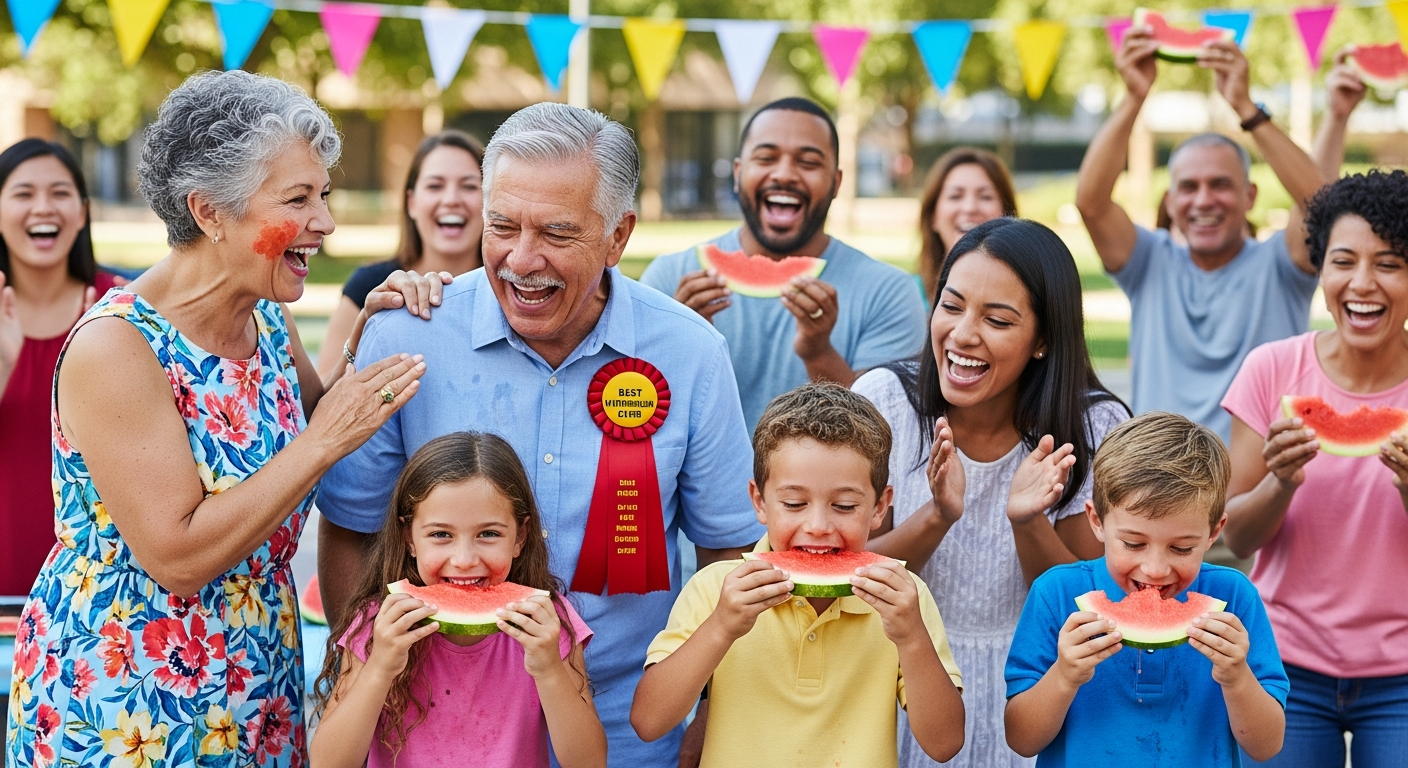
As the sun sets on another glorious American summer, and the last sticky watermelon rinds are cleared away, what remains is more than just a memory of sweet fruit. It’s the memory of laughter, of friendly rivalry, of community spirit. The `watermelon eating contest history` is more than just a timeline of events; it’s a testament to our nation’s enduring love for simple pleasures, for shared experiences, and for the kind of wholesome fun that brings us all a little closer.
These contests, born from the bounty of our land and the ingenuity of our people, continue to serve as vibrant focal points for our `small town Americana` celebrations. They remind us of a time when life felt a little simpler, when entertainment was homegrown, and when the bonds of community were strengthened over a shared plate, or in this case, a shared half of a juicy watermelon. It’s a `timeless tradition`, a `traditional summer game` that encapsulates the very best of what it means to be an American.
So, the next time you see a sign for a watermelon eating contest, don’t just walk by. Stop, watch, maybe even join in! You’ll be participating in a piece of living history, a joyous custom that continues to bring neighbors, friends, and families together, year after year, under the grand, expansive skies of our beautiful country. And trust me, that’s a tradition worth celebrating and preserving for generations to come. It’s a big, sweet, messy reminder of what makes America truly special.