Icons & Symbols of America
The Woman Who Sewed the Star-Spangled Banner: The True Story of Mary Pickersgill
When we think about the birth of our national anthem, our minds naturally drift to a ship bobbing in the dark, cold waters just off the coast of Maryland. We picture a young American lawyer named Francis Scott Key (1779-1843) straining his eyes through the dawn mist. He was searching for a sign of hope. And what he saw was a flag so massive it could be seen from miles away. That giant, defiant cloth became the Star-Spangled Banner. We sing about it at baseball games and parades, feeling a swell of pride when those notes hit the air. It is a song that unites us, reminding us of the enduring strength of our republic.
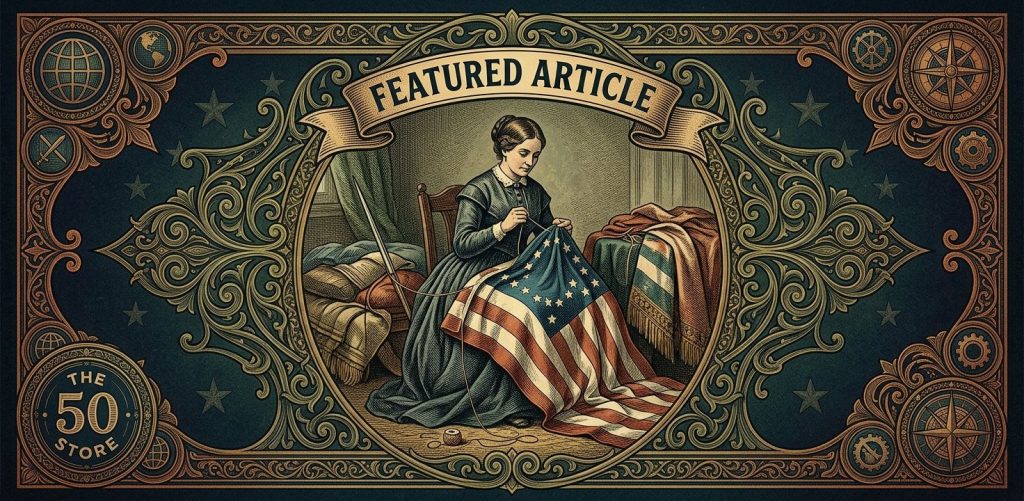
But the history books often overlook a quiet, hidden truth. Flags of that size do not magically appear. They are born from calloused hands, aching backs, and pure American grit. The real story belongs to a widow from Maryland who stitched that symbol of freedom on a wooden floor. Her name was Mary Pickersgill (1776-1857). Mary was not a soldier, and she was not a politician. She was an everyday citizen who used the skills she had to serve the country she loved with all her heart.
Let me pull up a chair and tell you her story. It is a tale of warmth, resilience, and the kind of quiet patriotism that built this wonderful country. Imagine being in Key’s shoes for just a moment. He was detained on a British truce ship, helpless as the most powerful navy on earth rained fire upon his countrymen. The night was dark, illuminated only by the terrifying flashes of exploding shells. When dawn arrived, the sheer size of the flag he saw changed the course of American history. But the hands that made it deserve our attention just as much. The story of our flag is the story of the American spirit itself.
The Core Narrative: Stitching the Giant Emblem
Part I: Fort McHenry Needs a Flag
The year was 1813. Our young nation was locked in the War of 1812, fighting once again for the very freedoms we had won just a few decades prior. The mighty British Navy was prowling the Eastern Seaboard, disrupting our way of life. Everyone knew that Fort McHenry in Baltimore was going to be a major target. The citizens of Baltimore knew a storm was coming. They were preparing to defend their homes, their families, and the independence they held so dearly.
The commander of the fort was Major George Armistead (George Armistead (1780-1818)). Armistead was a leader who understood the psychology of his men and the profound importance of morale. He knew an attack was imminent and needed a powerful symbol to unite his troops. He wanted to show the approaching enemy that America would not back down. Armistead issued a bold request for a flag so large that the British will have no difficulty seeing it from a distance. He wanted a banner that screamed defiance across the harbor.
This brings up a fascinating complication. Making a normal flag in the early nineteenth century was already a meticulous chore. Making a flag of monstrous proportions required serious logistical magic. The question echoing through the cobblestone streets of the city was simple. Who could build such a behemoth in time? The government needed a master artisan. The answer was a hardworking woman running a modest flag-making business out of her home.
Part II: Mary Pickersgill’s Workshop
Mary was not a stranger to hard work or patriotism. Born in Philadelphia, she learned the craft of flag-making from her mother, Rebecca Young, who had made the Grand Union Flag for George Washington. Craftsmanship ran deep in her family’s veins. After becoming a widow at a young age, Mary moved to Maryland and established herself as a premiere flag maker. She was an independent businesswoman in an era when that was exceptionally rare. She was respected in her community for her precision, her reliability, and her unwavering work ethic.
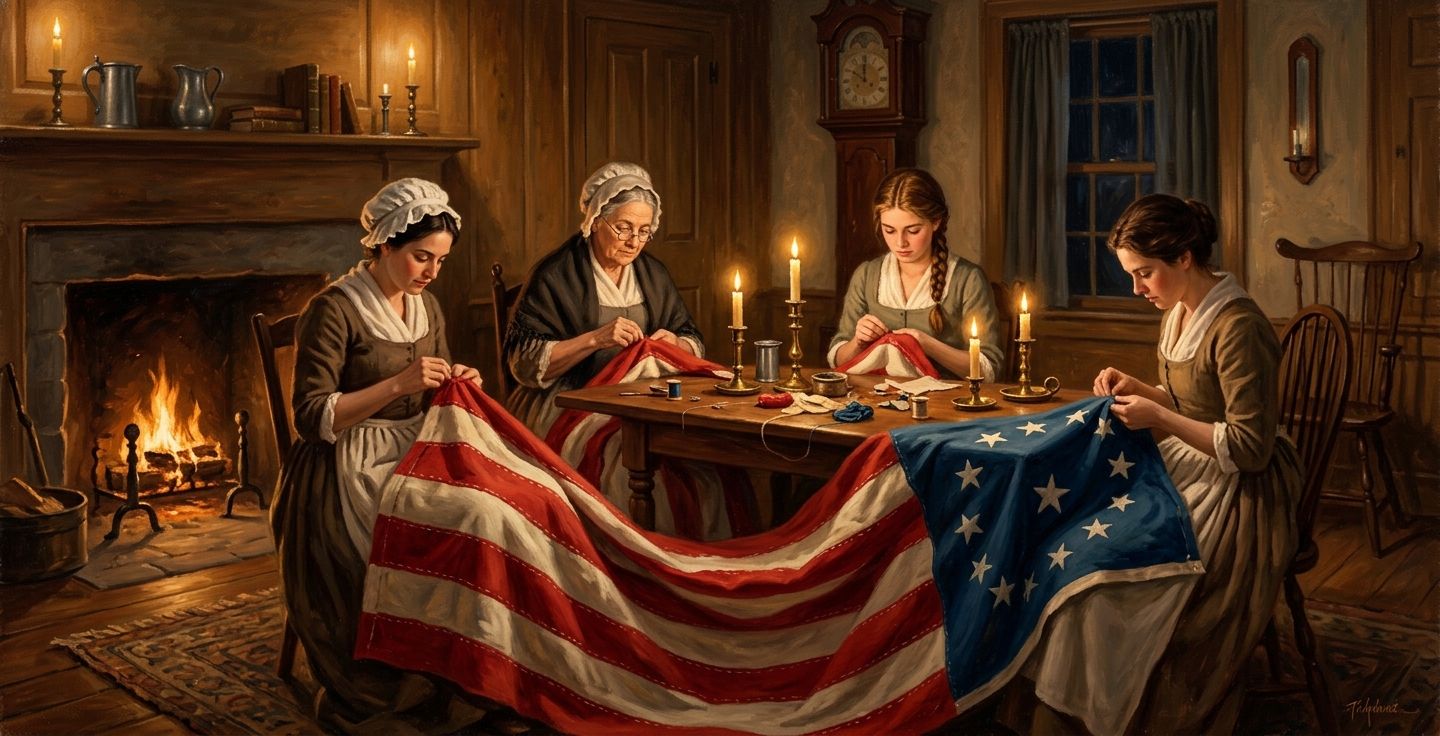
When the commission from Major Armistead came in, she understood the assignment, and she also knew she could not do it alone. Mary turned her home into a bustling workshop. She enlisted the help of her teenage daughter Caroline, two of her nieces, and an African American girl named Grace Wisher who lived and worked in the home. Grace Wisher’s contribution is a vital piece of this American puzzle. The intricate labor of these young women, working alongside Mary, highlights the diverse hands that built our national identity. Together, this small but mighty team of women took on an astonishing task. They had to cut and stitch 400 yards of wool bunting.
To put that into perspective, historians note that 400 yards of wool bunting weighs over 50 pounds. This was incredibly heavy, hot, and exhausting material to handle. It took six weeks of intense, manual hand-stitching to complete. They worked day and night by the flicker of candlelight. Their fingers bleeding, their shoulders aching, but their spirits resolute. This is a brilliant micro-history of America. The grand victories won on the battlefield are almost always supported by the quiet, relentless labor of ordinary citizens at home.
Part III: Parlor Floor Canvas
Very quickly, the project outgrew Mary’s parlor. The sheer dimensions of the flag were staggering. When fully assembled, the flag measured 30 by 42 feet. It was roughly a quarter the size of a modern basketball court. Imagine trying to maneuver a piece of fabric that large inside a typical nineteenth-century rowhouse. It was impossible. The seams were getting too long, and the material was piling up to the ceiling.
Let us talk about those specific dimensions because they are absolutely incredible. Each star on Mary’s flag was two feet wide. Each stripe was nearly two feet broad. When you are working on a canvas that large, you cannot just sit in a rocking chair with a sewing hoop. You need massive amounts of open space to lay the fabric flat and ensure the geometry is perfect. Mary secured permission to use the floor of a nearby brewery. The women carried the heavy, sprawling fabric down the street to Claggett’s brewery.
There, they spread the red, white, and blue wool across the wooden floorboards. Claggett’s brewery became a makeshift sanctuary of patriotism. The local brewers went about their daily business while Mary and her team worked tirelessly on the floor, surrounded by the towering wooden vats of ale. They literally had to crawl across the fabric to sew the final pieces together. Every stitch was an act of faith. Every seam was a prayer for the safety of their city. They worked late into the damp night, breathing in the strong smell of malt and yeast, pulling thick thread through coarse wool until the masterpiece was finally whole.
Part IV: The Flag That Stood
The true test of their labor came in September 1814. The British fleet sailed into the harbor and began a furious bombardment of Fort McHenry. For 25 agonizing hours, the sky was torn apart by Congreve rockets and mortar shells. The rain poured down in sheets, turning the ground into mud. Key paced the deck of the truce ship, his heart pounding with every deafening boom. He desperately wanted to know if the fort had fallen. The suspense was agonizing, a true trial of his faith in the American cause. The very earth shook under the weight of the explosions. Over 1,500 cannonballs were fired at the fort, creating a deafening roar that could be heard for miles around.
Through it all, the brave men at the fort held their ground. During the violent storm and the darkest hours of the attack, a smaller storm flag was flown. But when the sun finally broke through the gray clouds on the morning of September 14, Major Armistead ordered the massive garrison flag to be raised. In place of the storm flag, hoisted high into the damp morning air, was the gargantuan banner Mary had stitched. The rockets’ red glare had given way to the brilliant colors of American resilience.
The massive flag required over a dozen men to raise it, especially since the rain had soaked the wool, making it weigh hundreds of pounds. It flew defiantly. It was unbroken, vibrant, and beautifully stubborn. It survived the 25-hour British bombardment and inspired the iconic words of our national anthem. Mary’s careful stitches held strong against the storm, just like the young nation she loved.
Celebrate Our Star-Spangled Heritage
Stories like Mary’s are the heartbeat of our great nation. They remind us that history is not just made by generals and politicians. History is crafted by everyday Americans. It is made by mothers, daughters, and hardworking folks who pour their love into their craft to protect the values we hold dear. Our heritage is woven from the threads of countless unsung heroes who stepped up when their country needed them most.
When we remember the sacrifices of the past, we carry that same spirit forward into the future. We keep the fires of freedom burning bright for the next generation. We must never forget the hands that cut the fabric, threaded the needle, and sewed the stars. It is an honor to look back at the resilience of our ancestors and feel that same pride swelling in our own chests today. The American story is one of unity, hard work, and unyielding hope.
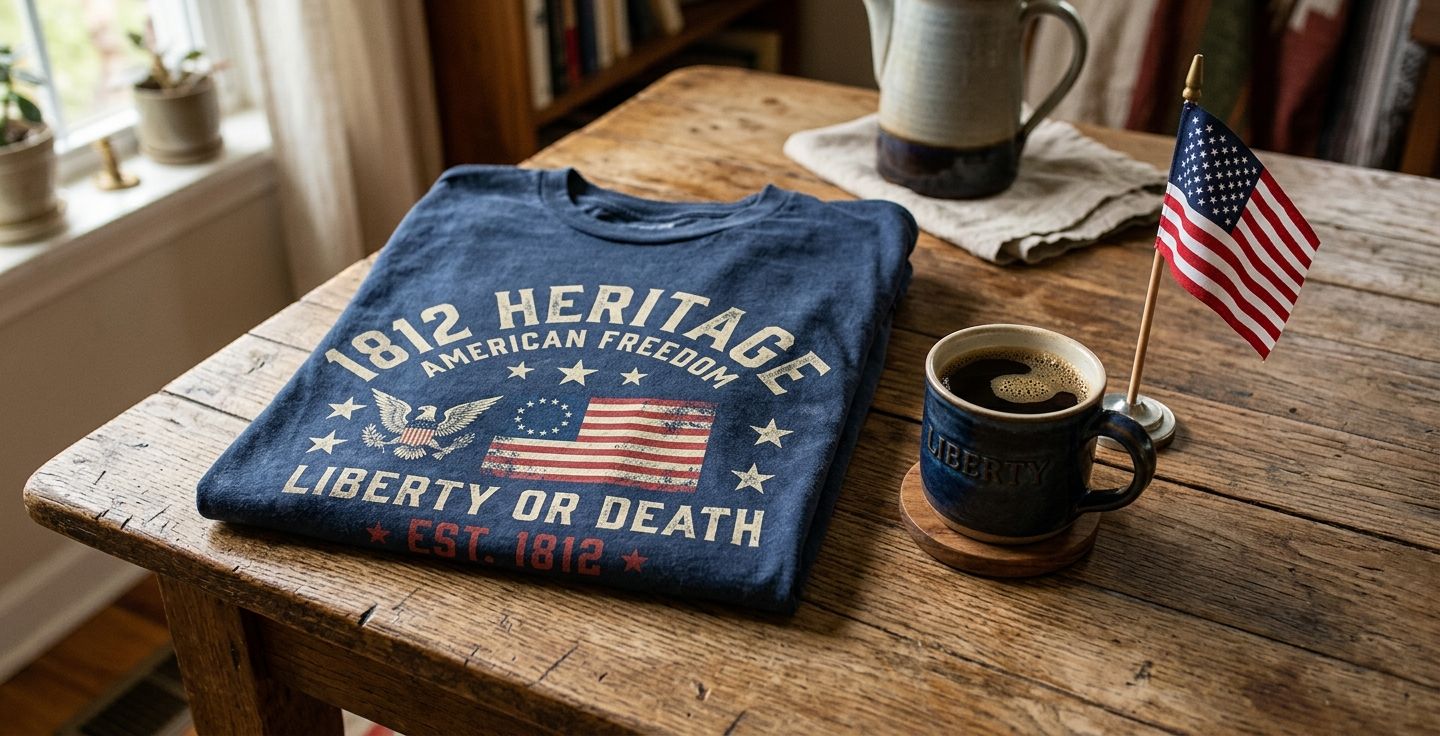
Celebrate the hands that crafted America’s symbols with our 1812 Mary Pickersgill Heritage Tee. Printed with water-based inks on our ultra-comfortable, ring-spun cotton tee, this shirt brings a piece of history right to your everyday wardrobe. It is a perfect fit for anyone who cherishes the true stories of American grit and the hidden figures behind our most beloved traditions. Grab yours today, and wear a beautiful, lasting reminder of the courage that keeps our flag flying high.