
Icons & Symbols of America
The Smokey Bear Legacy: How a Real Orphaned Cub Taught America Fire Conservation
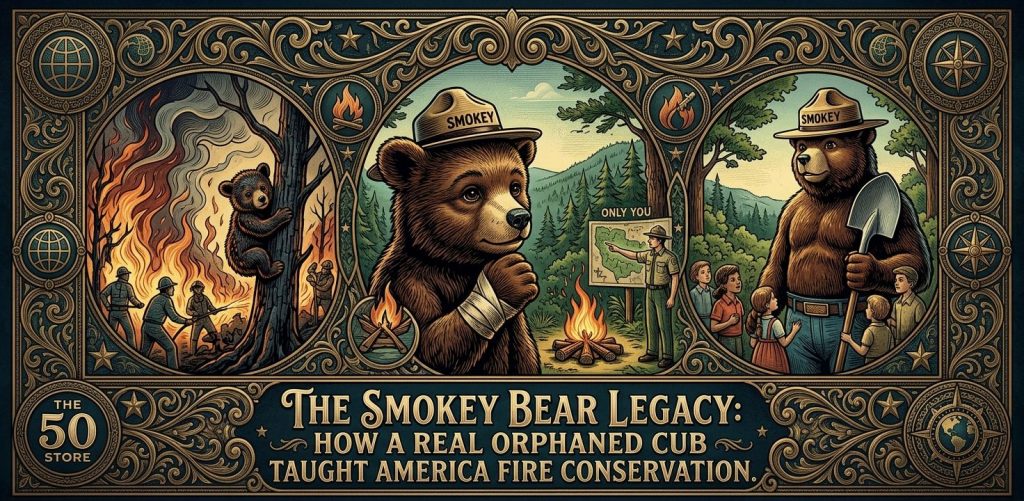
Well, hello there, friend. Pull up a chair and let us talk for a little while. If you grew up in this beautiful country of ours, spending your summers camping under the vast starry skies or hiking through the cool, quiet woods, you likely know a certain familiar catchphrase by heart: “Only you can prevent wildfires.” You probably picture a tall, sturdy bear in blue jeans and a flat-brimmed ranger hat, standing as a quiet guardian of the timber. But Smokey Bear was not just a clever advertising cartoon drawn up in a corporate boardroom by people who had never set foot in the dirt. The truth is much more grounded in the soil of our great land. He was a real, orphaned black bear cub rescued from a devastating New Mexico forest fire in 1950.
Back in the mid-twentieth century, America faced a very serious situation. Our national forests were vast and full of wonder, but human-caused fires were stripping millions of acres of precious timber and wildlife habitat every single year. The complication was simple but tragic: folks just did not realize the immense damage a stray unlit match or a carelessly abandoned campfire could do. Warning signs were posted everywhere across the parks, but they felt cold and distant to the average family on vacation. So, we had to ask an important question. How do you make an entire nation care deeply about protecting the woods? The answer came in the form of a frightened, badly burned little cub who showed us exactly what was at stake.
From Smoking Embers to National Mascot
Part I: The Capitan Gap Fire
It was the breezy spring of 1950 in the Capitan Mountains of New Mexico. The weather was unusually dry, the winds were howling through the rocky canyons, and a careless mistake sparked a raging forest fire. The Capitan Gap Fire swept through the heavy timber, painting the brilliant blue sky with thick, choking smoke. Volunteer firefighters, local crews, and dedicated forest rangers gathered their gear and battled the blaze round the clock. These brave men and women fought incredibly hard to protect the rugged beauty of the American Southwest. They worked in dangerous, exhausting conditions, sweating through their heavy canvas shirts to save the land they loved.
{VIS_1}
During the absolute chaos of the inferno, a crew of firefighters found themselves suddenly trapped by a massive wall of flames. They barely survived by lying face down on a bare rock slide for over an hour as the fire roared directly over them. When the smoke finally cleared a bit and the exhausted men bravely stood up, they noticed a tiny, terrified black bear cub. He had climbed a badly charred pine tree in a desperate attempt to escape the deadly heat. His mother was nowhere to be found, sadly lost to the flames. The poor little fellow was clinging to the blackened bark, his paws and hind legs badly burned by the searing ground. Right then and there, amidst the ash and total destruction, a true symbol of American resilience was born.
Part II: Healing ‘Hotfoot Teddy’
The firefighters carefully retrieved the frightened, whimpering cub and handed him over to the local forest rangers. They initially called him “Hotfoot Teddy” because of his badly blistered paws. A local rancher and dedicated state game warden named Ray Bell (1911-1998) stepped up immediately to help. Ray knew the little bear needed expert care, so he bravely flew the injured cub to Santa Fe to get proper medical attention.
In Santa Fe, a kind-hearted veterinarian gently bandaged the little bear’s paws and applied soothing salves to ease his terrible pain. Ray Bell then took the recovering cub into his own home. He lived with Ray’s wife, his son, and his young daughter, acting much like a playful, energetic puppy once his paws began to properly heal. He would play in the yard, drink milk from a bottle, and charm anyone who came to visit the Bell household. Word of the brave little bear spread very quickly across the tight-knit community.
Soon, news outlets across the entire nation picked up the touching story of the orphaned cub who miraculously survived the inferno. People everywhere were captivated. The state game warden and federal officials decided to officially rename him Smokey. This brilliant move aligned the real, living cub with the existing fictional wildfire prevention poster bear that had been created a few years prior in 1944. Now, the cartoon drawing on the posters had a living, breathing heart that the American people could truly rally behind.
Part III: A New Home at the National Zoo
As Smokey grew stronger and larger, it became quite clear that he belonged to the entire nation. The New Mexico state officials presented Smokey to the federal government with one very specific, very important condition: his life must be forever dedicated to forest conservation and teaching fire safety. He was flown out to our nation’s capital in Washington, D.C., taking up permanent residence at the National Zoological Park.
To say Smokey was a hit would be a massive understatement. He became an American icon almost overnight. Children from every state in the union, from the rocky shores of Maine to the sunny beaches of California, fell head over heels in love with him. They wrote him countless letters pledging to be careful in the woods. They eagerly promised to stir their family campfires with water and dirt until they were completely cold. They promised to protect the deer, the birds, and the majestic trees.
In fact, Smokey received so much mail from adoring citizens that the United States Postal Service eventually had to give him his very own, individual ZIP code: 20252. That is an uncompromised truth, friend. No other animal in our nation’s history has ever held such a distinct and prestigious honor. Imagine the mailrooms filled with bags upon bags of handwritten notes. Millions of letters poured in over the years, creating a powerful, grassroots movement of young Americans dedicated entirely to preserving our natural heritage.
Part IV: The Legacy of Conservation
Smokey lived a long, peaceful, and highly celebrated life at the zoo until his passing in 1976. After he passed, his remains were returned home to Capitan, New Mexico, where he rests today. But his impact on the United States is almost impossible to fully measure in simple words.
Before the Smokey Bear campaign began in earnest, wildland fires burned roughly 30 million acres of American forests every single year. According to historical data from the USDA Forest Service, that devastating number dropped drastically over the following decades. It eventually fell to an average of about 7 million acres annually in recent times. That is a staggering, monumental reduction. It means countless old-growth trees were saved, countless fragile wildlife habitats were preserved, and countless rural communities were kept completely safe from fiery destruction.
This magnificent little cub taught us a vital lesson. He taught us that we all share a deep, personal responsibility to protect our beautiful homeland. He reminded us that the natural beauty of the American outdoors is a fragile gift that we cannot ever take for granted. We must treat our woods, our plains, and our mountains with the utmost respect. The Smokey Bear legacy is not just about putting out campfires on a holiday weekend. It is about an enduring, sacred promise we proudly make to future generations. We protect the land today so our grandchildren and great-grandchildren can hike safely under those same towering pines tomorrow.
The Longest-Running Public Service Campaign in American History
{VIS_2}
When we sit back and talk about the history of American advertising and public awareness, we have to recognize a monumental achievement. The Smokey Bear program stands proudly as the longest-running public service campaign in United States history. It is a brilliant example of capturing the hearts of the public to do genuine good in the world.
First, the campaign grabbed our unwavering Attention with the striking, authoritative image of a bear dressed as a park ranger. Then, it built a deep, emotional Interest by sharing the heartbreaking but ultimately hopeful story of the real, orphaned cub rescued from the ashes. Next, it sparked a strong Desire in the hearts of everyday Americans to do better, to be active protectors of the wilderness rather than just passive visitors. Finally, it called us all to Action with that clear, unforgettable, and deeply personal rule: Only you can prevent wildfires.
It worked so incredibly well because it was honest, it was completely necessary, and it appealed directly to the basic goodness and stewardship inherent in the American spirit. We are a people who love our land, and Smokey just gave us the friendly nudge we needed to take better care of it.
Celebrate the Smokey Bear Legacy
As we look back on this remarkable journey from a charred pine tree in New Mexico to a nationwide conservation movement, it feels incredibly good to keep the grand tradition alive. The story of Smokey is our story. It is a story of rescue, of healing, and of making a promise to the land that sustains us.
If you want to carry a tangible piece of this proud history with you on your very next hike, fishing trip, or family camping adventure, consider picking up the Smokey Bear Heritage Embroidered Hat. Celebrate outdoor preservation with a classic. Crafted with durable, solid-color vector embroidery on an unstructured cotton cap, it is a simple but deeply meaningful way to show your commitment to our beautiful forests. Wear it with immense pride, friend. Let it be a gentle, daily reminder of the power of conservation and the brave little bear who taught America how to care for its woods.