
American History & Origins
The Mercy Train of 1947: How American Food Healed Post-War Europe
The Train That Healed Europe
I have lived in this beautiful country my entire life, and if there is one thing I know for sure about Americans, it is our boundless capacity for kindness. When the chips are down, we show up. When I think about the towns that dot our highways, from the rolling hills of Appalachia to the vast deserts of the Southwest, I see communities built on looking out for one another. Today, I want to take you back to a forgotten moment in our history. It is a story that proves the true strength of the American spirit.
In the freezing winter of 1947, war torn Europe was starving and in ruins. Families were desperate. Instead of waiting for government policy or bureaucratic red tape, ordinary Americans across the country pooled their own food. They loaded a massive cross country Mercy Train to feed their former allies. This is the story of how our heartland healed a continent.
A Continent in Ruins
Let us set the scene. The year is 1947. World War II ended two years prior, but the celebration had long since faded. The situation was grim. Across Europe, the devastation was nearly complete. Historic cities that had stood for centuries were reduced to piles of broken stone. Cathedrals were missing their roofs. The roads were virtually impassable, choked with debris and the charred remains of military vehicles.
Then came the weather. The winter of 1946 into 1947 was recorded as the most brutal freeze Europe had seen since 1880. Major rivers froze solid. Coal could not be transported to heat homes. When spring finally arrived, the heavy snowmelt caused massive flooding, which ruined the planting season. The complication was clear and terrifying. European wheat production plummeted by nearly fifty percent. Millions of people, particularly in France and Italy, were facing actual starvation. Bread rations in Paris were lower than they had been during the worst days of the Nazi occupation. Mothers were boiling grass and tree bark just to feed their children.
Here at home, President Harry S. Truman (1884-1972) and Congress were debating the Marshall Plan, but legislation takes time. The people of Europe did not have time. They were hungry right then. This raised a crucial question. How could ordinary people across the ocean help solve a crisis of this magnitude? The answer came not from politicians, but from the hearts of everyday folks who decided they could not sit by and watch others suffer.
The Friendship Train Begins
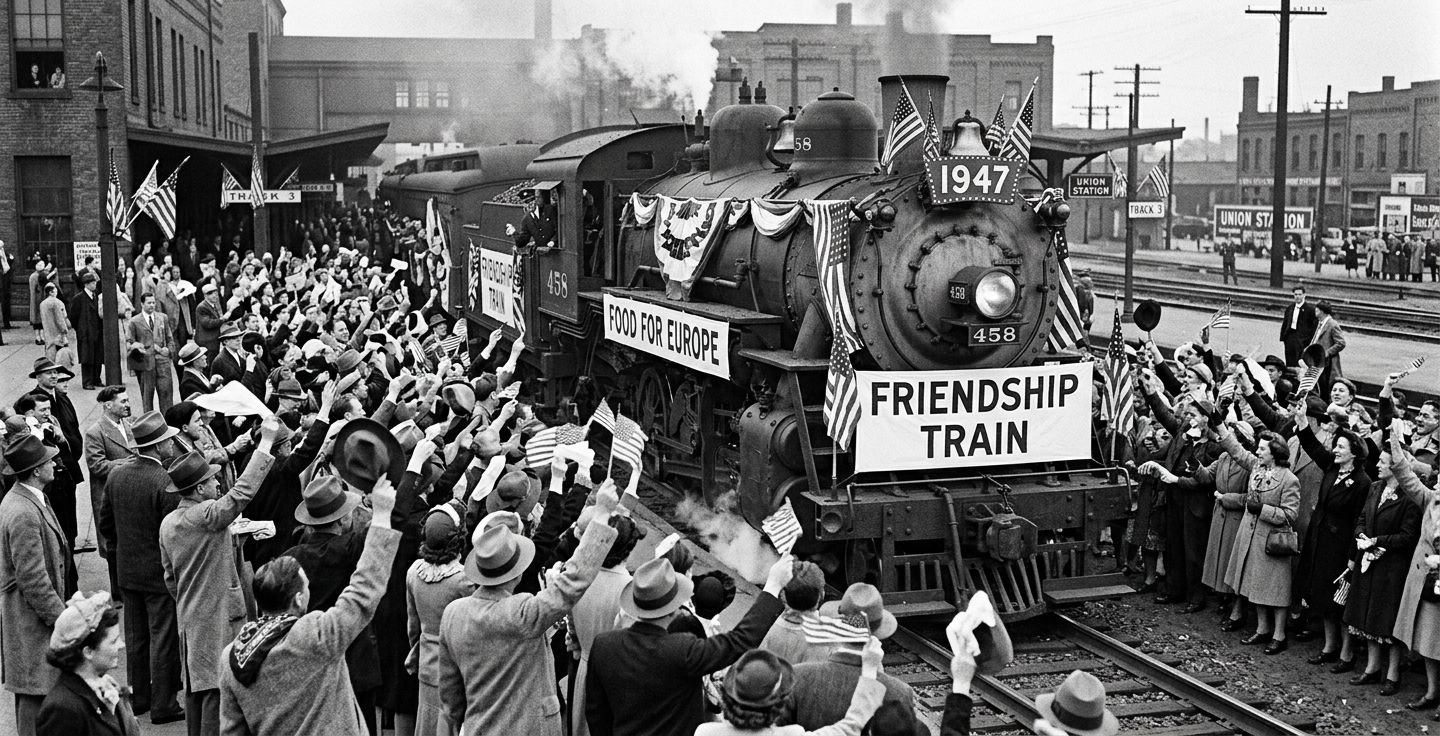
The spark was lit by a well known newspaper columnist named Drew Pearson (1897-1969). While touring Europe, Pearson saw the hunger firsthand. He noticed that the Soviet Union was sending small, highly publicized shipments of grain to sway European elections. Pearson knew Americans could do better, not for political gain, but out of genuine neighborly love. He proposed a grassroots food drive. He called it the Friendship Train.
The idea was simple but incredibly ambitious. A train would start on the West Coast, travel across the United States, and collect donations of non perishable American food at every single stop. There would be no government funding. Everything had to come from the pockets and pantries of private citizens.
On November 7, 1947, the train began its journey in Los Angeles, California. A Hollywood send off complete with movie stars helped build excitement, but the real heroes were the regular citizens. School children brought their pennies. Local grocers donated massive sacks of flour. They filled a handful of boxcars that first day. As the train chugged out of the station heading east, no one really knew just how massive this project would become.
An Avalanche of Kindness
What happened next is a beautiful testament to the warmth and generosity of the American homefront. As the train rolled eastward, it did not just pick up speed. It picked up an absolute avalanche of kindness. The train was scheduled to stop in major cities, but people in rural farming towns demanded that the train stop for them too.
High school marching bands would come out to play patriotic songs as the train rolled into town. Mayors would give rousing speeches from the back of pickup trucks. Local women’s clubs set up folding tables right on the train platforms, serving hot coffee and cherry pie to the railroad workers who were volunteering their time to drive the engines.
Let me share a micro history to paint the picture. Picture a quiet, snow covered morning in a small town in Iowa. A local farmer, who had lost his own son in the war, drove his truck right up to the tracks. He unloaded fifty bushels of his absolute best prize wheat. He told the volunteers that he wanted to make sure no other mother or father had to bury a child, even if that child lived an ocean away. Across the Midwest, church groups worked through the night to can vegetables. Boy Scouts went door to door collecting sugar and dried beans.
Here is a short list of what these wonderful folks packed into those train cars:
- Millions of pounds of enriched baking flour for bread.
- Thousands of cases of canned vegetables, often home canned by church ladies.
- Tins of condensed milk to keep babies nourished and healthy.
- Sacks of sugar to bring a little sweetness back into their lives.
- Dried beans and pastas that could survive the long ocean journey.
When the train reached Chicago, Illinois, the sheer volume of donations was staggering. The original few boxcars had multiplied. Other railroad lines offered free transport, creating a network of trains all converging on the East Coast. By the time the train finally pulled into New York City, the statistics were simply miraculous. Ordinary American citizens, many of whom were still recovering from wartime rationing themselves, had donated over forty million dollars worth of food entirely out of their own pockets. The train had grown to over seven hundred boxcars long. It was a rolling monument to hope.
Crossing the Sea
Of course, the trains could not cross the Atlantic Ocean. But the generosity did not stop at the shoreline. American shipping companies volunteered their cargo vessels to transport the food for free. Union stevedores and dockworkers worked around the clock, refusing any pay, to load the millions of pounds of macaroni, canned milk, sugar, and flour onto the ships.
When the ships finally arrived in ports like Le Havre, France, and Genoa, Italy, the scenes were profoundly moving. Thousands of French and Italian citizens gathered at the docks. They wept openly as the massive wooden crates were unloaded. Every single package had a label that read “From your American friends”.
Consider the story of a young mother in Paris. Her infant son had been sick for weeks due to a lack of clean milk. When a local distributor handed her a tin of American powdered baby milk, she reportedly fell to her knees in the freezing mud. She knew that someone in a town she could not even pronounce had bought that milk, packaged it, and sent it across the world just to keep her child alive. That is the power of true charity. It bridges oceans and heals the deepest wounds.
The French Return the Favor
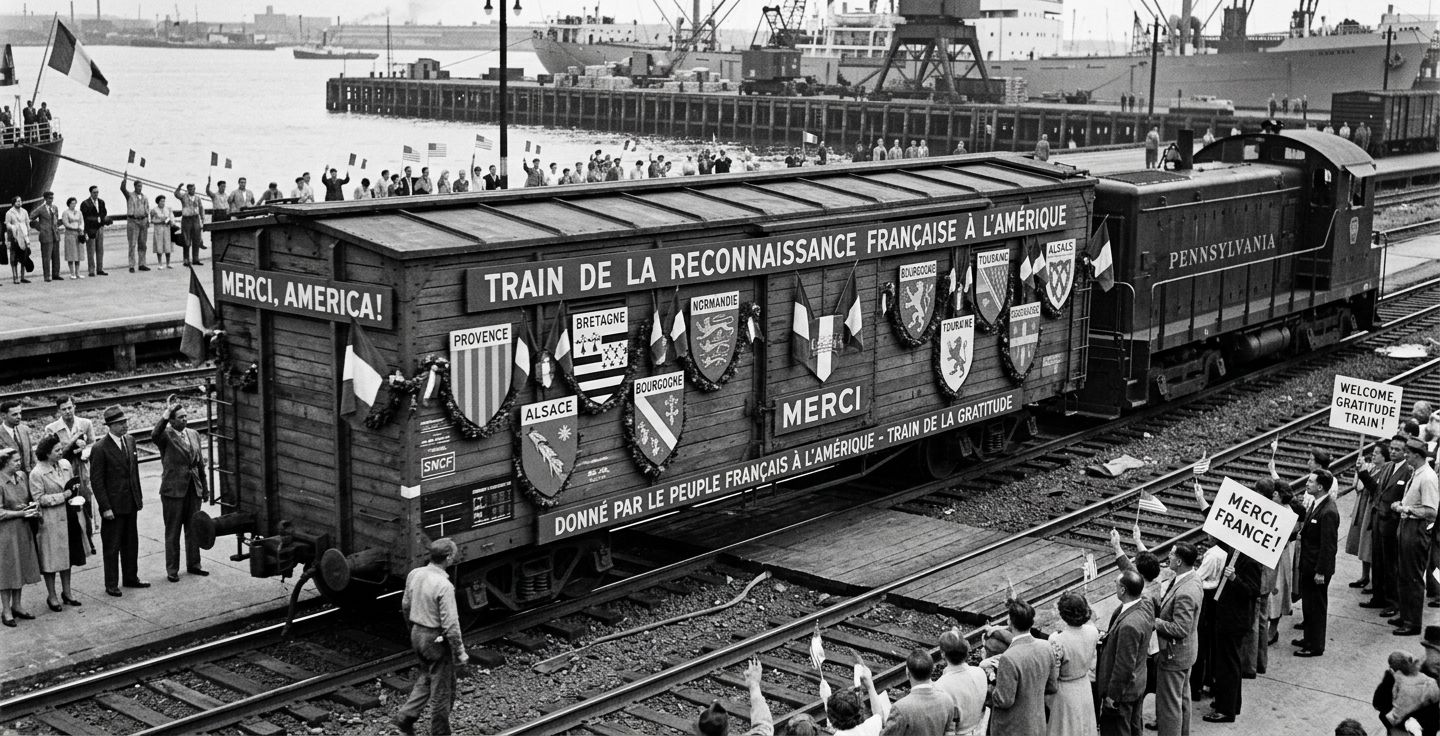
Now, if you give a gift with an open heart, you never expect anything in return. But the people of France were so deeply moved by this act of American grace that they felt compelled to say thank you. By 1949, they organized their own response. They called it the Gratitude Train.
France was still struggling economically, so they could not send money or massive amounts of food. Instead, they sent their most treasured possessions. They filled forty nine boxcars, one for every American state at the time, plus one to be shared by Washington D.C. and the territory of Hawaii. These boxcars were packed to the brim with historic family heirlooms.
Can you imagine the emotion involved in that? A grandmother in a small French village packing up a delicate porcelain doll she had kept safe through two world wars, just to send it to an unknown American family in Nevada or Ohio. Ordinary French citizens gave up intact historical silk wedding dresses, hand carved wooden toys, original paintings, and even seedlings from the historic oak trees of their villages. They sent medals won in battle and personal letters written by school children expressing a deep, abiding love for the American people. It was a beautiful, equal exchange of love. We sent them what they needed to survive, and they sent us pieces of their heritage.
Keep the Spirit Alive
Friends, stories like this remind me why I am so proud to call this country home. We are a people of action. We are a people of immense, quiet generosity. The history books often focus on the generals and the politicians, but the real strength of America lies in our living rooms, our town squares, and our local rail stations.
I want to invite you to wear this history with pride. If you love this incredible story as much as I do, check out our new Mercy Train 1947 Commemorative Tee. Celebrate the quiet, massive generosity of the American homefront. Printed on a buttery soft retail tee designed for absolute everyday comfort, this shirt is a wonderful conversation starter. When someone asks you about the vintage train on your shirt, you can tell them the story of the winter we fed the world. Wear it to your local coffee shop, your family barbecue, or your next community gathering. Let us keep the spirit of 1947 alive today.