
American History & Origins
The Liberty Tree of Boston: Where Colonial Resistance Was Seeded
Welcome, my fellow Americans. Pull up a comfortable chair, pour yourself a hot cup of coffee, and let us take a little journey back in time. We often think of the American Revolution as a story told exclusively in grand brick halls, featuring wealthy men in powdered wigs dipping feathered quills into ink to sign historic parchment. We think of perfectly tailored uniforms and polished silver. But the real story is much grittier, much more grounded, and far more inspiring.
Decades before the Declaration of Independence was ever drafted, the American Revolution began in the shade of a single, massive elm tree in Boston. Known as the Liberty Tree, it was the sacred gathering place where the very first seeds of colonial resistance were sown. This is a story about everyday folks. Blacksmiths, bakers, dockworkers, and farmers who decided they had simply had enough. It is a story of how a simple piece of nature became the beating heart of a movement that would change the world forever.
This great elm was planted way back in 1646. It stood proudly at the corner of Essex and Orange Streets in the bustling maritime hub of Boston, Massachusetts. For over a century, it was just a beautiful, quiet part of the neighborhood. It provided cooling shade to weary travelers on horseback, a spot for children to play, and a meeting point for neighbors trading local gossip. Then, as it often does, history called upon the ordinary to become extraordinary.
The Situation: An Empire Drowning in Debt
To truly understand how this tree became a legend, we have to look at the difficult situation our ancestors faced back then. By 1765, Boston was a thriving, hard-working port city of about 15,000 people. The colonists were industrious, scratching out a living on the edge of a vast frontier. But across the Atlantic, the British Empire was drowning in a sea of debt. The recent Seven Years War, which we often call the French and Indian War, had left the British Crown owing a staggering 130 million pounds. According to historians, the interest alone on that debt consumed more than half of the national budget. It was an astronomical financial burden.
The British Parliament felt that since the war was fought partly to protect the American colonies, the colonists should foot a portion of the bill. So, Parliament decided to levy new taxes. The complication was glaringly simple. The colonists had absolutely no voice in Parliament. No representative from Massachusetts or Virginia was sitting in London debating these laws.
How Do Everyday People Fight Back?
How could a group of everyday citizens stand up to the most powerful, sprawling empire on earth? How do you fight back when you have no formal political voice, no standing army, and no legal right to protest the laws handed down from a king an ocean away?
The answer is as beautifully American as it gets. You gather your neighbors, you step outside into the fresh air, and you start talking.
Under the Great Elm
Part I: The Stamp Act Crisis
Let us look at a pivotal chapter in our shared history, known to us as the Stamp Act crisis. In 1765, the Crown decreed that almost every single piece of printed material in the colonies required a special stamped paper produced in London. This was not just a tax on wealthy merchants importing luxury goods. It was a direct tax on everyday life. Newspapers, legal documents, marriage licenses, ship papers, almanacs, and even playing cards carried a mandatory tax. If a sailor wanted to play a game of dice at the local tavern, the dice were taxed.
Bostonians were absolutely furious. Let me share a small story that explains the national mood. Let us look at a man named Andrew Oliver. He was a wealthy local merchant who willingly accepted the profitable job of being the stamp distributor for Massachusetts. To the average working-class Bostonian, Oliver was a symbol of pure betrayal. The common people were struggling just to keep their businesses afloat and feed their families, while Oliver was getting rich off their hardship.
But the colonists had no legal, sanctioned way to protest this unjust tax. Writing a polite letter to the King was a waste of paper. They needed a place to organize their deep frustration. They needed a focal point for their righteous anger. They needed a symbol. {VIS_1}
Part II: The Sons of Liberty
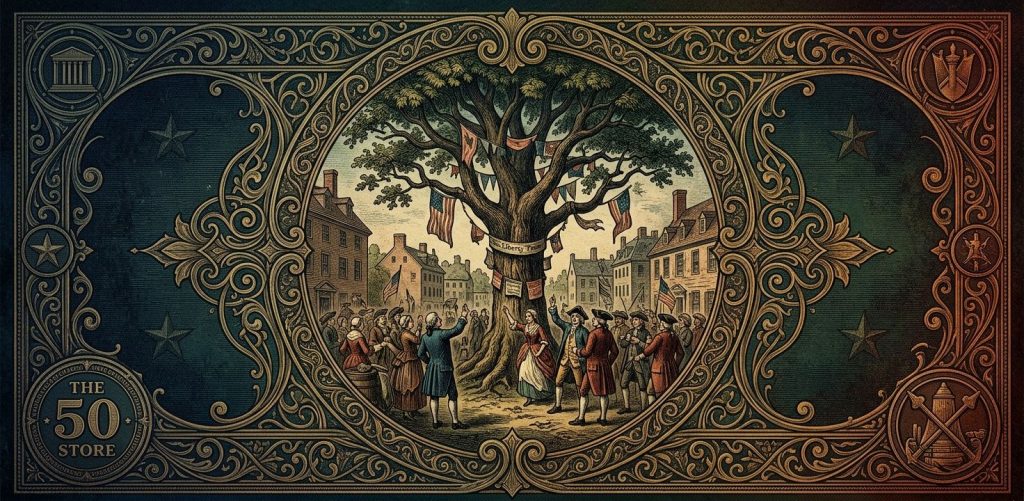
On the muggy morning of August 14, 1765, folks walking past that massive old elm tree saw a startling, unforgettable sight. A newly formed group of patriots calling themselves the Sons of Liberty had taken matters into their own hands. They had hung effigies from the thick lower branches of the great tree. One was a crude straw dummy representing Andrew Oliver. Beside it hung a giant green boot with a wooden devil crawling out of it. This was a very clever visual insult aimed directly at the Earl of Bute, the British official who had authored the terrible tax. The name Bute sounded like boot, and the devil clearly indicated his evil intentions.
This was a brilliant piece of political theater. It captured the attention of the entire city. Picture the scene, my friends. The smell of salt air rolling off Boston Harbor mixed with the scent of roasting meats from nearby taverns. The cobblestone streets echoed with the clatter of horse hooves and the loud, animated arguments of citizens who were just waking up to their own political power.
By sunset, a massive crowd had gathered under the canopy of the elm. Men like the visionary Samuel Adams (1722-1803) saw the immense power in this grassroots movement. Adams was a master at organizing everyday people. He was not a glamorous man, but he was a tireless worker for the cause of freedom. He understood a fundamental truth. A single voice crying out in the wilderness might be ignored, but thousands of voices shouting in unison under a shared canopy could shake an empire to its very foundations. The elm tree rapidly became a beacon of hope. The patriots fastened a tall pole to its sturdy trunk. Whenever you saw a special flag raised on that pole, you immediately knew a meeting of the Sons of Liberty was about to happen.
Part III: A Sacred Canopy
Before long, this magnificent elm was officially christened as the Liberty Tree. A polished copper plate was proudly nailed to its trunk in 1766, bearing the simple but profound inscription: The Tree of Liberty. The tree became Boston’s outdoor town hall. The ground beneath it was the most democratic space in the world. Thousands of men and women would gather beneath its sprawling branches to hear rousing, passionate speeches about God-given rights and the dignity of man.
The legendary silversmith and midnight rider Paul Revere (1734-1818) was among those who found profound inspiration under its green leaves. Revere, a man whose hands were permanently stained from his hard work in the silver shop, would stand quietly in the crowd, absorbing the fiery rhetoric. It was under this tree that Revere built the trusted network of friends and fellow patriots who would later help him organize his legendary rides. The magic of the Liberty Tree was that it belonged to everyone. You did not need to own a sprawling estate or hold a fancy royal title to stand under its shade. The poorest dockworker smelling of salt water and the richest merchant in his fine coat stood shoulder to shoulder in the Boston dirt. It was a beautiful, chaotic, and inspiring preview of the American democracy they were risking their lives to build.
The concept of the Liberty Tree was so powerful that it spread like wildfire. Down in Providence, Rhode Island, they dedicated a massive sycamore. In Charleston, South Carolina, a majestic live oak served as their Liberty Tree. It was a quiet network of timber stretching down the eastern seaboard, binding thirteen vastly different colonies into one unified family of defiance. The image of the Liberty Tree was soon printed on revolutionary flags and carried into battle. It became our founding symbol of unity, defiance, and enduring hope. Even the Marquis de Lafayette, the great French general who fought by our side, remarked years later when he visited Boston that the world should never forget the spot where the Liberty Tree stood. {VIS_2}
Part IV: The Axe of the Enemy
Of course, the British military eventually recognized the grave threat of this wooden giant. During the brutal, freezing Siege of Boston in the winter of 1775, the city was locked down. The patriots had fled to the countryside to form the Continental Army, leaving the city in the hands of the redcoats and those colonists who remained fiercely loyal to the King.
Driven by political spite and a desperate need for firewood in the bitter cold, British soldiers and Loyalists marched to Essex Street. Led by a Loyalist named Job Williams, they viciously chopped the majestic Liberty Tree down. It was said to have produced fourteen cords of wood. They swung their axes with malice, mocking the patriots with every single blow.
They honestly thought that by destroying the tree, they would destroy the movement. They believed that cutting off the branches would silence the cries for independence. But they gravely misunderstood the American spirit.
The physical trunk was gone, chopped up and thrown into parlor fireplaces, but the roots ran incredibly deep into the soil of our newly forming national identity. The spot where it stood remained a sacred symbol of unyielding resistance. The stump left behind became an emotional shrine for the patriots. The destruction of their beloved tree only fueled their fire. It served as a powerful reminder that liberty requires deep sacrifice, and that true freedom can never be permanently cut down by the axe of tyranny.
Wear Your Heritage With Pride
Today, centuries later, we still carry that unyielding, resilient spirit in our hearts. We remember the incredible courage of those everyday folks who gathered in the dirt, looked up into the branches of an old elm, and demanded a better future for themselves and their children. They stood tall against all odds, and because of them, we enjoy the blessings of liberty today.
If you want to wear a piece of this proud, defiant heritage, our Sons of Liberty Tree Vintage Tee is exactly what you need. Stand tall like the elm that sheltered a revolution. Features a detailed, hand-drawn vector print on our premium, breathable combed cotton. Wear it with pride, my friends. Let the world know that the roots of liberty run deep, and they can never be ripped from the American soul. Keep the spirit of that old elm alive in your heart, and always remember the price of our precious freedom.