
Geography & the American Landscape
Teddy Roosevelt and John Muir: The Historic Yosemite Campfire That Saved Public Lands
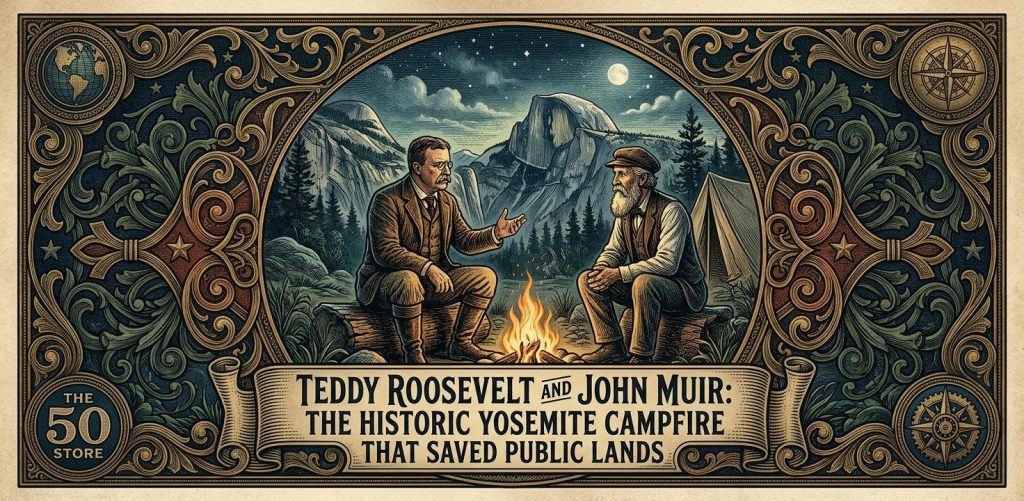
The Campfire That Saved the American Wilderness
Hello there, friend. Pull up a chair and settle in. If you have lived in this great country of ours for any length of time, you know that America is a place of breathtaking contrasts. We have bustling cities that scrape the sky and quiet country roads that seem to stretch on forever. But the true heart of our nation does not beat in the concrete and steel. The true heart of America lives in the quiet, towering forests and the deep, echoing canyons of the American wilderness.
There is a hidden truth about how some of our most sacred lands were saved. It did not happen in a fancy boardroom. It did not happen over a banquet table in Washington. In May 1903, President Theodore Roosevelt (1858-1919) took an official tour of California. Politicians and business leaders had planned grand parades and lavish dinners in his honor. But instead of attending those stuffy events, the President of the United States slipped away from his secret service detail. He chose to disappear into the woods to sleep on redwood boughs in a snowstorm with a lone, rugged naturalist named John Muir (1838-1914). That single weekend changed the landscape of our country forever.
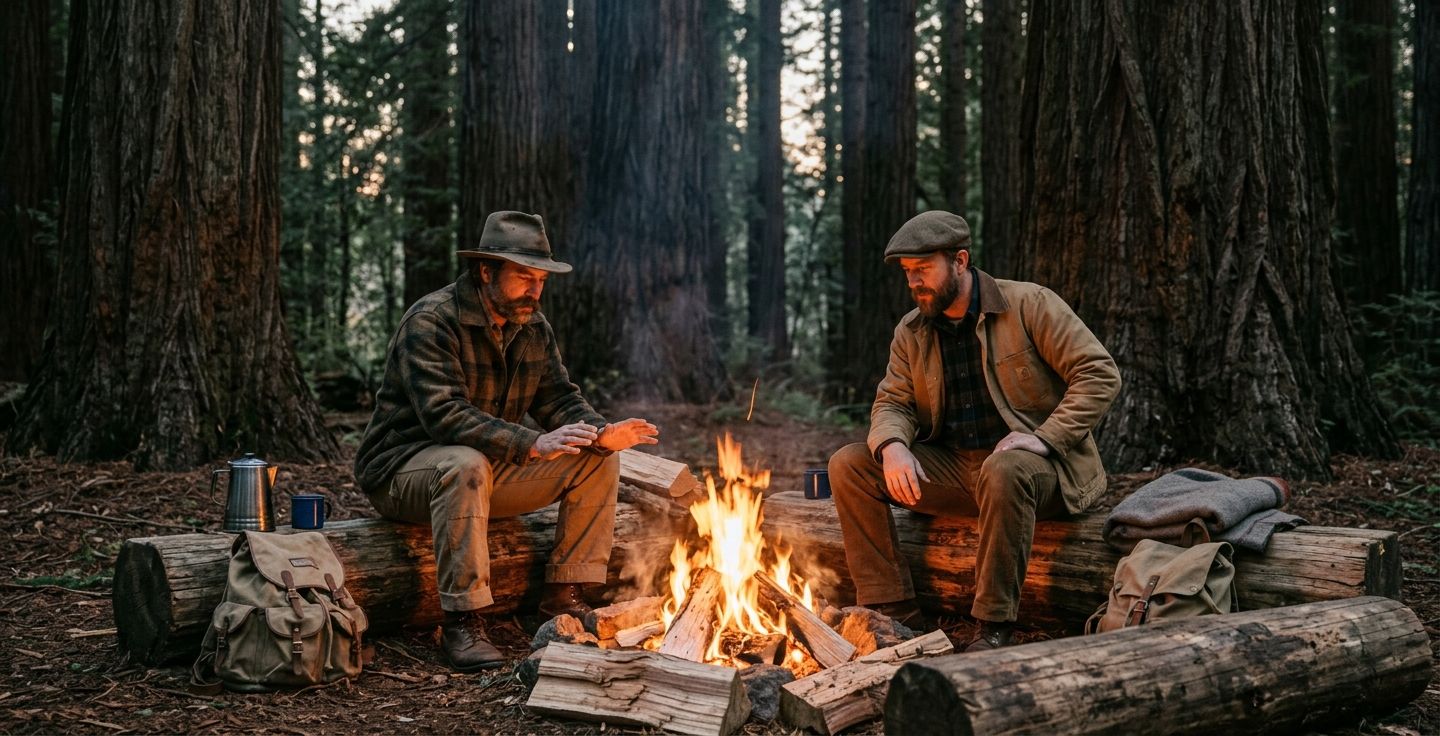
A Conversation Under the Giant Redwoods
Escaping the Press
To understand the magic of this moment, we have to look at the situation our country was facing at the turn of the century. America was growing rapidly. We were building railroads, raising factories, and expanding our cities at a dizzying pace. That growth was exciting, but it came with a heavy cost. The complication was clear to anyone paying attention. Our magnificent natural resources were being treated as if they would last forever. They were being auctioned off to the highest bidder.
During his 1903 western tour, Theodore Roosevelt found himself surrounded by the noise of politics. Every mayor and governor wanted a piece of his time. They wanted him to cut ribbons and shake hands. But Roosevelt was a man who felt most at home under the open sky. As a young man, he had suffered from terrible asthma and frail health. Later in life, after losing his young wife and his mother on the exact same day in 1884, he retreated to the rugged Badlands of the Dakota Territory. The wilderness had literally saved his life and healed his broken heart. He knew the healing power of the open air.
So, when Roosevelt arrived in California, he had one specific request. He sent a letter ahead to John Muir, asking the famous outdoorsman to show him the great trees. Roosevelt wanted no politicians, no reporters, and no guards. He just wanted to be a man in the woods. When the presidential train arrived near Yosemite National Park, Roosevelt politely but firmly dismissed his entire detail. He hopped onto a horse, rode out into the trees with Muir, and left the civilized world behind.
John Muir’s Passion
The two men rode deep into the Mariposa Grove of giant sequoias. John Muir was the perfect guide for this journey. Born in Scotland, Muir had grown up with a fierce love for wild places. Years earlier, a horrific accident in a wagon parts factory had temporarily blinded him. Lying in the dark, Muir made a promise to himself. If he ever got his sight back, he would spend the rest of his life looking at the beautiful, wild creations of the world. He kept that promise. He walked a thousand miles to the Gulf of Mexico, eventually making his way to the soaring granite cliffs of Yosemite.
That evening, they built a roaring fire. As the flames danced and cast warm shadows against the ancient bark of the giant trees, Muir spoke with deep passion. The question hanging in the cold night air was simple but profound. How could America save its natural cathedrals from destruction? Muir brought out the hard facts. He explained how commercial logging operations were tearing through the ancient groves. According to historical data from the National Park Service, by the early 1900s, unchecked commercial logging had wiped out roughly eighty percent of the original old growth forests in various regions of the country. Sheep, which Muir colorfully called “hoofed locusts”, were overgrazing the delicate mountain meadows. Muir pleaded with the President to step in. He argued that these lands did not belong to the timber barons. They belonged to the American people.
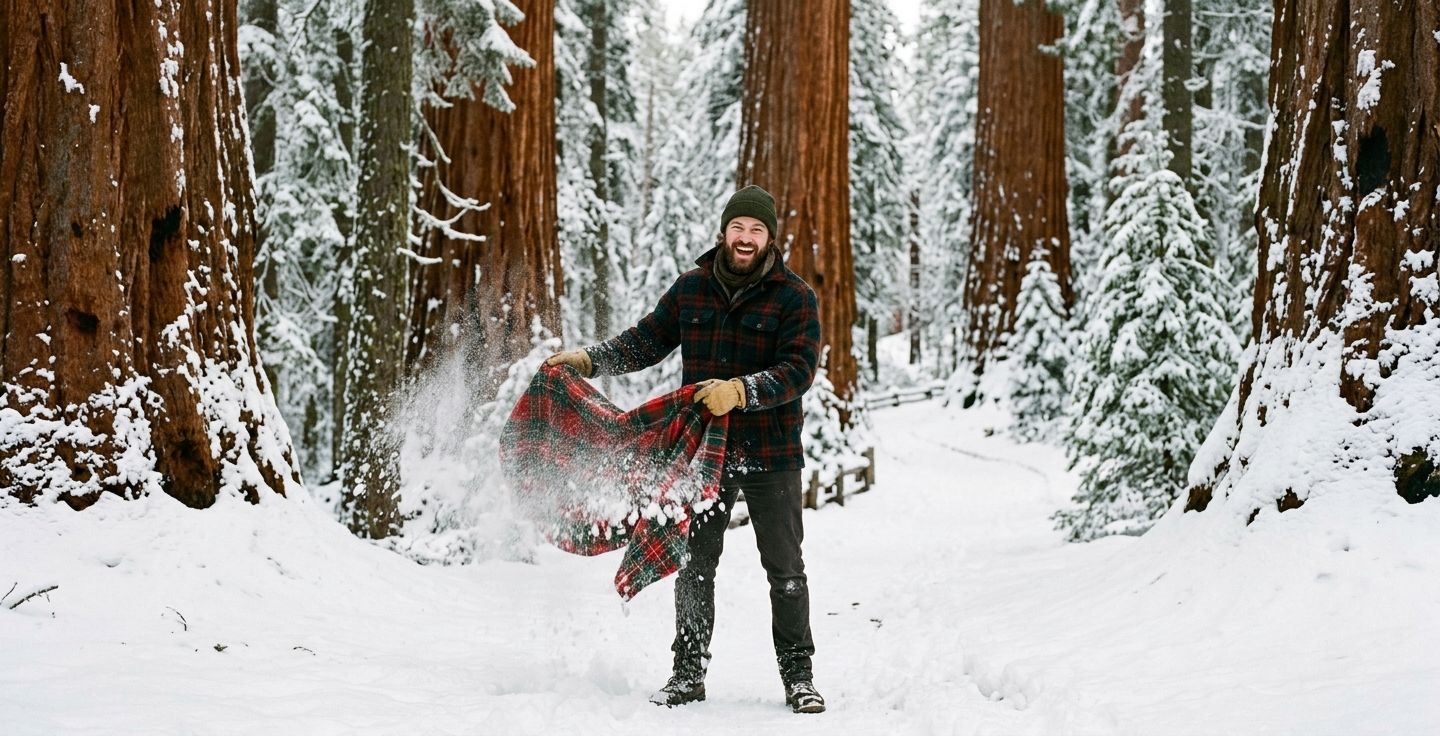
Sleeping in the Snow
As the night wore on, the temperature dropped sharply. The sky clouded over, and soon, thick white flakes of snow began to fall through the canopy. Most men of extreme wealth and power would have demanded to go back to a warm hotel. Not Theodore Roosevelt. He insisted they sleep right there on the ground. They piled up a thick mattress of fragrant fir and redwood boughs, pulled their heavy wool blankets tight around their shoulders, and let the storm roll in.
The micro-history of that morning is one of my absolute favorite stories in all of American lore. When the sun finally rose, it revealed a winter wonderland. The giant trees were dusted in sparkling white. Roosevelt woke up with about four inches of fresh mountain snow covering his thick wool blankets. He did not complain. He did not shiver and ask for a hot bath. Instead, he shook the snow from his broad shoulders, breathed in the sharp pine air, and shouted out with absolute joy. He declared to Muir and the silent forest, “This is the grandest day of my life!”
In that snowy silence, an unbreakable bond was formed. The President of the United States had experienced the wild purity of the mountains exactly as they were meant to be experienced. He understood Muir’s message in his very bones. These places were too beautiful, too sacred, to be lost to the sawmills. They were places where the American soul could be restored.
The Birth of Conservation
The answer to the great question of how to save the land came swiftly. Roosevelt returned to Washington with a fire lit inside his heart. He realized that waiting for a slow moving Congress to protect the land piece by piece would take too long. The chainsaws were moving faster than the politicians. He needed a way to act quickly and decisively.
This single weekend campfire directly inspired the creation of the Antiquities Act of 1906. This remarkable piece of legislation gave the president the power to declare historic landmarks and natural wonders as protected monuments by executive order. Roosevelt used this new tool with joyful enthusiasm. He did not just save a few trees. He went on a crusade for conservation. By the time he left office, Roosevelt had established five National Parks, fifty-one federal bird reservations, four national game preserves, one hundred and fifty National Forests, and eighteen National Monuments. He protected the mighty Grand Canyon National Park when mining companies wanted to tear it apart.
Altogether, this brave president safeguarded over two hundred and thirty million acres of public lands. And it all started with a simple camping trip. Yosemite remains one of the world’s most cherished and protected wildernesses today, a living monument to the friendship between a politician and a poet.
Carry the Flame Forward
When we look back at the history of our great country, we see that true patriotism is about more than just flying a flag. It is about taking care of the land itself. It is about ensuring that our children, and our children’s children, can stand under the same giant redwoods and feel the same awe that Theodore Roosevelt felt. The outdoors belong to you. They are your inheritance.
If you are feeling a stirring in your chest, if you want to step away from the noise of the modern world and smell the woodsmoke, you might want to bring along our Yosemite 1903 Campfire Hoodie. Carry the spirit of preservation and the open trail. Crafted with thick, soft-brushed fleece to keep you warm around your own campfire. It is the perfect companion for chilly nights under the stars. Wear it as a reminder of the night two men slept in the snow and changed the course of history.
When did Theodore Roosevelt and John Muir camp in Yosemite?
Theodore Roosevelt and John Muir took their historic camping trip in Yosemite over a three day weekend in May 1903. They slipped away from the official presidential tour to spend time alone in the wilderness.
Why is the 1903 Yosemite camping trip so important to American history?
This specific trip deeply impacted President Roosevelt. Hearing John Muir speak passionately about the destruction of the forests convinced Roosevelt to make wilderness preservation a primary focus of his presidency.
How many acres of land did Theodore Roosevelt protect during his presidency?
President Theodore Roosevelt protected approximately two hundred and thirty million acres of public land during his time in office. This included National Parks, National Forests, and bird reservations.
What was the Antiquities Act of 1906?
The Antiquities Act is a law signed by President Roosevelt that allows the President of the United States to create National Monuments from federal lands to protect significant natural, cultural, or scientific features.
Who was John Muir?
John Muir was a Scottish born naturalist, author, and early advocate for the preservation of wilderness in the United States. He was instrumental in saving Yosemite Valley and co-founded the Sierra Club.
Did Theodore Roosevelt really sleep in a snowstorm?
Yes, he did. During his camping trip with Muir, a late spring snowstorm rolled in. Roosevelt slept under several wool blankets on a bed of pine boughs and woke up covered in a fresh layer of mountain snow.