
Immigration, Diversity & Identity
The Chinese Railroad Workers Who Built the West
Red White Brewed Eagle Beer T Shirt
Wear your story with pride! Celebrate classic American values, history, and heritage with our premium crafted apparel, designed for comfort and durability.
The Iron Veins of a Growing Nation
Whenever I take a walk down by the old rail yards near Sacramento, I like to stop and just listen. If you stand quiet enough, past the hum of the modern diesel engines and the chatter of folks waiting on the platform, you can almost hear the ghosts of the past. You can hear the heavy ring of iron striking iron, the roar of black powder echoing down the canyons, and the voices of thousands of men who moved mountains. I have lived in this country my entire life, and I have seen cities rise from the dirt and roads stretch across deserts. But nothing quite matches the sheer scale, the impossible ambition, of the men who built our railroads.
This country is vast. It is wider and wilder than most folks realize until they try to drive across it. Back in the middle of the nineteenth century, America was a young, restless place, deeply wounded by a bitter Civil War. We needed something to bind our scattered states together. We needed a ribbon of steel to tie the East to the West. The dream of a Transcontinental Railroad was born from that desperate need for unity. On the eastern side, the tracks were being laid across relatively flat, forgiving plains. The real challenge, the true monster of this story, was waiting in the west.
Standing like a frozen, jagged wall between California and the rest of the country was the mighty Sierra Nevada. This was not just a mountain range. It was a fortress of solid granite, wrapped in thick pine forests and buried under deadly winter snows. The men who started laying the track quickly realized they were in over their heads. The work was brutal. It was backbreaking. White laborers, many of them Irish immigrants who had travelled out west, took one look at the sheer cliffs and the freezing camps, and they simply walked away. The work was too hard. The pay was not worth the risk of being blown to pieces or buried in an avalanche. The railroad company was desperate. Progress had crawled to a painful, expensive halt.

Red White Brewed Eagle Beer T Shirt
Wear your story with pride! Celebrate classic American values, history, and heritage with our premium crafted apparel, designed for comfort and durability.
Red White Brewed Eagle Beer T Shirt
Wear your story with pride! Celebrate classic American values, history, and heritage with our premium crafted apparel, designed for comfort and durability.
The Great Question of the West
This brought our nation to a historic crossroads. The situation was dire. The mountains were unyielding. The complication was simple but devastating: there was no one willing to do the work. The great question that hung in the air over the camps and the corporate boardrooms was this: How on earth could we overcome this impossible terrain? Who had the strength, the skill, and the pure grit to build an iron road through the clouds?
The answer did not come from the local mining towns. The answer came from across the great ocean. The answer was the Chinese railroad workers.
Numbers That Tell a Staggering Story
Let me share some numbers with you, because sometimes we need hard facts to truly understand the sacrifices of the past. When I first learned the scale of this effort, it stopped me in my tracks. According to the historians at the Stanford University Railroad Workers Project, by 1868, there were between twelve thousand and fifteen thousand Chinese immigrants on the payroll of the Central Pacific Railroad. They did not just help build the road. They were the road. They made up nearly ninety percent of the entire western workforce.
These brave men carved fifteen separate tunnels through solid mountain granite. They did this without modern dynamite, using dangerous black powder and hand tools. They laid track at a blistering pace, famously laying ten miles of track in a single, exhausted day. And for this superhuman effort, they were paid roughly thirty dollars a month. Out of that meager wage, they had to buy their own food, their own clothing, and their own tents. The white workers, by contrast, were paid more and had their room and board provided. It is a surprising, sobering statistic that reminds us of the steep price paid for progress.
Baskets Over Cape Horn
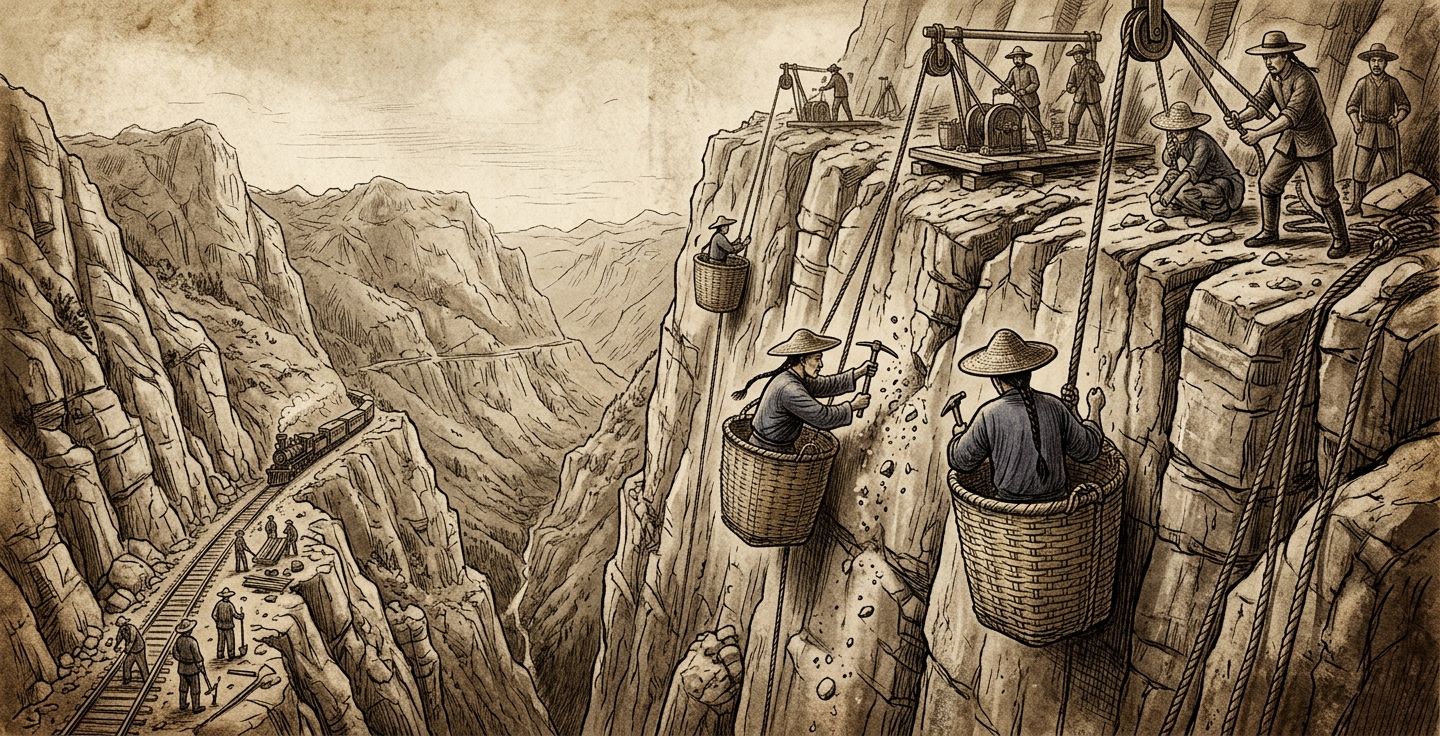
There is a spot high up in the mountains called Cape Horn. I always think about this place when I consider what human beings are capable of achieving. Cape Horn is a near vertical cliff that drops fourteen hundred feet straight down into the rushing American River. There was no ledge. There was no foothold. But the track had to go through.
The story of how they did it is a micro-history that captures the spirit of the whole era. The Chinese workers wove large, sturdy baskets out of reeds. They attached these baskets to ropes. The men, many of them just young boys far away from their families in the Pearl River Delta, climbed into these baskets. They were lowered down the side of the freezing cliff face by their fellow workers. Swaying in the mountain wind, hundreds of feet in the air, they chipped away at the solid rock by hand. They packed black powder into the holes they drilled, lit the slow fuses, and then tugged desperately on the ropes to be hauled up before the cliff exploded.
It was terrifying. It was magnificent.
A businessman named Charles Crocker (1822 – 1888) was the man who originally pushed to hire them. People laughed at him at first. They held deep prejudices and thought these men, who were often slight of build, could never handle the heavy labor. Crocker simply pointed to history and reminded his doubters that the ancestors of these men had built the Great Wall of China. He saw their incredible work ethic, their discipline, and their resilience. They proved him right every single day.
Life, Tea, and Snow in the High Camps
If you close your eyes, you can picture their camps. The winters in the high mountains were brutal. The winter of eighteen sixty six was one of the worst on record. Snowdrifts piled up to forty feet high. Entire camps were buried. The men essentially lived like badgers, carving complex tunnels beneath the snow just to travel from their bunkhouses to the rock faces. Tragically, many were lost to sudden avalanches. Whole crews were swept away into the deep ravines, their bodies not found until the spring thaw.
Yet, they survived and persevered through wisdom and community. While other camps suffered terribly from dysentery and disease caused by drinking dirty water, the Chinese camps stayed relatively healthy. Why? Because they insisted on boiling their water for tea. They drank hot, clean tea from delicate bowls, sitting around campfires in the freezing dark, sharing letters sent from home. They ate dried fish, rice, and vegetables they procured themselves, keeping their strength up in the face of incredible odds. They were not just laborers. They were a community of brothers.
They even had the courage to stand up for their worth. In eighteen sixty seven, thousands of Chinese workers dropped their tools and went on strike, demanding equal pay and shorter hours in the cramped, dangerous tunnels. Though the company eventually starved them out and forced them back to work, their organized protest remains a powerful moment of early labor history in our country. They knew their value, even if the world around them refused to acknowledge it.
The Missing Faces at the Golden Spike
Finally, the impossible was achieved. On May 10, 1869, the two halves of the railroad met at Promontory Summit in Utah. It was a day of national jubilation. Telegraph wires sent the news across the country. Bells rang in the cities. The president of the railroad, Leland Stanford (1824 – 1893), raised a silver maul and drove in the ceremonial golden spike.
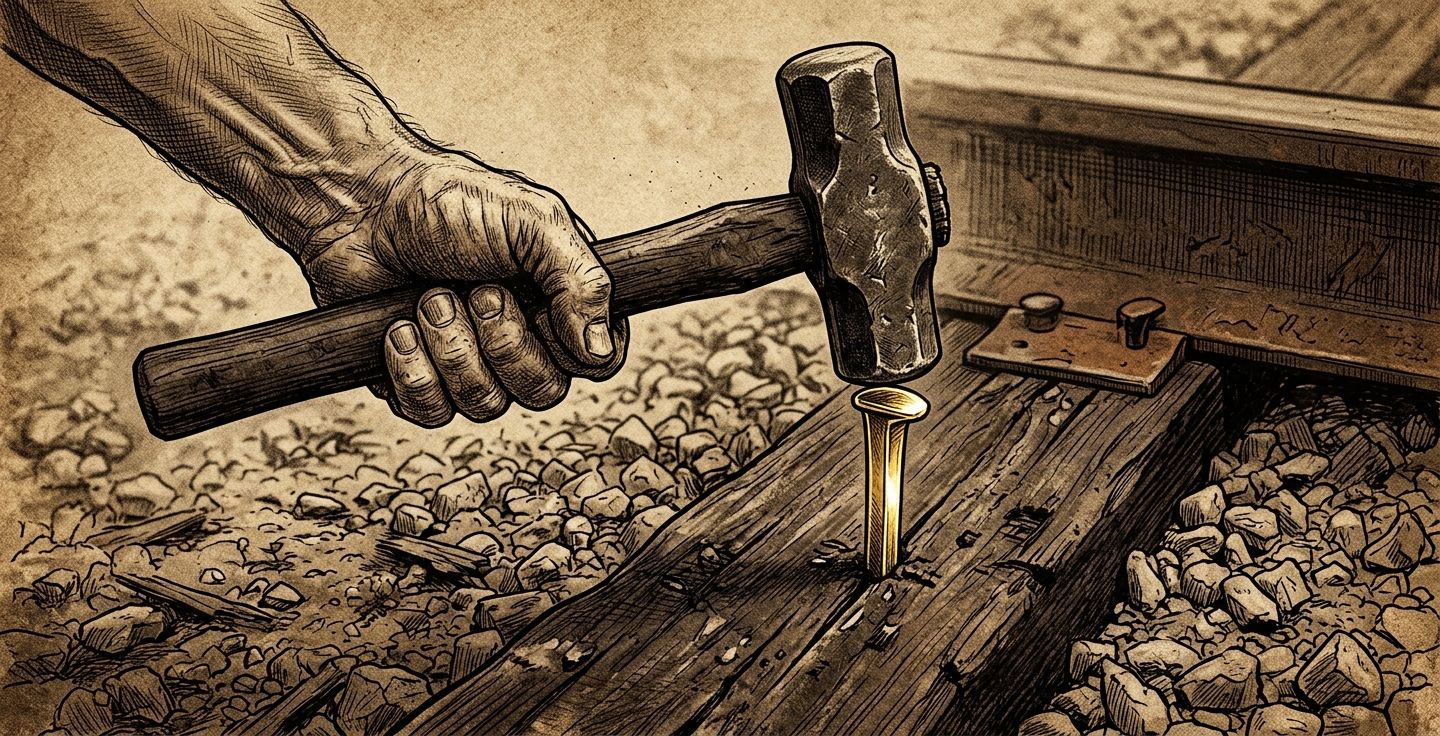
There is a famous photograph of that moment. You have probably seen it in history books. It shows two massive steam engines facing each other, surrounded by hundreds of cheering men holding bottles of champagne. But if you look closely at that photograph, you will notice something heartbreaking. The Chinese workers, the men who had blasted the tunnels, braved the winter snows, and hung in baskets over the abyss, are nowhere to be seen. They were pushed out of the frame.
The tragedy did not end there. Just over a decade later, our government passed the Chinese Exclusion Act of 1882. It was a harsh and ungrateful law that banned Chinese laborers from entering the country and blocked those already here from becoming citizens. The very hands that built the foundation of the American West were suddenly turned away at the door.
A Legacy Carved in Stone and Spirit
But history has a way of outlasting prejudice. The tracks they laid remained. The towns that sprang up along those tracks flourished. And the descendants of those brave men stayed. They built businesses, raised families, and woven themselves into the very fabric of our nation. Looking at the younger generations today, I feel a profound warmth and hope. We are finally learning to tell the whole truth about our past. We are finally looking back and recognizing the quiet heroes who built the world we live in.
It is up to us to keep these stories alive. When we share these micro-histories, when we talk about the baskets at Cape Horn or the freezing tunnels of the mountains, we give those forgotten men the honor they were denied at Promontory Summit.
Questions You Might Be Wondering About
How many Chinese workers died building the railroad?
What happened to the Chinese workers after the railroad was finished?
Why were the Chinese workers excluded from the famous Promontory Summit photograph?
Passing the Torch
The story of the Chinese railroad workers is a testament to human endurance, quiet dignity, and the unyielding spirit of those who seek a better life. They faced a granite wall, and they broke through it. They faced freezing storms, and they survived them. They faced a country that did not fully welcome them, yet they left a permanent, invaluable mark on its landscape.
As we look to the future, we carry their legacy with us. We must ensure that our children and grandchildren know exactly who built the roads they travel. I encourage you to take a moment the next time you hear a train whistle blowing in the distance. Think of the hands that laid those first iron rails. What other forgotten stories of everyday heroes are waiting in your own family tree to be discovered and shared?