Icons & Symbols of America
How Symbols Unite Americans Across Generations
Sweet American Summer Bomb Pop T Shirt
Wear your story with pride! Celebrate classic American values, history, and heritage with our premium crafted apparel, designed for comfort and durability.
The Quiet Anchors in a Noisy World
I have sat on countless folding chairs on sidewalks across this great country, watching local parades march by. The smell of roasted peanuts mixes with the exhaust of old farm tractors. Children wave tiny paper flags on wooden sticks. We all stand up when the brass band starts to play. It is a simple thing. It is a quiet moment. But it means something incredibly deep.
These are the rare moments when our shared history feels close enough to touch. We pass down these old songs, these stone monuments, and these simple rituals from one pair of hands to the next. That is the situation we find ourselves in as Americans. We are inheritors of a vast, sweeping story. We hold onto objects and places that speak louder than words alone ever could. They remind us that we belong to something bigger.
Yet, I know times feel very different now. You turn on the evening news and see a country that sometimes feels like it is pulling at the seams. People argue over fences and across digital screens. Neighbors misunderstand each other. The pace of modern life spins so incredibly fast that it threatens to throw us all completely off balance. This complication is not entirely new to our era, but it sure feels heavy on our shoulders today.
It makes a person wonder. How do these simple symbols hold us together when everything else seems to push us apart? Why do we still get a lump in our throats when the fireworks light up the sky over the local community park? How does a piece of dyed cloth or a green copper statue manage to calm the noise?
The answer is that these symbols act as our common ground. They are the strong anchors holding fast in choppy waters. They remind us of who we were, who we are, and most importantly, who we can be tomorrow.
Sweet American Summer Bomb Pop T Shirt
Wear your story with pride! Celebrate classic American values, history, and heritage with our premium crafted apparel, designed for comfort and durability.
Sweet American Summer Bomb Pop T Shirt
Wear your story with pride! Celebrate classic American values, history, and heritage with our premium crafted apparel, designed for comfort and durability.
The Surprising Strength of Our Common Bonds
If you listen only to the loudest voices on the television, you might easily think we have forgotten the true meaning of our American symbols. But the quiet truth is much more encouraging. A few years ago, I read a fascinating report by the Pew Research Center. It had a surprising statistic that stuck with me ever since. The researchers found that nearly 80 percent of Americans still feel a deep, personal pride when they see the American flag flying.
Another comprehensive study from the Smithsonian Institution showed that over 25 million people make the pilgrimage to our national monuments and historic sites every single year. These are staggering, beautiful numbers. It is not just older generations like mine showing up. It is young parents pushing strollers up marble steps. It is teenagers on crowded school trips. It is newly sworn-in citizens holding their naturalization certificates tightly in their hands, with tears in their eyes.
We are still showing up. We still care deeply. These numbers tell a beautiful story about our deep desire to connect with something larger than ourselves. They show that beneath the surface noise, there is a profound, steady current of national unity flowing through our towns, our cities, and our farmlands.
Stitches in the Dark
Let me tell you a small story about a very big piece of cloth. If you ever walk the old cobblestone streets of Baltimore near the harbor, you might find yourself standing near the modest brick home of Mary Pickersgill (1776 – 1857). She was a professional flag maker. More importantly, she was a widow trying her best to keep her family business afloat during difficult times.
In the humid summer of 1813, Major George Armistead (1780 – 1818) wanted a special flag for Fort McHenry. He did not want just any flag. He wanted one so incredibly large that the British Navy would have absolutely no trouble seeing it from miles away. The dimensions were staggering. It needed to be thirty feet by forty two feet. Mary bravely took the job.
Think about what that actually meant for a moment. This was not a modern factory production line. Mary, her young daughter, two nieces, and an indentured African American girl worked together in a hot, dusty brewery nearby because Mary’s own house was simply too small to hold all the fabric. They stitched together 400 yards of heavy wool bunting. Each of the fifteen stars measured two full feet across. They worked by flickering candlelight. They pricked their fingers. They sweated in the oppressive Maryland summer air. They labored for weeks on end.
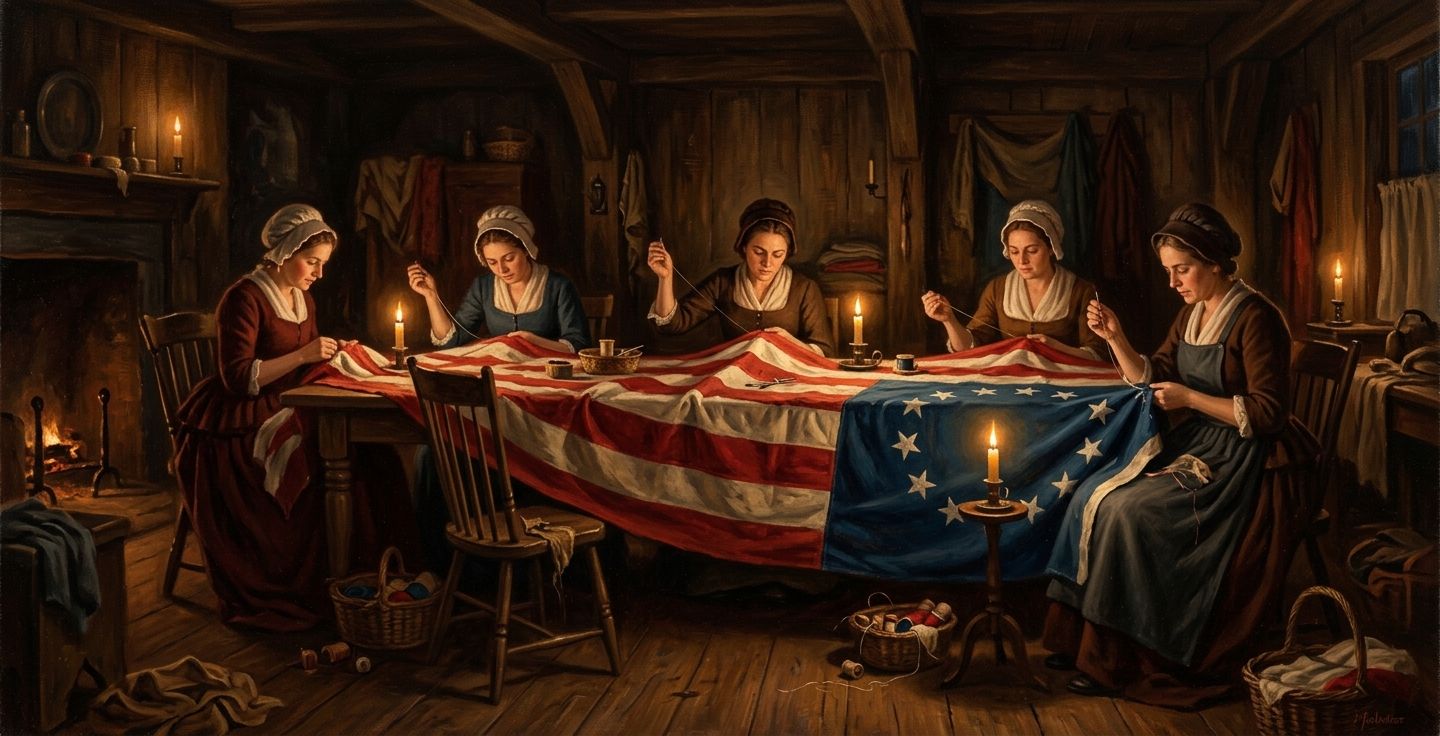
That giant flag was not woven by a cold machine. It was stitched by the calloused hands of ordinary people working together into the deep night. When it flew over the fort and inspired our national anthem, it was a symbol born directly from the sweat of a struggling widow and her hardworking household. Our cultural heritage is built on the sturdy backs of quiet, dedicated people like Mary. When we look at the flag today, we are looking at their personal legacy. We are looking at a promise stitched in the dark.
Pennies for the Copper Lady
We see that exact same promise standing tall in the busy, salty harbor of New York. The Statue of Liberty is perhaps our most famous greeter. But the story of how she got her massive stone pedestal is a beautiful reminder of how ordinary folks build this country from the ground up.
The people of France generously gave us the majestic statue, but America had to build the base to hold her. And we were entirely out of money. The wealthy politicians and wealthy businessmen refused to pay for it. The project was completely stalled. The beautiful copper pieces sat packed away in heavy wooden crates, gathering dust.
Then, a passionate newspaper publisher named Joseph Pulitzer (1847 – 1911) had a brilliant idea. He printed a bold call to action in his paper, asking the working-class citizens for help. He promised to print the name of every single person who donated in his newspaper, no matter how small the amount.
The response was incredibly beautiful. Children sent in their lunch money. Shoe shiners sent in their hard-earned nickels. Grandmothers sent in pennies saved in their sewing jars. Over 120,000 everyday people donated to the cause, and most of the gifts were well under a single dollar. They built that pedestal together, brick by brick. They provided a permanent home for the words of poet Emma Lazarus (1849 – 1887), who gave the silent statue its true voice as the Mother of Exiles.
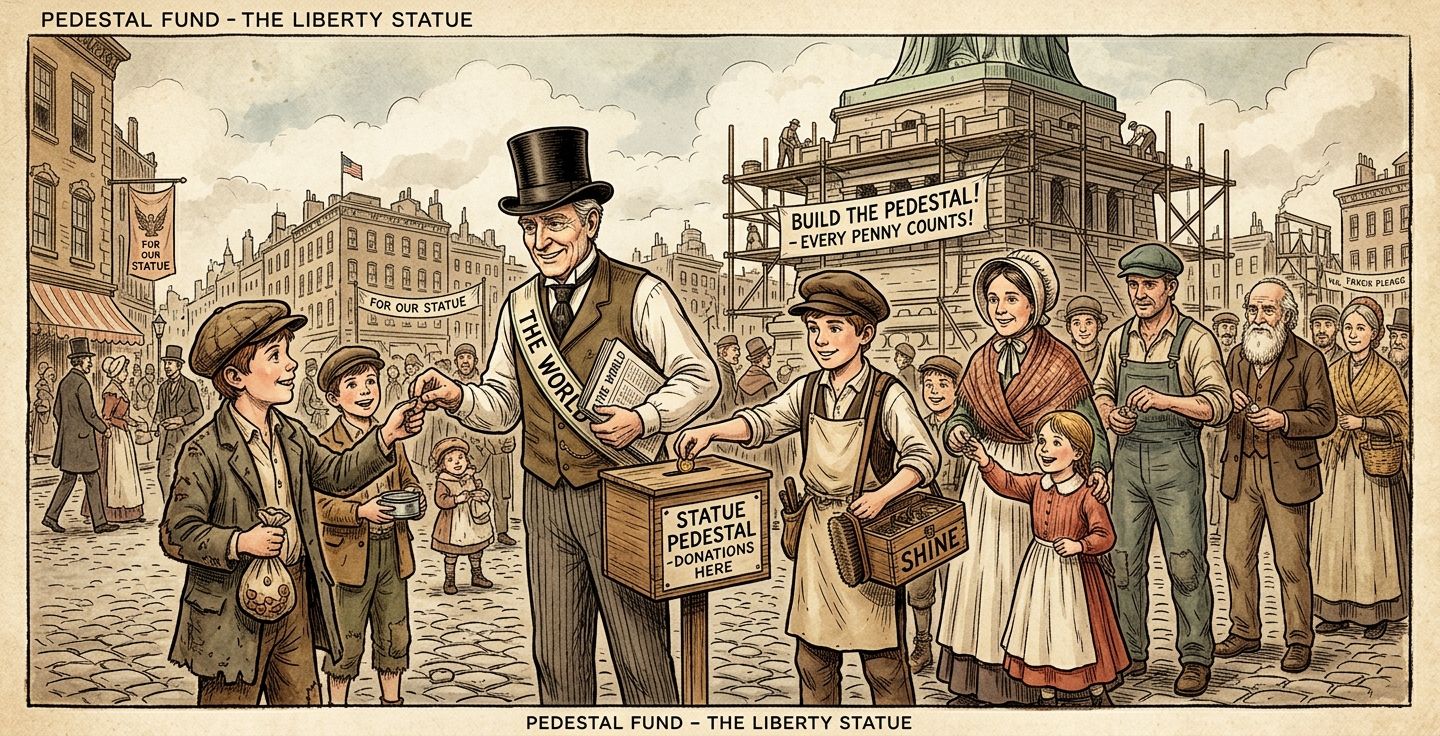
This is exactly how enduring values are kept alive. They are maintained by the collective pennies and prayers of regular, everyday folks. When I see that green copper lady reaching her torch toward the sky, I do not just see a generous gift from France. I see the lunch money of thousands of American children.
Passing the Torch to the Next Generation
I have watched many seasons pass over this land. I have seen the harsh winter frost thaw and the bright green shoots of spring break through the hard earth. Sometimes, folks my age worry about the younger generations. We worry they will forget the old stories. We worry the loud noise of the future will completely drown out the quiet lessons of the past.
But I do not worry. I have seen my own grandchildren stand in quiet awe at the National Mall. I have seen young people volunteering in their local communities, planting trees, and helping their neighbors rebuild after terrible storms. They might listen to different music or communicate on glowing digital screens. Yet, their hearts beat with the exact same hope that Mary Pickersgill and Joseph Pulitzer felt all those years ago.
They are taking these old symbols and polishing them up. They are making them shine in completely new ways. Our monuments, our flags, and our songs are not dusty relics of the past. They are living, breathing promises. They are the shared language we use to speak to one another across the boundaries of age, geography, and personal background.
Questions You Might Have About Our Symbols
As we think about these things together, certain questions naturally bubble up. I have heard these asked by friends over coffee or by young students trying to make sense of our history.
Why are symbols so important to a nation?
Symbols act as a common language for people who might otherwise have nothing in common. They are visual and physical reminders of our shared principles, like freedom, resilience, and equality. When words fail us, a song or a monument can remind us that we are part of the same extended family.
How can we teach younger generations the value of these symbols?
The best way is through storytelling. Facts and dates are important, but stories capture the heart. Tell them about the real people behind the monuments. Tell them about the struggles, the pennies collected, and the late nights working by candlelight. When history becomes a story about human effort, it becomes alive.
Do symbols change their meaning over time?
Yes, they absolutely do, and that is a very healthy thing. As our country grows and learns, we often look at old symbols with a new understanding. Sometimes we add new symbols to our national collection to reflect a wider, more inclusive story of who we are. The core values remain, but our understanding deepens.
A Story We Continue to Write
Let us take a moment to look back at what we have covered today. We started by looking at the noise of our modern world and how easy it is to feel disconnected. But we found that the vast majority of us still hold our shared symbols dear. We remembered the hard work of a widow in Baltimore stitching our flag by candlelight. We remembered the young children who emptied their piggy banks to build a mighty pedestal in New York Harbor.
These micro-histories remind us that America is built by everyday hands. Our symbols belong to you, and they belong to your children. They are the solid glue that holds our generations together through times of peace and times of struggle.
So, I encourage you to take a walk in your own town this week. Look at the local monuments in your town square. Find the history right outside your front door. Share these stories with someone younger than you. Keep the bright flame burning strong for the next generation to see.
I will leave you with this question to ponder today. What is a symbol of our country that holds a special, warm memory for you, and who can you share that wonderful memory with this week?