
Icons & Symbols of America
Cher Ami: The Pigeon Who Saved the Lost Battalion of WWI
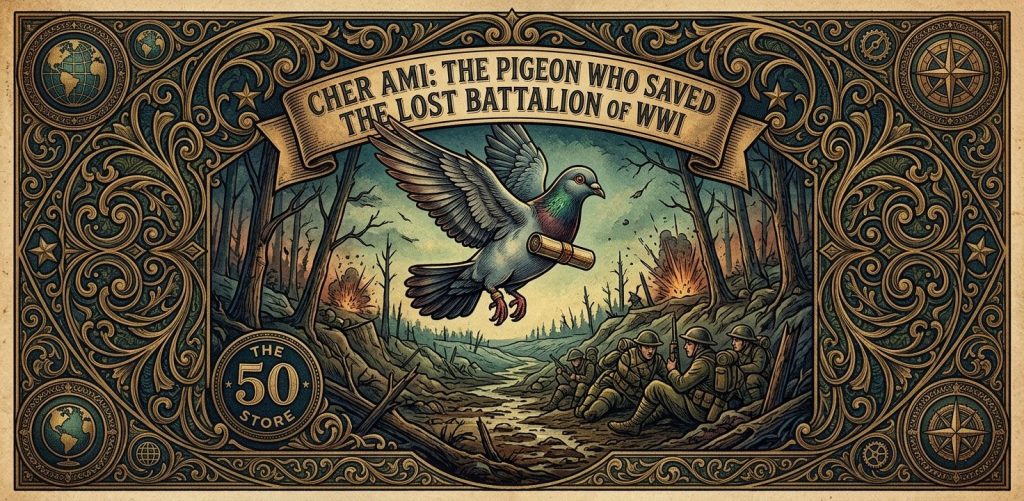
A Feathered Soldier’s Unlikely Journey
Hello there, friend. Pull up a comfortable chair, pour yourself a hot cup of coffee, and sit a spell with me. I have lived in this beautiful country for a lot of years. I have seen times of great prosperity and times of deep struggle. Throughout all those changing seasons, one truth has always remained clear to me. Hope often comes from the most unexpected places. In times of darkness, we do not just rely on the might of great armies or the brilliance of generals. Sometimes, the spirit of America is carried on the smallest of shoulders. Or, in the story I am about to share with you today, on the smallest of wings.
Imagine being trapped in a muddy trench, surrounded by enemy fire, and accidentally shelled by your own side. This was the fate of 194 men of the Lost Battalion in WWI, whose only hope lay in the wings of a small, brave homing pigeon named Cher Ami. It is a story of grit, loyalty, and the kind of steadfast courage that makes you proud to be an American.
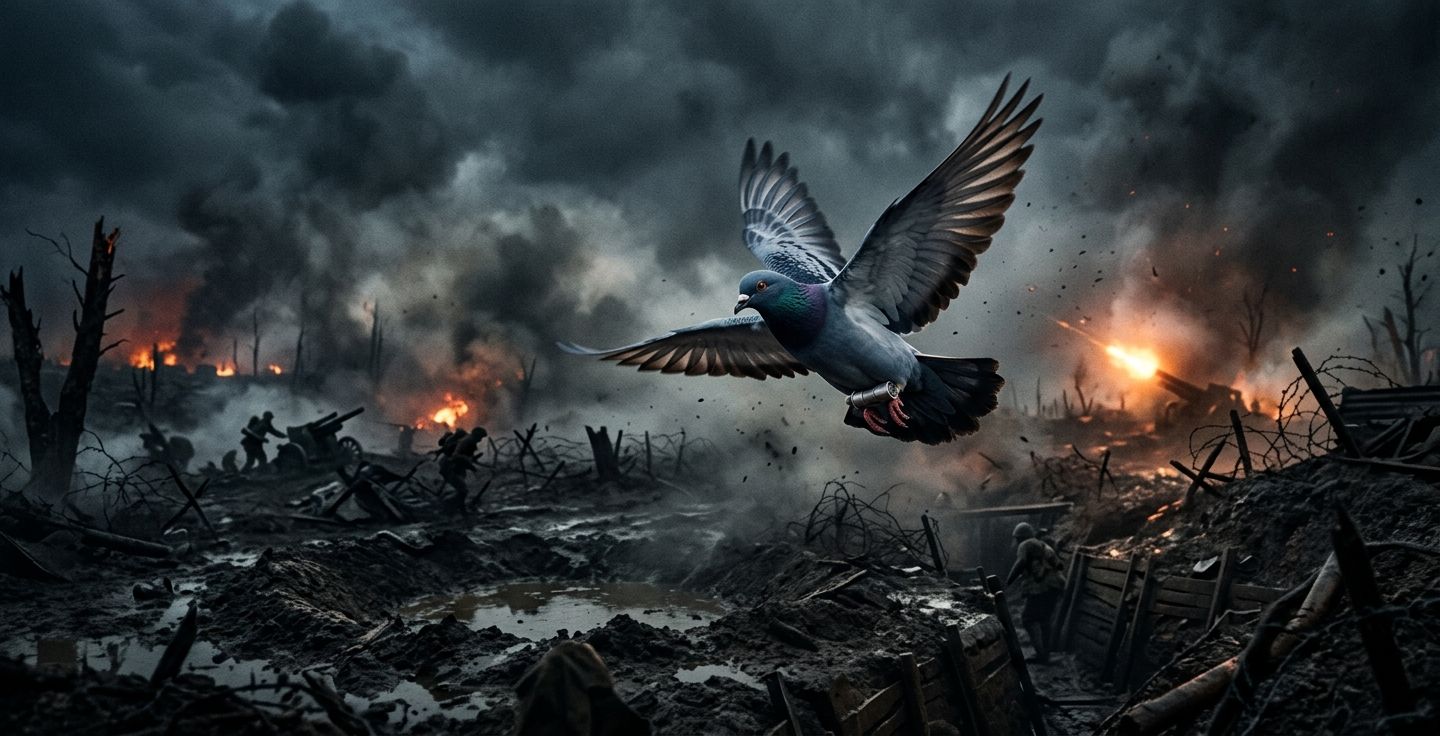
Flight Through the Shrapnel Storm
Part I: Trapped in the Argonne
The year was 1918. The world was gripped by the Great War. Across the ocean, American boys were fighting in places they could hardly pronounce, far away from their homes in Ohio, Texas, and New York. To understand this moment, we have to look at a small slice of life from that era. At the time, the United States Army relied heavily on the Pigeon Service. It might sound funny to us now in the age of smartphones, but the military deployed over 500,000 pigeons during the war. According to the United States Army Signal Corps, these remarkable birds delivered their messages with an astonishing 95 percent success rate. When telegraph wires were blown to bits by artillery and human runners could not make it across the battlefield, a pigeon was the most reliable piece of technology a soldier had.
In October of that year, the 77th Division was pushing hard into the Argonne Forest. This division was special. They were known as the Statue of Liberty Division. Many of these young men were fresh off the streets of the Lower East Side of Manhattan. They were tailors, factory workers, and clerks. Now, they were soldiers covered in mud under the thick canopy of ancient French trees. They were led by Charles White Whittlesey (1884-1921). Whittlesey was a quiet, bespectacled lawyer from New York. He certainly did not look like a seasoned combat veteran, but he had a heart of pure iron.
Under strict orders to advance without stopping, Whittlesey led his men deep into a ravine. They did exactly what they were told to do. The problem was that the French and American forces on their left and right flanks had been stalled by heavy resistance. Whittlesey and his men were entirely cut off. They were surrounded by German forces behind enemy lines with no radio contact, no food, and very little water. The situation was grim. The trap was sprung.
Part II: The Final Messenger
For days, the men held their ground. They fought off wave after wave of enemy attacks. Their ammunition was running dangerously low. To make matters worse, they had to pull water from a muddy stream while under constant sniper fire. But the darkest moment was yet to come. On the second day of their entrapment, the earth began to shake. Explosions erupted all around them. It was artillery fire, but it was not coming from the Germans. The American artillery, unaware of Whittlesey’s exact position, had begun a heavy barrage to clear the area. Our boys were being shelled by their own side.
Whittlesey knew he had to get a message to the rear lines immediately. He reached for his wicker baskets. He had only a few homing pigeons left. He wrote a desperate note on a small piece of paper, rolled it up, and placed it into a tiny canister attached to the leg of his first bird. The pigeon took to the sky, but the enemy knew exactly what these birds were doing. A volley of bullets brought the first messenger down. Whittlesey tried again with a second bird. That bird met the exact same tragic fate.
Only one bird remained. It was a sturdy little Black Check cock named Cher Ami. His name translates to Dear Friend in French. Whittlesey wrote one final, desperate plea on a slip of onion paper. The message was simple and haunting. It read: “We are along the road parallel to 276.4. Our own artillery is dropping a barrage directly on us. For heaven’s sake, stop it.” Whittlesey attached the note, held the bird in his hands, and released him into the smoke-filled sky.
Part III: Slashed but Unbroken
Cher Ami burst from the brush and flew straight up. The air was thick with flying lead and explosions. Almost immediately, the little bird was hit. The soldiers in the muddy trench watched in sheer horror as their final hope tumbled out of the sky toward the ground. It seemed like the end for the men of the 77th Division. But then, a miracle happened. Cher Ami fluttered his wings. He caught a downdraft, leveled out, and began to climb again. He flew right through the storm of shrapnel.
The journey was grueling. Cher Ami had been shot completely through the breast. He was blinded in one eye. One of his tiny legs was hanging on by nothing more than a single tendon. Most creatures would have given up right then and there. But this little bird had a job to do. He possessed an unbreakable spirit. Bleeding and battered, Cher Ami flew 25 miles in just 25 minutes. He crossed over the devastating front lines and arrived at his home loft at division headquarters.
Part IV: Saved by a Wing
When the handler at the loft heard the familiar ping of the arrival bell, he rushed over. He found Cher Ami covered in blood, lying on his back. The little canister was dangling from the mangled leg. The handler quickly opened the message and passed it to the commanding officers. The terrible mistake was realized instantly. The American artillery guns fell silent.
Because of that brave little bird, the friendly fire ceased. A relief force was finally able to break through the German lines and reach the pocket. Out of the original men who entered the ravine, 194 American soldiers walked out alive. They were saved by the courage of a feathered soldier who refused to quit when the sky was falling.
Honoring a True American Hero
General John J. Pershing (1860-1948), the commander of the American Expeditionary Forces, personally inspected the surviving men and made sure Cher Ami was given the best medical care available. Army medics actually worked to save the bird’s life. They even carved a tiny wooden leg for him to replace the one he lost in battle. Cher Ami became an absolute legend among the troops.
For his incredible service, Cher Ami was awarded the French Croix de Guerre medal with a palm Oak Leaf Cluster for his legendary bravery in the field. He survived the war and traveled by boat back to the United States, living his final days in comfort. Today, we do not forget heroes like him. You can actually see his preserved body carefully displayed at the Smithsonian National Museum of American History in Washington, D.C. It is a powerful reminder that bravery is not determined by your size. It is determined by the size of your heart.
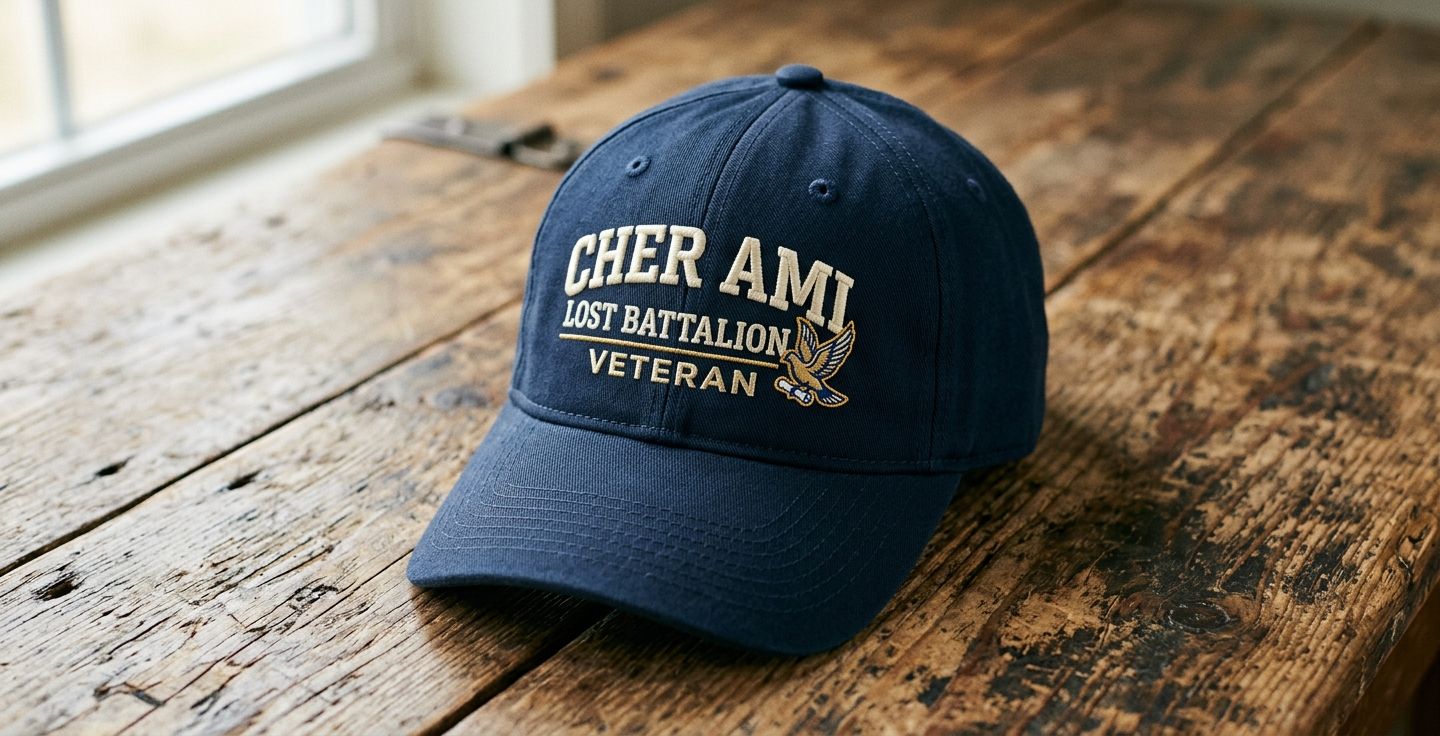
The Heritage Cap
Small things can do mighty deeds. Wear this heritage cap, embroidered with clean vector lines, built to endure any storm you face. Introducing the “Cher Ami: Lost Battalion Veteran” Embroidered Hat. When you put on this cap, you are not just wearing a piece of clothing. You are carrying a story of resilience, hope, and true patriotism. You are reminding yourself and everyone around you that no matter how loud the noise gets or how difficult the journey seems, you can weather the storm.
This country was built by everyday folks who simply refused to give up when things got hard. We honor the soldiers in the trenches, we honor the medics in the field, and yes, we honor the little pigeons who flew through the fire. I encourage you to wear this hat proudly. Let it be a symbol of the enduring American spirit. Keep your head up, keep moving forward, and never forget the dear friends who help us along the way.