
Culture & Traditions
What Farmers Markets Say About Modern America

The morning air always holds a special kind of stillness before the sun fully clears the horizon. I remember standing on the edge of town decades ago, watching the farm trucks roll in under the pale light. They were heavy with the weight of the season. Bushels of sweet corn stacked high in the humid summer. Crates of hardy root vegetables piled together in the crisp autumn. Back then, knowing the person who grew your food was not a luxury. It was simply the way of the world. We ate what the earth offered us, exactly when it was ready. We shook hands with the men and women who pulled our dinners from the soil.
Then the world sped up. The dusty roads turned into wide highways. The modest local grocers were slowly replaced by sprawling supermarkets with glaring fluorescent lights. Aisles grew longer and wider. They were stocked with flawless tomatoes wrapped tightly in plastic, shipped from thousands of miles away to look perfect on a shelf. It was a marvel of modern logistics. We gained endless convenience. But we quietly lost something deeply important along the way. We lost the seasons. We lost the dirt. We lost the names of our neighbors. Our agriculture became an industry rather than a relationship.
So where does that leave us today? How do we find our way back to each other in a country that feels so fast, so distant, and so overwhelmingly large?
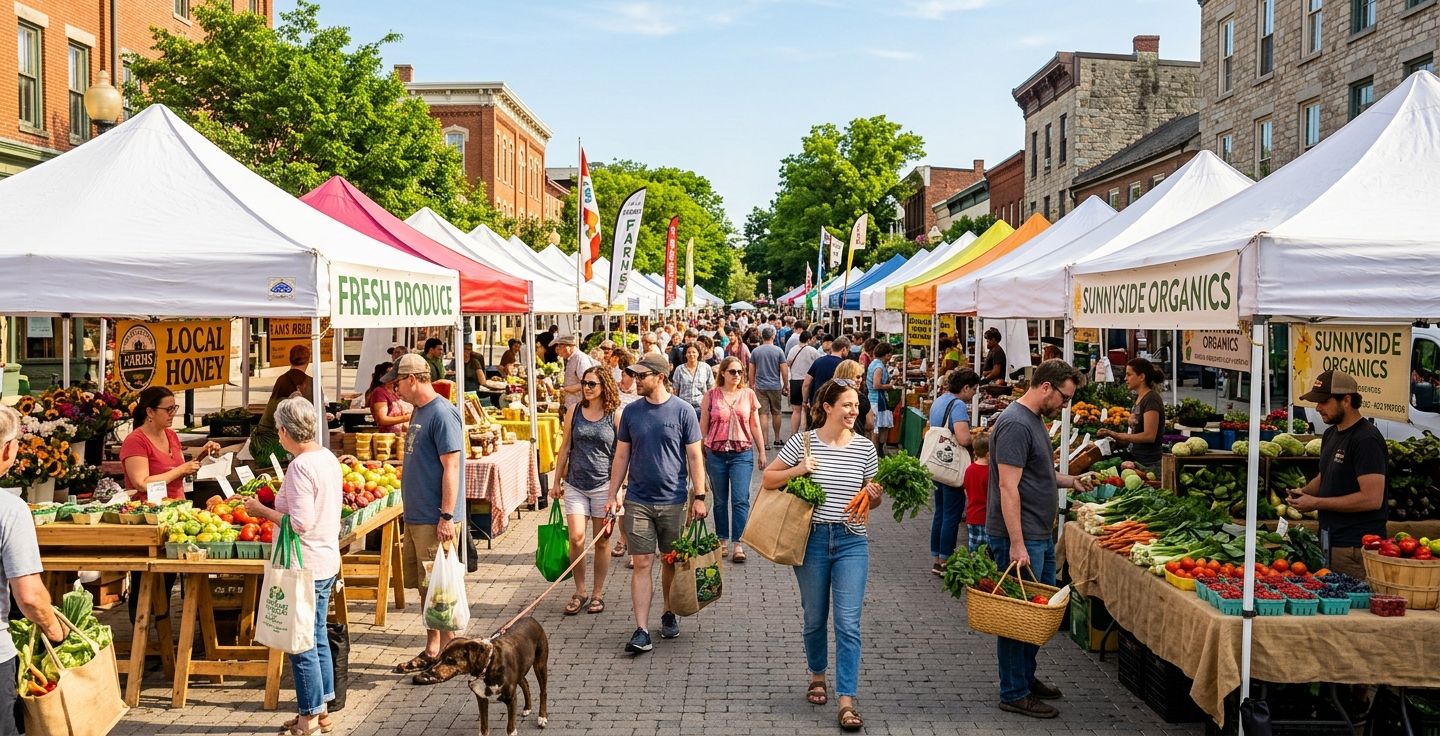
You just have to look at the white pop up tents that bloom like resilient flowers on a Saturday morning. The modern farmers market is our quiet, joyful answer.
A Surprising Shift in Our Habits
You might think these weekend markets are just a quaint hobby for a small group of people. The truth is far more encouraging. The return to local food is a quiet revolution happening in every corner of this country. According to the United States Department of Agriculture, the number of farmers markets has skyrocketed from fewer than two thousand in 1994 to well over eight thousand today. That is a massive shift in how Americans are choosing to spend their Saturday mornings. It is a clear signal that people are waking up.
But the impact goes much deeper than just foot traffic and fresh air. The Farmers Market Coalition shares a statistic that always makes me smile. Growers selling locally create thirteen full time jobs for every million dollars in revenue. The conventional, industrialized food system creates just three jobs for that exact same amount. When you buy a pint of strawberries directly from the grower, you are not just getting a sweeter berry. You are funding a livelihood. You are paying the wages of the teenager helping to pick the crop. You are rebuilding the local economy from the soil up.
The Story of the Square
To understand this national shift, we only need to look at a single piece of pavement. Let us consider a place like Monument Square in Portland, Maine. In the early part of the twentieth century, central squares like this were the beating heart of civic life. Farmers brought their wagons right into the center of town. But as the decades rolled by and the suburbs called out to the middle class, the downtown squares emptied out. Pavement replaced the old brick. The vibrant chatter of the marketplace was replaced by the low, steady hum of passing traffic. We became completely disconnected from our public spaces.
Then, a small group of people decided to set up a few folding tables. They brought fresh greens, some homemade preserves, and a little bit of hope. It was a modest start. Yet, it echoed the wisdom of people like J. I. Rodale (1898 – 1971), who spent his life teaching Americans about the deep link between healthy soil and healthy people. Rodale understood that our physical and social well being begins in the dirt. Even legends of American cooking like James Beard (1903 – 1985) spent their careers trying to teach us that our homegrown ingredients were something to celebrate. They championed the local farmer long before it was fashionable again.
Slowly, the square came back to life. Today, if you visit that same spot on a Wednesday morning, you will see a beautiful sight. You will see elderly folks carefully picking out the best apples, squeezing them gently to check for firmness. You will see young parents pushing strollers, teaching their toddlers the names of different colorful vegetables. The pavement has not changed. But the soul of the space has completely returned. This one little street tells the story of modern America. We wandered away from our roots for a while. Now, we are finding our way home.
More Than Just Vegetables
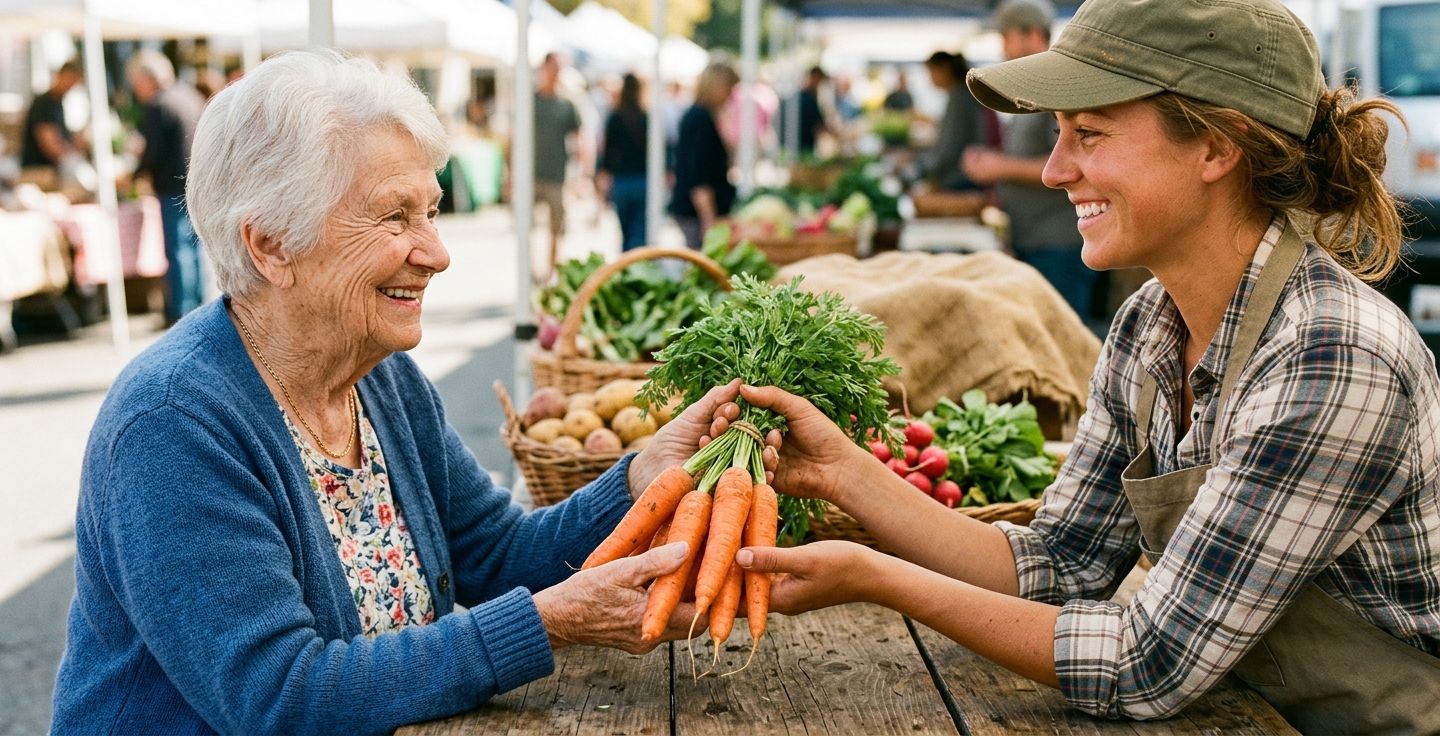
When I walk through the aisles of a market today, I am struck by the sheer diversity of the crowd. The farmers market is one of the few places left in our society where people from completely different walks of life stand shoulder to shoulder. You have the baker setting out fresh loaves of sourdough bread. You have the young farmer with dirt permanently etched under his fingernails. You have the office worker picking up a bright bouquet of fresh flowers for the weekend. For a few hours, the invisible barriers we build between ourselves simply vanish. We are all just neighbors sharing a beautiful morning.
This kind of community is exactly what we need right now. We live in an era where we can buy almost anything with the tap of a finger on a glass screen. A brown cardboard box magically appears on our porch a day later. It is highly efficient. But it is deeply lonely. The farmers market forces us to slow down. It asks us to look someone in the eye and say thank you. It reminds us that every single bite of food we take is the result of human labor, unpredictable weather, and the incredible grace of the earth.
Planting Seeds for the Future
It fills my heart with an immense amount of hope to see young people returning to the land. Farming is backbreaking work. It demands early mornings before the birds wake up, late nights under the glow of a tractor light, and a constant, humbling battle with the elements. Yet, a new generation is willingly choosing this challenging path. They are deeply passionate about sustainability. They care about healing the land, reducing synthetic chemicals, and leaving the soil much healthier than they found it. These young men and women are proving that a meaningful life is not always found in a high rise office building. Sometimes, the most important work is found in a quiet field just outside of town.
When you hand your hard earned money to a young farmer across a folding table, you are doing far more than making a simple transaction. You are casting a powerful vote. You are voting for a world where people matter more than giant corporations. You are voting for a landscape that is tended with care and respect. You are making a vital connection that bridges the gap between the rural fields and the urban streets.
Our local markets tell a deeply comforting story about modern America. They tell us that despite our endless pursuit of progress and technology, we still crave the simple, timeless things. We crave food that tastes like the place it was grown. We crave genuine human interaction and a friendly smile. I have seen a lot of changes in my lifetime. Some were good, and some were hard to understand. But watching families gather around a local farm stand is a change that brings me profound peace. As long as there are young hands willing to plant the seeds, and neighbors willing to gather in the town square to celebrate the harvest, I believe our country is going to be just fine.
Common Questions About Modern Farmers Markets
Are farmers markets actually more expensive than grocery stores?
It is a common belief that buying directly from the grower costs a lot more. However, when you look closely at organic or locally grown produce, farmers markets are often competitively priced or even cheaper than supermarkets. You are not paying for the massive transportation costs or the fancy store lighting. You are simply paying for the food and the honest labor it took to grow it.
How do I know if the food is truly local?
The beautiful thing about these markets is that you can just ask. Most authentic markets have rules stipulating that a high percentage of the goods must be produced by the vendor. Take a moment to strike up a conversation with the person behind the table. Ask them where their farm is located. A real farmer will be thrilled to tell you all about their fields.
Can I use government food assistance at these markets?
Yes, and this is one of the most wonderful changes in recent years. A large and growing number of markets now accept nutrition assistance benefits. Many even participate in matching programs, where every dollar spent on fresh fruits and vegetables is doubled. It is a fantastic way to ensure that healthy food is accessible to every single family in our community.
What is the best time to visit the market?
If you want the absolute best selection, you should arrive early, right when the market opens. This is when the chefs and local cooks do their shopping. But if you prefer a slower pace and want to take the time to really talk with the vendors, late morning is wonderful. Sometimes you might even find a few bargains right before the market closes.
Why do some markets close in the winter?
Farming is intimately tied to the seasons. In many parts of the country, the frozen ground simply needs to rest. However, thanks to the increasing use of greenhouses, many farmers are extending their growing seasons. You will find that more and more towns are now hosting indoor winter markets, offering hearty root vegetables, local meats, and fresh baked goods all year long.