
American Lifestyle
Why Americans Drive Everywhere Instead of Walking
The Quiet Streets of Morning
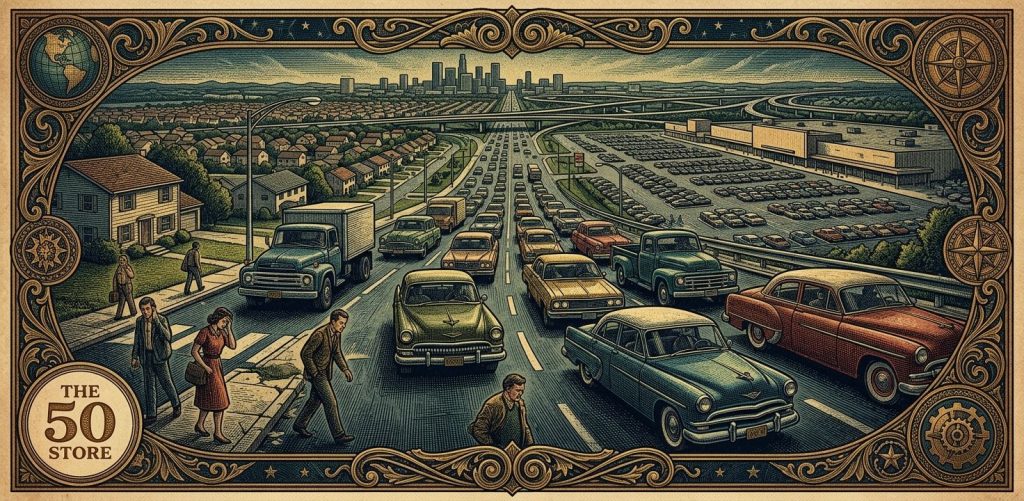
When I look out the front window of my home in the early morning, the streets are wonderfully quiet. I see paved driveways and closed garage doors. A few birds chirp in the oak trees. It is a beautiful and peaceful sight. Yet, something profound is missing from this picture of American life. Where are the people? Decades ago, morning meant the rhythmic sound of footsteps on the sidewalk. Neighbors walked down to the corner bakery. Children walked in little groups to school. Today, a heavy and unnatural silence hangs over the neighborhood until the car engines start.
We have built a magnificent country filled with wonders. However, we now experience it almost entirely through a windshield. Think about your own daily routine. If you need a quart of milk, do you grab your coat and walk down the block? For most of us, the answer is a simple shake of the head. We grab our car keys instead. We live in comfortable homes, surrounded by comfortable cars, traveling to vast stores. But this modern convenience has created a strange distance between us and our communities. Walking has become a rare activity. In many towns across our nation, taking a casual stroll to the local pharmacy is not just difficult. It is practically impossible, and sometimes very dangerous.
It makes a person sit back and wonder. How did we get here? When did we stop using our own two feet to get around our hometowns? Why do Americans drive everywhere instead of walking? These are fair questions. The answer is not just about laziness or a simple love for shiny automobiles. It is a fascinating story of history, design, and choices we made over the last century.
The Road We Traveled
To understand our current reality, we have to look back at how our neighborhoods drastically changed. Let me share a little piece of history about a man named William Levitt (1907-1994). After the Second World War, millions of young men and women came home looking to start fresh families. They desperately needed places to live. Levitt had a grand vision for mass-produced housing. He bought up massive tracts of potato fields and built whole communities from scratch. One of the most famous examples of his work is Levittown, Pennsylvania.
These new towns were true miracles of modern efficiency. They offered affordable homes with green grassy lawns and gleaming modern appliances. But they also introduced a massive shift in how we lived our daily lives. The old, centralized town squares were left behind. Homes were built further and further away from shops and workplaces. This severe separation of homes from businesses was the absolute birth of suburban sprawl. We separated everything into tidy boxes. Houses went in one zone. Grocery stores went in another. Offices went in a third. The physical distances between these zones were simply too vast for a casual stroll. You needed a car just to cross the empty void.
A Nation on the Move
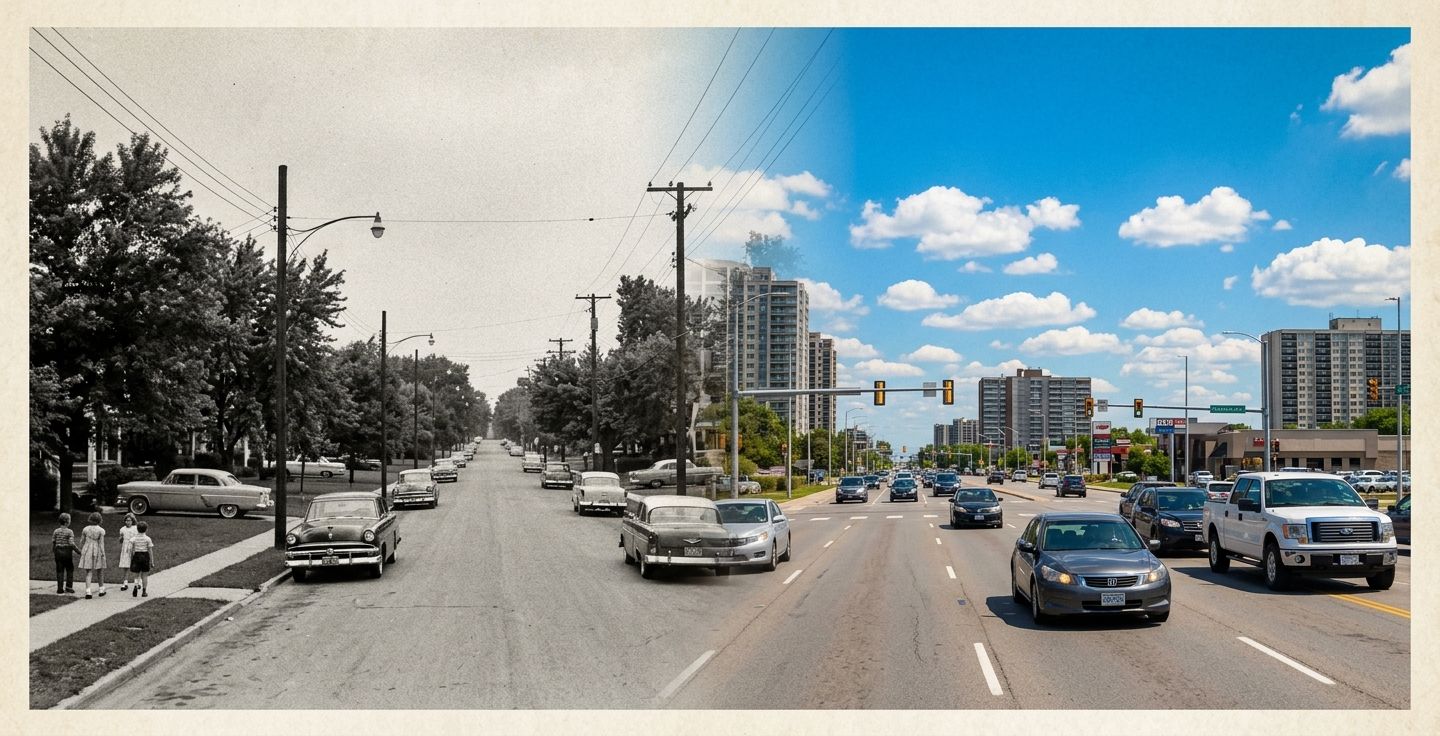
Around the same time, our national leaders looked at the growing number of automobiles and realized we needed better roads. When Dwight D. Eisenhower (1890-1969) championed the interstate highway system, he was partly inspired by the efficiency of the road networks he saw in Europe during the war. He wanted a way to move people and supplies quickly across our vast land. It was a brilliant piece of engineering that connected our country from coast to coast. However, the execution in our local cities was often brutal. Thriving, historic neighborhoods were divided to make way for elevated concrete highways. The bustling streets where people lived and walked were suddenly buried in exhaust fumes.
Our national focus shifted completely to the automobile. Main Street widened into a busy multi-lane thoroughfare. Sidewalks shrank or vanished entirely. Before the automobile dominated our lives, the front porch was the social center of the American home. You sat out there in the evening. You watched the world go by. You learned the names of the folks walking their dogs. But as cars grew louder and streets grew wider, the front of the house became noisy. We retreated to the backyard patio. We built high wooden fences. We traded community connection for private isolation. Our entire way of life began to revolve around the driveway.
The Surprising Truth About Our Trips
You might think that we only drive because we have massive distances to cover. The United States is a huge country, after all. But the statistics tell a very different, and quite surprising, story. According to the Bureau of Transportation Statistics, over half of all daily trips made in the United States are less than three miles long. Even more shocking, nearly thirty percent of all trips are less than one single mile.
Yet, how do we make these incredibly short trips? We drive. We hop into our vehicles for over seventy percent of trips that are under a single mile. Imagine that reality for a moment. A distance that takes less than twenty minutes to walk is routinely driven. The Environmental Protection Agency has shared some eye-opening facts on this. If we chose to walk or ride a bicycle for just half of these short trips, we would save billions of gallons of fuel every single year. We would also drastically reduce daily traffic and breathe much cleaner air.
These numbers opened my eyes wide. We have ingrained the habit of driving so deeply into our minds that we do not even consider walking an option. Our deep-rooted car culture tells us that driving is the default choice for everything. We will gladly sit in frustrating traffic for ten minutes just to travel a tiny distance we could have easily walked in fifteen.
A Vision for Our Grandchildren
It is easy to look at these wide, noisy streets and feel a bit discouraged about the state of things. But I am filled with a profound and steady sense of hope. I look at the younger generations, and I see a wonderful shift in perspective taking root. Young folks today are looking for something fundamentally different. They are tired of the endless traffic jams. They are weary of the isolation. They want communities where they can step out their front door and walk directly to a coffee shop or a park.
They deeply understand the lasting value of a pedestrian-friendly neighborhood. Walking is not just about getting from point A to point B. It is about human connection. When you walk, you bump into your neighbor. You stop and ask about their summer garden. You smile at the postal worker carrying the mail. You notice the beautiful blooming dogwood trees in the spring. Walking binds a local community together in a warm way that driving past it never can.
Changing the Landscape
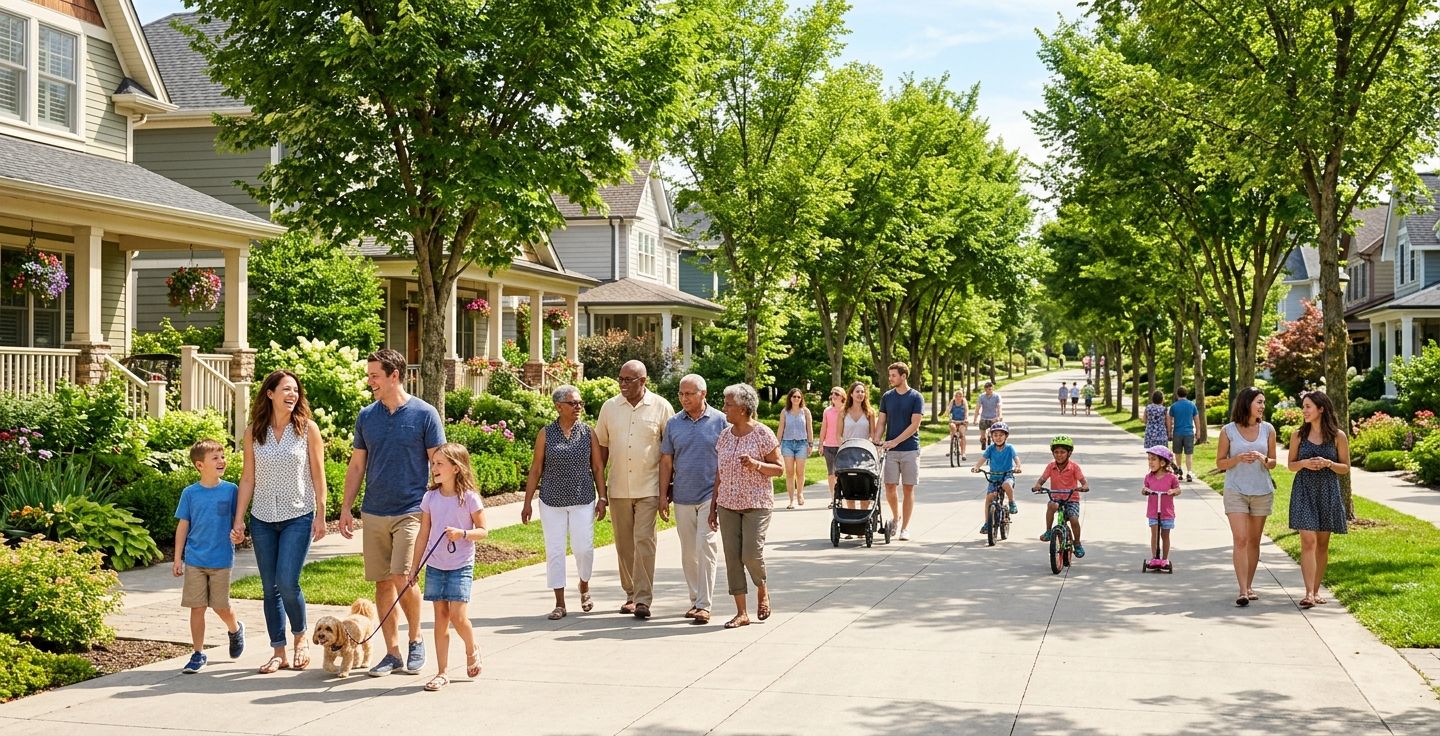
Slowly but surely, towns across America are beginning to listen to this desire. They are finally realizing that good urban planning is not about moving cars faster. It is about making life significantly better for people. Forward-thinking towns are narrowing their overly wide streets to naturally slow down speeding traffic. They are planting large shade trees and building wider, safer sidewalks.
Take a place like Main Street, St. Charles, Missouri. It is a beautiful example of a historic area that fully preserves the timeless joy of walking. You will find lovely brick paved sidewalks, welcoming storefronts right up against the walking path, and a profound feeling of safety for anyone on foot. When towns prioritize people over fast vehicles, the local businesses absolutely thrive. People linger longer. They talk with strangers. They spend time simply enjoying the fresh outdoor air. This is the exact future I want for my grandchildren. A bright future where they are not trapped behind a steering wheel, but are free to explore their wonderful world on their own two feet.
Taking the First Step
We certainly do not have to wait for city planners to completely rebuild our entire world. The real change can start with us, right here and right now. The very next time you need to run a small errand, pause for a brief moment. Ask yourself honestly if it is possible to walk. It might take a few extra minutes out of your day. You might have to carry a simple cloth bag for your groceries. But those extra minutes are a true gift to yourself.
Walking is wonderfully beneficial for your physical health, of course. It keeps the heart beating strong and the aging joints moving smoothly. But far more than that, it is remarkably good for the human soul. It reconnects you with the solid ground beneath your feet and the expansive sky above your head. So, lace up your most comfortable shoes. Step confidently out the front door. Wave to a passing neighbor. Every great journey really does begin with a single step. Let us all work together to make walking a joyful and normal part of our American lives once again.
Common Questions About American Walking Habits
Why are there no sidewalks in many American suburbs?
During the mid-twentieth century housing boom, builders prioritized speed and cost. Sidewalks were often omitted to save money and space, under the incorrect assumption that everyone would always travel by personal automobile.
How does walking impact local community businesses?
Walking is incredibly beneficial for local shops. When people walk, they travel at a slower, more observant pace and are much more likely to stop into a store, buy a coffee, or browse a window display compared to someone driving by at high speeds.
Is it really possible to make an old, car-centric town walkable again?
Yes, absolutely. Many towns are actively adopting new improvement programs. They are adding protected walking paths, planting mature trees, and reducing road lane widths to naturally slow down traffic and make pedestrians feel secure.
Why is it generally safer to walk in older, historic neighborhoods?
Older historic neighborhoods were carefully built long before the automobile took over. They feature grid-like street patterns, shorter blocks, and buildings positioned very close to the sidewalk, which naturally slows down passing cars.
What can I personally do to encourage more walking in my community?
You can start by simply walking more yourself. Beyond that, you can attend local city council meetings to actively request better crosswalks, advocate for reduced speed limits on residential streets, and publicly support local zoning changes.
Are younger people driving less today than previous generations?
Yes, recent data consistently shows that younger adults are getting their driver licenses later in life and driving fewer miles. They strongly prefer living in areas where they can easily walk, bike, or take public transit to their daily destinations.