
American History & Origins
The Four Chaplains: The Ultimate Sacrifice on the USAT Dorchester
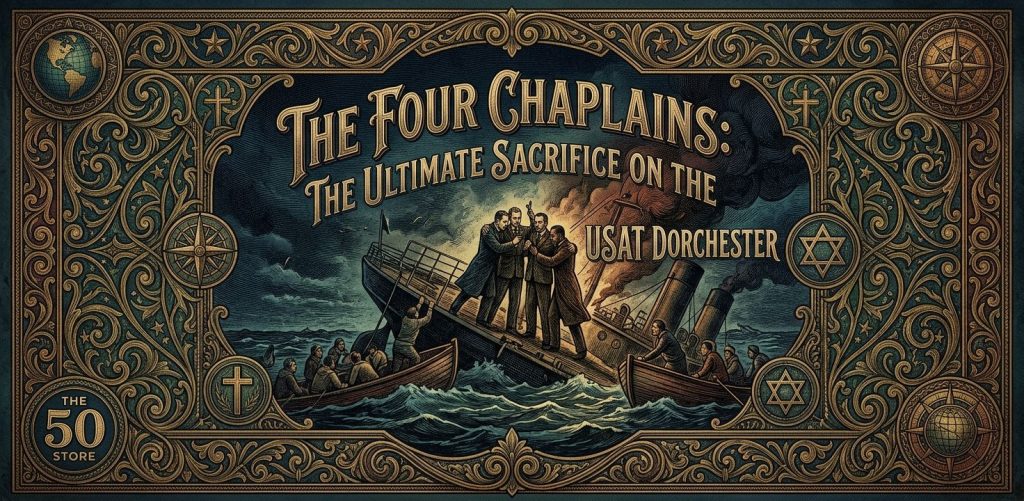
The Night the Ocean Froze
Pull up a chair and let me share a story with you. We hear a lot of noise on the news these days. It is easy to think folks have forgotten how to look out for one another. But whenever I start to worry about the future of our great country, I think back to the winter of 1943. I remember the men who proved that American grit and grace can conquer even the darkest nights.
On February 3, 1943, a German torpedo ripped through the troop ship USAT Dorchester in the icy North Atlantic Ocean. It was just after midnight. The water was violently cold. The massive ship lost all electrical power instantly. In the pitch black panic, hundreds of young soldiers scrambled out of their bunks. Many were entirely disoriented. Some were screaming in the dark. Yet, amid the sheer terror of a dying ship, four men of different faiths stood calmly on the tilted deck. They were distributing life jackets. They were steadying terrified young soldiers. They were showing the world exactly what love looks like.
Brotherhood on a Sinking Deck
Part I: Sinking into the Abyss
The situation aboard the Dorchester was a true nightmare. She was originally built as a luxury coastal liner. She was meant to carry happy vacationers from Miami to Boston. But when war came, she was painted gray and crammed with extra bunks to serve as a military transport. On that fateful voyage, she was carrying 902 men across some of the most dangerous waters on Earth.
Because of the constant threat of enemy submarine attacks, the captain had ordered all men to sleep in their clothes. He told them to keep their life jackets close at hand. However, the cramped quarters below deck were unbearably hot near the engine room. Many soldiers simply ignored the order. They slept in their underwear. When the torpedo hit, it completely knocked out the steam whistles and the radio. There was no way to sound the general alarm. There was no way to call for help from the escort ships.
Men rushed topside into subzero air. The reality of the situation was brutal. The ship was taking on water fast. Lifeboats were frozen to the deck and would not budge. Rafts were flipping into the churning ocean before men could secure them. Panic took hold of the boys. Most of them were just young kids from farms in Iowa and factory towns in Ohio. They were staring into an abyss of black water and freezing rain, realizing their ship was going down.
Part II: The Four Chaplains
Enter four incredible men. They were chaplains in the United States Army. They came from completely different backgrounds, yet they found common ground in their service to God and their country.
First, there was George L. Fox (1900-1943). George was a Methodist minister from Vermont. He already knew the grim horrors of combat. He had lied about his age to serve as a medic in World War I, where he received the Silver Star for exceptional bravery. He came home, built a life, and found his calling in the church. When the second world war broke out, he told his wife he had to go back. He was 42 years old, practically an old man to the young soldiers who affectionately called him the Padre. He knew those boys would need him.
Next was Alexander D. Goode (1911-1943). Alexander was a Reformed Jewish rabbi born in Brooklyn and raised in Washington, D.C. He was a brilliant man and an outstanding athlete who loved his community fiercely. He even started an integrated Boy Scout troop in Pennsylvania. He tried to join the Navy after Pearl Harbor but was turned down. He did not quit. He joined the Army instead. He wanted to serve the nation that offered his people religious freedom.
Then we have John P. Washington (1908-1943). John was a Roman Catholic priest. He grew up in the tough neighborhoods of Newark, New Jersey. He was a scrappy kid who survived childhood illness and a BB gun accident that left him nearly blind in his right eye. He hid that injury just to get into the seminary. When war came, the Navy rejected him because of his eye, but the Army accepted him. He used his street smarts to connect with the roughest soldiers. He loved a good laugh, playing the piano, and a friendly game of cards.
Finally, there was Clark V. Poling (1910-1943). Clark was a minister in the Reformed Church in America. He came from a long, proud line of clergymen dating back seven generations. Before he shipped out, he asked his father to pray for him. He specifically asked his dad not to pray for his safe return. He simply asked his father to pray that he would be brave and do his duty.
These four men became fast friends at chaplains school. They learned to respect each other deeply. They learned that faith is a unifier, not a divider. When the torpedo hit, they did not run to the lifeboats. They ran to the men.
Here is a surprising statistic that puts their bravery into perspective. Out of the 902 men aboard the Dorchester, only 230 survived the freeze. Four of those survivors lived specifically because they were wearing the chaplains’ own life vests.
Part III: The Ultimate Sacrifice
As the ship settled lower into the water, the chaplains opened a storage locker to hand out extra life jackets. They moved with absolute purpose. They guided frantic men to the few deployable boats. They offered quiet words of comfort. Rabbi Goode even gave his warm gloves to a young officer. The rabbi lied and said he had a second pair in his cabin. He did not.
Then, the true test arrived. The locker was completely empty. The life jacket bin ran dry. There were still frightened soldiers left on the deck with nothing to keep them afloat in the freezing water.
What does a man do when he looks into the terrified eyes of a fellow American and realizes there is only one way to save him?
These four men did not hesitate. They committed the ultimate sacrifice. In a singular motion of pure grace, the Methodist, the Rabbi, the Catholic, and the Reformed minister took off their own life jackets. They forced them onto the trembling shoulders of the young soldiers. They gave up their only chance at survival. They did it for boys they barely knew.
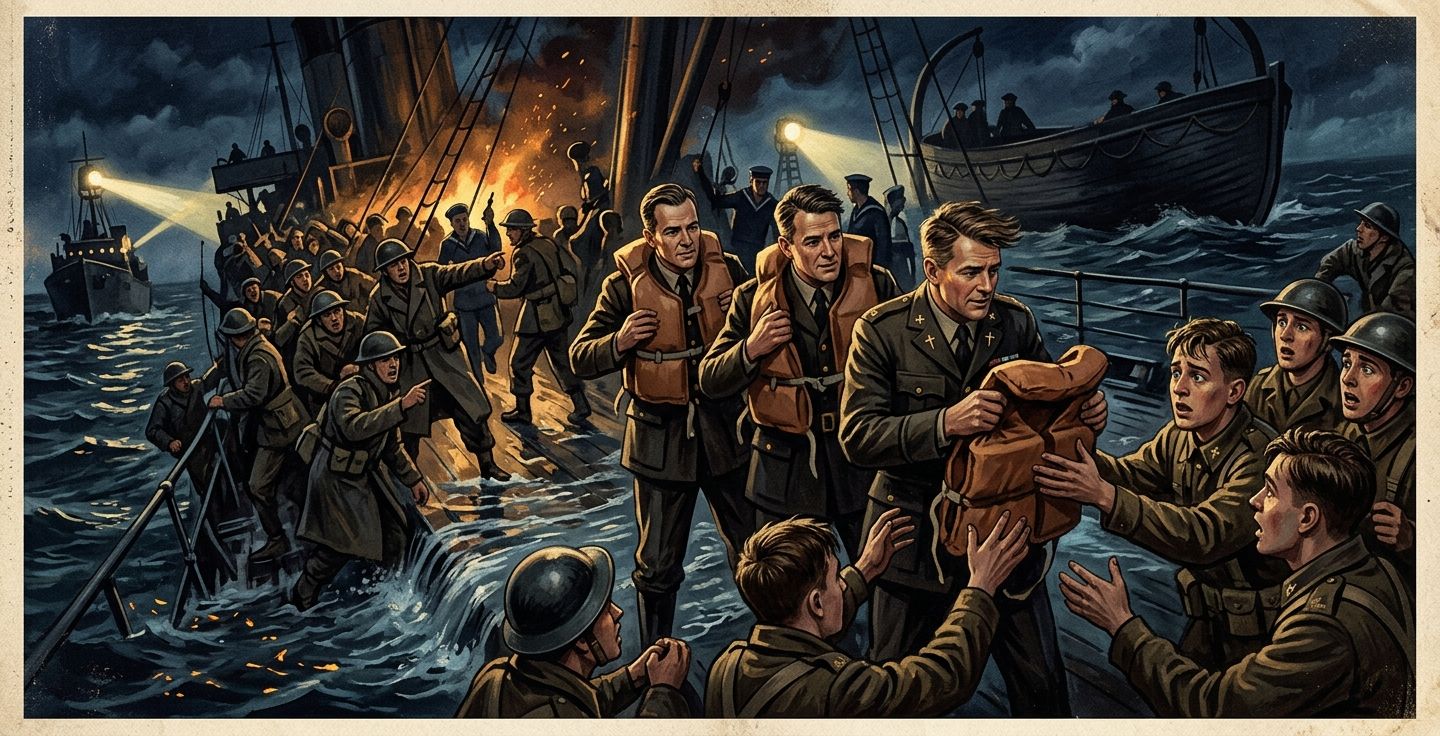
The ship took a final, steep dive. The freezing water rose over the deck. Those who had managed to get away in the rafts looked back at the doomed vessel. They witnessed a sight that would be permanently burned into their memories. The four chaplains had linked arms. They braced themselves against the slanting deck. They were praying together. They prayed in Hebrew, in Latin, and in English. Their voices carried over the roar of the ocean and the frantic cries of the dying.
Surviving witnesses later recounted a beautiful and heartbreaking historical fact. The chaplains’ prayers were the exact last sounds heard from the ship before she slipped beneath the waves.
Part IV: A Legacy Carved in Light
They went down together. They died exactly as they had lived. They were brothers serving a higher calling. The news of their passing shocked the nation, but it also inspired a profound sense of unity across every state. In a time of global darkness, their light shone brilliantly for all to see.
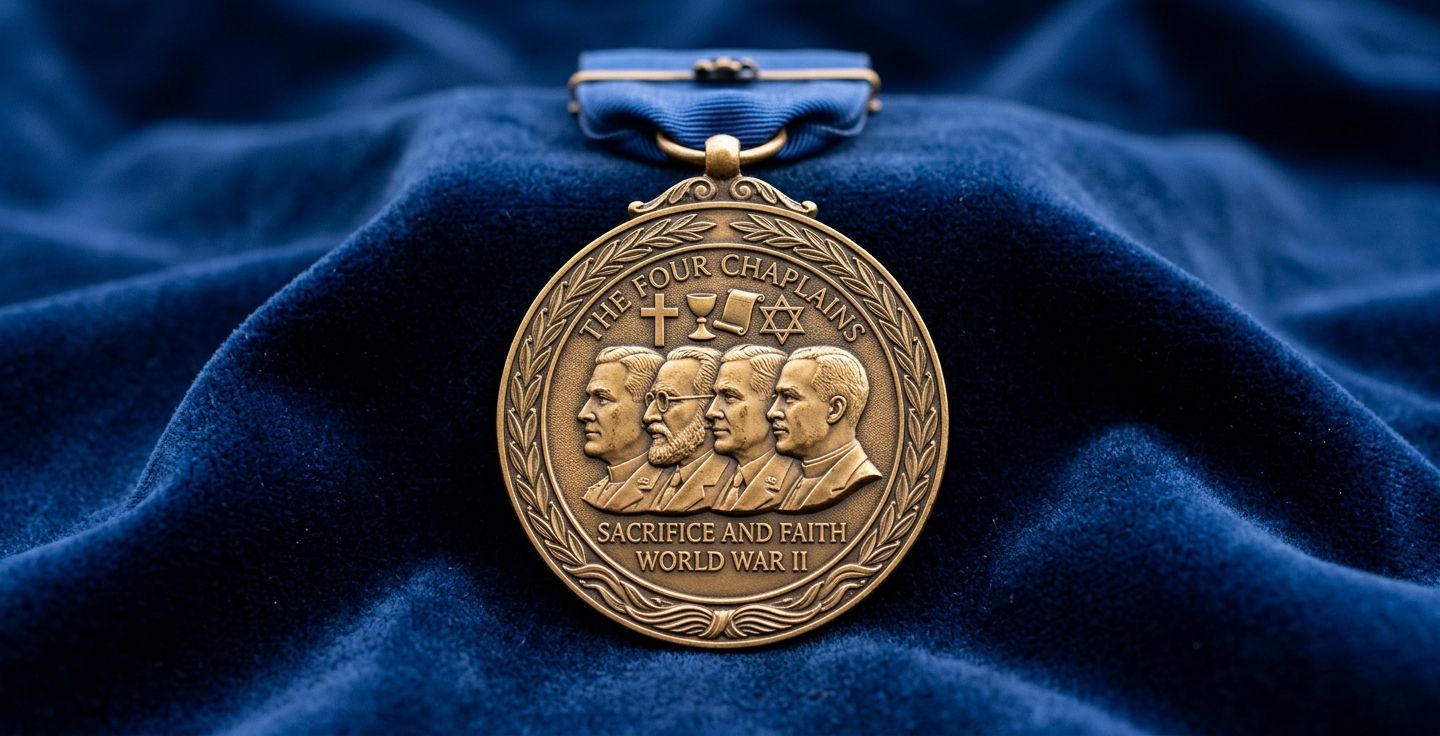
After the war, the United States Congress wanted to honor them with the Medal of Honor. However, the strict rules of the award required a soldier to have engaged in direct combat with the enemy. Since they were noncombatants, they did not technically qualify. Congress decided that their heroism was so immense, it required something entirely unique. On January 18, 1961, Congress authorized the Four Chaplains’ Medal. It is a one of a kind posthumous award. It holds the exact same weight and prestige as the Medal of Honor. It is widely remembered as the Congressional Medal of Valor for its distinct place in our nation’s history.
Their story is a monument to selfless brotherhood. It reminds us of a fundamental truth about America. We are a mighty nation woven together from different backgrounds, different faiths, and different origins. When the storm hits, we do not check to see what church our neighbor attends before we lend a helping hand. We simply reach out. We hold on to each other. We sink or swim together.
The young soldiers who wore the chaplains’ life jackets never forgot the weight of that incredible gift. They lived full lives. They had children and built the prosperous America we enjoy today. They lived because four men of God decided that love was stronger than the freezing depths of the sea.
Carry the Spirit Forward
We must keep their story alive for the next generation. We must teach our children about the night the ocean froze and the brave men whose faith kept them warm. You can carry the spirit of selfless brotherhood with you every day. I encourage you to look at The Four Chaplains Memorial Tee.
Carry the spirit of selfless brotherhood. Made from buttery-soft combed cotton, built to withstand the elements like those who stood tall on the Dorchester. It is not just a piece of clothing. It is a true conversation starter. It is a meaningful way to honor the legacy of four absolute American heroes. Wear it with pride, and share their story with anyone who asks. Because as long as we remember them, The Four Chaplains are still standing watch.
What was the USAT Dorchester?
The USAT Dorchester was a coastal passenger steamship that was converted into a military transport ship during World War II. It was tragically sunk by a German submarine in 1943 while crossing the Atlantic Ocean.
Who were the Four Chaplains?
The Four Chaplains were four United States Army officers serving together: Methodist minister George L. Fox, Reform Jewish rabbi Alexander D. Goode, Catholic priest John P. Washington, and Reformed Church in America minister Clark V. Poling.
What happened when the USAT Dorchester was torpedoed?
On February 3, 1943, a German U-boat fired a torpedo that struck the Dorchester in the middle of the night. The ship quickly lost power and began to sink rapidly in the freezing North Atlantic waters.
Why are the Four Chaplains famous?
When the ship was sinking, life jackets ran out. The four chaplains bravely gave up their own life jackets to save young soldiers. They were last seen locking arms and praying together as the ship went down into the ocean.
How many men survived the sinking of the USAT Dorchester?
Out of the 902 men aboard the transport ship, only 230 survived the freezing waters. Notably, four of those survivors were saved directly because they were given the chaplains’ personal life jackets.
Did the Four Chaplains receive the Medal of Honor?
Because they were not engaged in direct combat with the enemy, they did not qualify for the Medal of Honor. However, Congress created a special, one time award for them known as the Four Chaplains Medal, which holds the exact same high prestige.
Where did the USAT Dorchester sink?
The ship sank in an incredibly cold area of the North Atlantic Ocean situated between Newfoundland and Greenland, often referred to as the Labrador Sea.