
American Mythos & National Character
How Myth and Reality Mix in American Identity
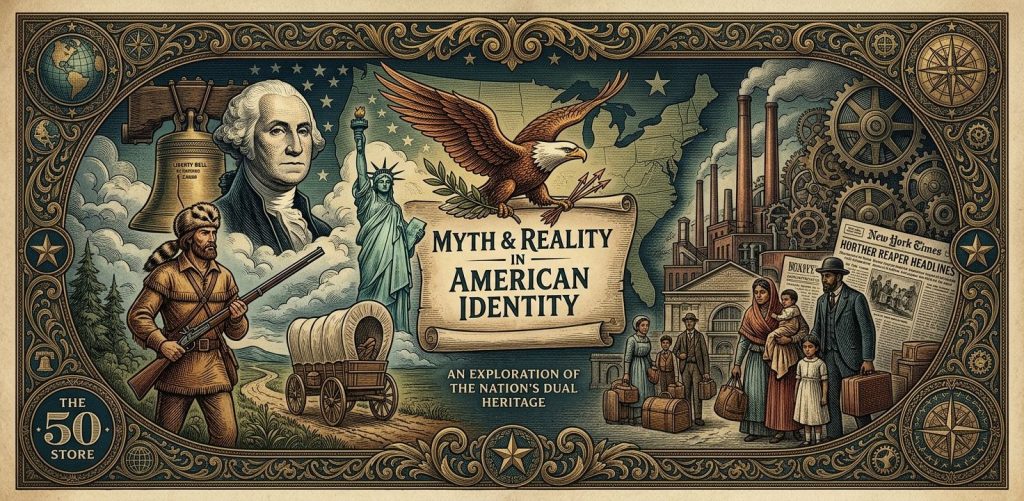
The Stories We Tell on the Front Porch
Welcome to the front porch, friend. Pull up a chair. Grab a cup of coffee. Let us sit and watch the morning sun rise. As I look out over the yard, I often think about the stories we tell ourselves. Growing up in the shadow of The Appalachian Mountains, I heard my fair share of tall tales. I heard about Paul Bunyan clearing forests with a single swing of his axe. I heard about Johnny Appleseed planting hope across the wild frontier. I heard about brave men and women who stood tall against impossible odds to carve a nation out of the wilderness.
These are our shared stories. They set the stage for our American identity. But as we grow older, the picture gets a bit more complicated. We go to school. We read thick history books. We learn that the famous story of George Washington (1732-1799) and the cherry tree was just a fable invented by an eager biographer trying to sell books. We discover that the bold pioneers who settled the west often relied heavily on government land grants and military protection to survive.
This brings up an important question. What happens to our national pride when we find out the stories are not entirely factual? Do we toss them out with the morning trash? Do we become cynics?
Absolutely not. We hold onto them tighter. We just learn to understand them differently. These myths are not lies. They are the blueprints of our national soul. They show us what we aspire to be. Today, I want to talk with you about how the myths we cherish and the hard realities we face blend together to create something truly beautiful.
The Legend of Pulling Yourself Up
When you think about the United States, one specific image always comes to mind. It is the image of the self-made man. This is the fellow who starts with nothing but the shirt on his back and a pocket full of dreams. He works from dawn until dusk. He saves his pennies. Eventually, he builds an empire through sheer force of will.
This idea is baked right into our cultural DNA. A recent study from the Pew Research Center found that around 73 percent of Americans believe that working hard is very important for getting ahead in life. That is a massive number of people who still hold onto this core belief. It captures our attention and holds our interest because it promises that our destiny is entirely in our own hands.
Let me share a quick story with you. It is the story of my great-uncle Silas. Silas was born on a dirt-poor farm in the rural south. In the winter of 1924, he packed a cardboard suitcase and bought a one-way train ticket to Detroit, Michigan. He did not know a single soul in the city. He just knew there were jobs in the great auto plants, pouring steel and assembling the machines that would change the world.
Silas stood outside the factory gates for three days in the freezing cold, stomping his boots to keep his toes from going numb, until a foreman finally pointed at him and told him to get on the assembly line. He worked double shifts until his hands blistered and calloused. He saved enough to buy a small house with a little patch of grass in the front. Over the years, he put three kids through college, ensuring their lives would be easier than his own.
Silas lived the myth. But he also lived the reality.
We love the story of Silas because it echoes the life of Benjamin Franklin (1706-1790). Franklin famously arrived in Philadelphia, Pennsylvania as a runaway apprentice. He walked down Market Street with three puffy rolls of bread, looking completely ridiculous to the locals. Yet he rose to become a wealthy printer, a brilliant scientist, and a founding father. Franklin literally wrote the book on pulling yourself up by your bootstraps. His autobiography became the instruction manual for the American dream.
Where the Rubber Meets the Road
The Messy Truth
Now, let us look at the reality of these situations. It is true that Silas worked incredibly hard. But he did not do it in a vacuum. He had a supportive community at his local church that brought his family casseroles when times were lean. He joined a brotherhood of workers that fought for his weekend hours and his fair wages. The roads he drove his new car on were paved by his fellow citizens.
The same goes for old Ben Franklin. While he was undoubtedly a genius, he relied on benefactors to establish his first printing shop. He also had a brilliant wife, Deborah, who ran the business with an iron fist while he was in Europe working the political system.
The reality is always messier than the myth. The myth says we do it completely alone. The reality says we succeed because we are part of a massive, connected family of citizens.
The Beautiful Blend
{VIS_1}
This is where the magic happens. We need the myth of the lone pioneer to spark the initial fire in our bellies. If Silas did not believe that his hard work would pay off, he never would have boarded that train to Detroit. The myth gave him the courage to take the leap. The reality of his community gave him the safety net to survive the landing.
This blend of belief and community support is backed up by facts. The Global Entrepreneurship Monitor regularly reports that the United States consistently ranks among the top developed nations for entrepreneurial intent. Over 15 percent of working-age adults in this country are actively trying to start a new business. They are dreaming big. They are taking risks. They are doing this because the myth tells them it is possible. Then, they join local chambers of commerce, they find mentors, and they secure loans from community banks. The reality of our society helps them build their dreams into brick and mortar.
We do not have to choose between the myth and the reality. They are two hands washing each other. The story gets us out of bed in the morning. The reality of our shared struggles and shared triumphs helps us sleep soundly at night.
The Fuel for Our Future
Why do we hold onto these stories so tightly? Why do we keep telling our children about the cowboys, the pioneers, and the inventors?
We hold onto these founding myths because they give us deep strength during difficult times. Life is not always easy. We face economic downturns. We face global conflicts. We face natural disasters that sweep away entire towns. In those dark moments, we need a reservoir of hope to draw from.
Consider Abraham Lincoln (1809-1865). The popular myth paints him as a simple backwoods rail splitter who read borrowed books by firelight, chopped down trees with his bare hands, and somehow stumbled his way into the White House through pure homespun wisdom. The historical reality is quite different. Lincoln was a highly educated, wealthy corporate lawyer who represented massive railroad companies. He was a shrewd, calculating political operator who knew exactly how to direct the flow of power.
But his political allies intentionally played up the rail splitter myth during his presidential campaign. Why? Because the nation was tearing itself apart. The people needed to believe in a leader who understood the common struggle. The myth of the log cabin made Lincoln relatable. That relatability allowed him to hold the Union together through the darkest hours of the Civil War.
{VIS_2}
We desire that connection to greatness. We want to see a reflection of Washington, Franklin, and Lincoln staring back at us in the mirror. We want to believe that the American spirit lives inside us, ready to be called upon when the hour grows late.
That spirit is not just an old dusty story. It is a living, breathing thing. It is the volunteer firefighter pulling a shift after working all day at the lumber yard. It is the single mother taking night classes to get her nursing degree. It is the teenager organizing a food drive in their neighborhood. They are all adding their own chapters to the great American storybook.
Wear Your Pride on Your Sleeve
We have a duty to keep these stories alive. We have a responsibility to pass them down to the next generation. We must teach them that the myths inspire us, and the realities ground us.
One beautiful way to honor this incredible heritage is by displaying it proudly. When we wear patriotic apparel, we are doing more than just putting on a shirt or a hat. We are making a statement. We are telling the world that we still believe in the dream.
Our clothing line is designed for folks who appreciate the hard work, the history, and the hopeful spirit of our great nation. Every stitch is a tribute to the men and women who built this country from the ground up. Whether you are heading out to a Friday night football game, gathering with family for a backyard barbecue, or just running errands around town, our comfortable and durable apparel lets you carry a piece of the American story with you.
Take a look at our latest collection today. Find the piece that speaks to your heart. Put it on, step out your front door, and continue writing your own incredible chapter in our shared history.
What makes the American identity so unique?
Our identity is unique because it is built on a shared set of ideals and stories rather than a single common ancestry. It blends hard realities with inspiring tales to create a forward looking and optimistic culture.
Who is considered the ultimate example of the self made man?
Many historians point to Benjamin Franklin as the classic example. He arrived in Philadelphia with almost nothing and rose to become a leading scientist, writer, and founding father through hard work and community support.
Do Americans still believe in the concept of pulling yourself up by your bootstraps?
Yes, they certainly do. Studies regularly show that a large majority of citizens still believe that hard work and determination are the most important factors for achieving success in life.
Why do we still teach historical myths if they are not entirely factual?
We teach these stories because they represent our highest aspirations. While the historical facts provide important context, the myths provide the moral courage and hope needed to face difficult times.
How can I proudly display my belief in the American spirit?
One wonderful way is by wearing patriotic apparel that honors our nations history. It acts as a daily reminder of the hard work and community strength that built our country.