
American History & Origins
Why Did Americans Move West? The Real Story of Expansion
The Dust on Our Boots
When the autumn wind picks up across the plains, it carries a very specific scent. It smells like dry earth, crushed sagebrush, and a quiet sort of promise. I have breathed in that scent my entire life, standing on soil my family has called home for generations. Sometimes, as I look out over the vast stretches of land that roll out toward the setting sun, I catch myself thinking about the folks who first rutted those paths. My old heart feels a deep kinship with them.
We often hear grand tales about why everyday folks packed up their entire lives to chase the setting sun. The history books call it manifest destiny. They paint pictures of glorious conquests, bold politicians, and endless horizons. But the real story is much quieter. It is found in the creak of wooden wheels, the smell of canvas in the rain, and the calloused hands of people who simply wanted a place to breathe.
Let us look at a young man named John Bidwell (1819-1900). John was just a twenty-year-old school teacher scraping by in Ohio. He did not care about national expansion or political boundaries. He had managed to save enough for a modest plot of land, only to have it stolen out from under him by a smooth-talking swindler. John was left with nothing but the clothes on his back and a deep, burning ache for a fair shake. So, he gathered up a few dozen restless souls in Independence, Missouri, and helped organize one of the very first organized overland journeys to California. He just wanted a piece of dirt no one could take away from him. It was a simple desire. It changed the world.
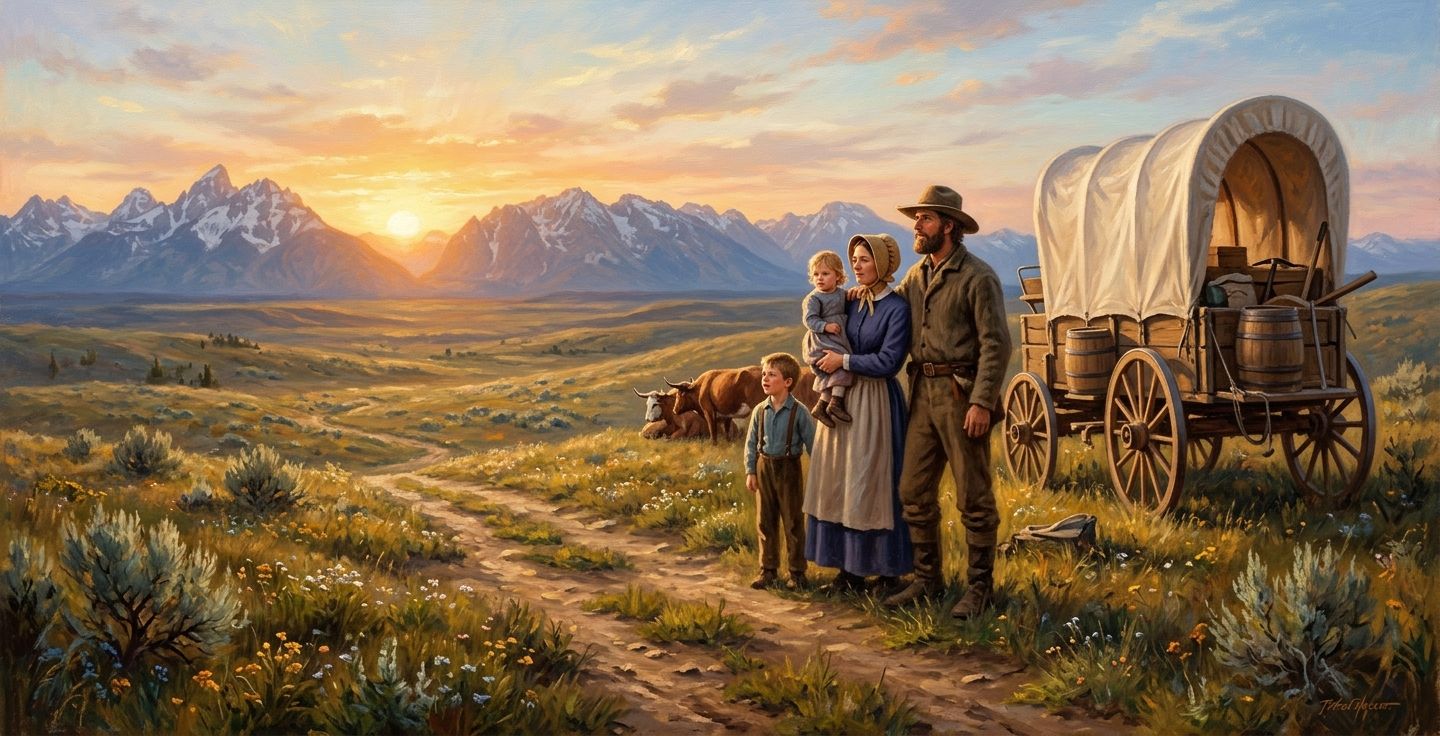
Before they left town, families had to make agonizing choices about what to bring. A typical wagon would be packed with absolute necessities:
- Hundreds of pounds of flour, bacon, and coffee to sustain them for months.
- Basic tools like axes, shovels, and ropes for repairing wagons along the trail.
- Heirloom seeds carefully wrapped in cloth, carrying the hope of next year’s harvest.
The Great Squeeze of the East
To understand why ordinary folks risked everything, we have to look at the situation back east. By the early 1840s, the United States was experiencing a tremendous squeeze. Families were large. Farms were being divided among sons until the plots were too small to feed a growing family. Cities were filling up with smoke, noise, and people. It felt terribly cramped. People looked at their children and wondered how they would ever provide for them.
Then came the economic panics. The Panic of 1837 hit the country like a sudden winter storm. Banks collapsed. Savings evaporated overnight. Good, hardworking people lost their homes and their livelihoods. That is the true complication of our story. It was not just a matter of wanting more space. It was often a matter of having absolutely nothing left. The east coast felt like a trap closing in on them.
A Journey by the Numbers
The scale of the resulting migration is still hard to wrap my mind around. If you read the historical records from credible sources like the Oregon-California Trails Association, you find statistics that make you sit back in your chair. Between 1840 and 1860, well over 400,000 men, women, and children walked the overland trails. They walked. Step by agonizing step across a wild, unforgiving continent.
Here is a statistic that always stops me in my tracks. According to historical estimates, nearly one out of every ten pioneers who set out on that journey died along the way. Diseases like cholera swept through the camps with devastating speed. Accidents with wagons and river crossings were horrifyingly common. The trail was, in many ways, a massive graveyard. Yet, they kept coming.
Furthermore, the 1850 United States Census reveals a fascinating fact about our young nation. Roughly half of the entire American population was under the age of fifteen. We were quite literally a nation of children. We were a young, bursting country desperate for room to grow. Those young families needed a future, and the East simply did not have enough room for all of them.
Why Did We Go?
So, we must ask ourselves a big question. Why would a mother pack her babies into a narrow wooden box and walk beside it for two thousand miles, knowing she might bury one of them by the side of the trail? Why would a father leave everything he knew to face mountains, deserts, and the threat of starvation?
The answer is hope. The answer is the absolute conviction that a better life was waiting at the end of the road. They were drawn by the fertile soils of the Willamette Valley, where rumors said the crops grew taller than a man. They were drawn by the promise of the western frontier, a place where a person was judged by the sweat on their brow rather than the pedigree of their family name.
Take Narcissa Whitman (1808-1847), for instance. She was one of the first white women to cross the Rocky Mountains. She kept a detailed journal of her trip. She did not write about conquering nations. She wrote about the exhausting heat, the lack of decent drinking water, and the simple, overwhelming joy of finding a cool spring after days in the choking dust. Her personal, quiet struggles tell us so much more than any political speech ever could.
Chasing the Sparkle and the Soil
Naturally, some folks were drawn by a more sudden fever. When James W. Marshall found shiny flakes in the water at Sutter’s Mill, it set off the great gold rush. Young men from all over the world rushed in, hoping to strike it rich overnight. But the real lasting wealth of the West was never pulled from a riverbed. The real wealth was the soil itself.
Consider Daniel Freeman (1826-1908). History remembers him as the very first person to file a claim under the Homestead Act of 1862. Just after midnight on New Year’s Day, Daniel convinced a land office clerk to open up just long enough for him to file his paperwork for a plot of land near Beatrice, Nebraska. He did not want shiny gold. He wanted to be a farmer. Millions of homesteaders followed his quiet example. They built houses out of thick sod, fought off terrifying grasshopper plagues, and survived brutal winter blizzards. They did it because that land belonged to them.
When you picture a wagon train heading out across the plains, you are not just seeing a historical event. You are seeing a traveling neighborhood. You are seeing folks helping each other fix a broken axle, sharing a bit of flour, or singing songs around a buffalo chip fire to keep the dark at bay. They formed tight-knit communities long before they ever laid the foundations for a permanent town.
What We Can Learn Today
I look at our young people today, and I still see that exact same spark. You might not be hitching up oxen or walking to California, but you are still pioneers in your own right. Every time you start a new business, move to a new city for a better job, or work late into the night to provide for your children, you are honoring that old spirit. You are pushing your own personal boundaries.
The frontier is no longer a physical place on a map. It is in our minds, our sciences, and our local communities. We are still building a better country, step by steady step. That fills my old heart with immense warmth and hope for the generations to come. The journey was never really about the land itself. It was always about the resilient people we became along the way. I encourage you to dig into your own family stories. Find the folks who took a chance. Draw strength from their remarkable courage.
How long did the journey west actually take?
For most families traveling by wagon, the journey took anywhere from four to six months. They had to leave in the spring when the grass was green enough for their animals to eat, and they had to beat the winter snows in the mountains. It was a race against time and the changing seasons.
Did the pioneers really ride inside the wagons all day?
No, they did not. The wagons did not have suspension springs, making the ride incredibly bumpy and uncomfortable. Plus, the wagons were packed full of heavy supplies. Most people, even children, walked alongside the wagons for the entire two thousand miles to spare the tired oxen.
What did families eat while on the trail?
The daily diet was very simple and quite repetitive. They mostly ate bacon, beans, rice, and hard bread. If they were lucky, hunters might shoot a buffalo or antelope for fresh meat. Women would often hang a bucket of milk under the wagon, and the constant bumping would churn it into butter by evening.
Were there traffic jams on the pioneer trails?
Surprisingly, yes. During peak migration years, thousands of wagons left the starting points around the same time. The trail could become incredibly crowded. Pioneers often complained about choking on the thick dust kicked up by the hundreds of wagons traveling just a mile or two ahead of them.
How much did it cost to pack up and leave?
It was not cheap. A family might spend between six hundred and one thousand dollars to buy a wagon, animals, and enough supplies for the trip. In the 1840s, that was a small fortune. Many families sold everything they owned just to afford the journey westward.