
Icons & Symbols of America
The Statue of Liberty’s Shifting Meaning Across Generations
I often find myself standing near the shores of New York Harbor, feeling the cold salt breeze coming off the water. The seagulls cry out overhead, diving toward the green ferries that churn the dark water into white foam. The scent of roasted peanuts from street vendors mixes with the heavy smell of the sea. Out there, standing resolute and quiet against the vast, bustling skyline, is the Statue of Liberty. She is a constant fixture of our landscape, a towering guardian looking out toward the horizon. I remember standing by these very docks as a young boy. My small hand was completely lost in my father’s rough palm as he pointed her out to me through the morning fog. Back then, she seemed impossibly huge, a fixed point in a world that felt incredibly large and uncertain. I have lived my entire life under the wide, changing skies of this country, and she has always been there, watching over our triumphs and our struggles.
We live in a world that moves incredibly fast. Over the many decades I have walked this earth, I have watched the country shift, stumble, and grow. The Statue of Liberty has remained anchored in the harbor, a comforting and constant presence in our daily lives. Yet, the America my grandfather knew is vastly different from the America my grandchildren navigate today. The world has shifted around us, and so has the meaning of the great copper lady. She was not always meant to be the mother of exiles.
How did a simple gift of international friendship become such a heavy, complex symbol of hope, debate, and shifting ideals? What is the true promise she holds for the generations yet to come? The answer is simple but profound. She changed because we changed. Her meaning evolved as our nation matured, adapting to the hopes and fears of each new generation that arrived on our shores or grew up in our cities.
When I talk to young people today, I love to share a few surprising facts to capture their interest. Let us look at some numbers from credible historical sources that paint a fascinating picture. According to the National Park Service, our steadfast lady in the harbor is struck by lightning around six hundred times every single year. Imagine that. She stands tall through every violent storm, literally taking the hits, yet her torch never dims. In addition, when she was first unveiled to the public in 1886, she was not green at all. She was the color of a shiny new penny. It took roughly thirty years for the salty air and oxidation to give her that familiar, beautiful sea-green patina we all recognize. And perhaps most astonishingly, data from the Ellis Island Foundation reveals that nearly forty percent of all current citizens in this great country can trace at least one ancestor directly back to the ships that passed under her watchful gaze.
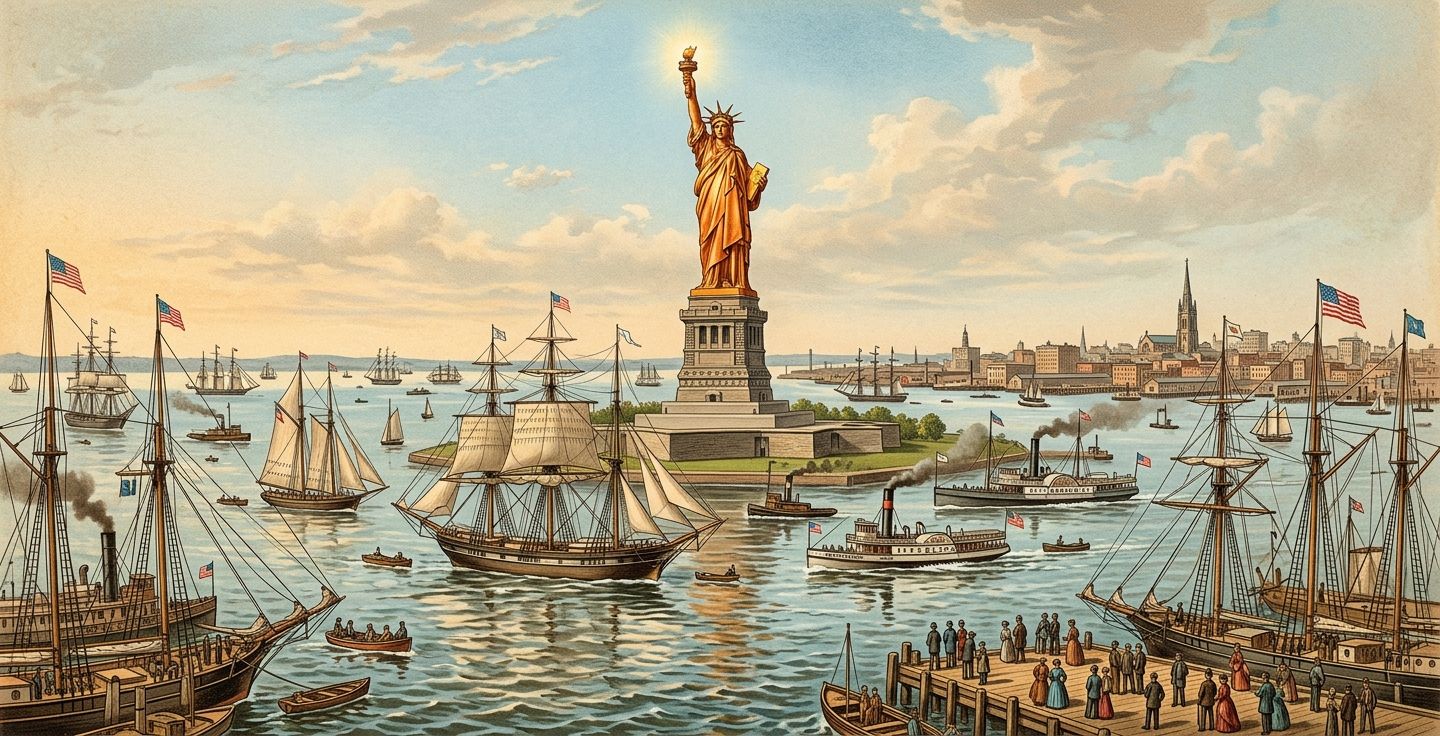
A Gift of Friendship and Freedom
To understand her shifting meaning, we must look at a small slice of history. Let me share a story about a man named Édouard René de Laboulaye (1811, 1883). He was a brilliant French political thinker, and he originated the idea for the monument. He shared this massive dream with his close friend, the sculptor Frédéric-Auguste Bartholdi (1834, 1904). They did not build her for immigrants. They built her to celebrate the survival of the American Union after our incredibly bloody Civil War and to honor the final abolition of slavery. If you look closely at her feet, you will see heavy, broken shackles. Most people never notice them. The creators wanted her to symbolize the end of cruel oppression and the bright dawn of human liberty.
But a monument is never defined just by its makers. It is defined by the tired eyes that look up at it. The meaning began to shift significantly because of a young writer named Emma Lazarus (1849, 1887). Emma had been working closely with Jewish refugees arriving from Eastern Europe. She saw their deep pain, their poverty, and their desperate need for a safe haven. When asked to write a poem to help raise funds for the statue’s pedestal, she penned The New Colossus. Emma gave the silent copper giant a compassionate, beating heart. She turned the monument from a stern symbol of republicanism into the welcoming mother of exiles.
The Beacon for the Weary
In the early twentieth century, the great waves of migration hit our shores. Think of Orchard Street, a narrow, bustling stretch in the Lower East Side of Manhattan. In those days, it was packed tightly with wooden pushcarts, filled with the loud cacophony of a dozen different languages mixing in the damp morning air. You could smell pickled herring, fresh bread, and the sweat of hard labor. My own family walked these cobblestone streets. They lived tightly packed in small tenement buildings, working from dawn until dusk just to put food on the table. For a young tailor or a weary mother arriving from across the sea, terrified and exhausted, Lady Liberty was not about political theories. She was a giant, silent promise. She meant you could breathe. She meant you could work and raise your children without the constant fear of persecution. That was the micro-history of our nation, written one tired, hopeful family at a time.
A Symbol of Defiance During Dark Times
Time marched on, and the world plunged into the dark, frightening years of the Second World War. I remember those days vividly. The harbor was filled with gray naval ships, and the sky was often thick with worry. We walked the streets at night with blackout curtains drawn tight over our windows. During this era, the meaning of the statue shifted once again. She was no longer just a welcoming mother. She became a proud, defiant symbol of democracy standing tall against the rapid spread of fascism and tyranny. We bought war bonds with her strong image printed on them. We looked out at the harbor and saw a steadfast guardian of freedom. She reminded us of what our boys were fighting for across the globe. She was a brilliant beacon of resilience in a world that felt incredibly dark.
The Promise for Our Grandchildren
Today, I sit on my porch and listen to my grandchildren talk about the world. They are smart, compassionate, and deeply aware of the massive challenges we face today. For their generation, the statue represents a much more complex mirror. They see her promises of liberty and justice, but they also see the painful places where we have fallen short of those high ideals. They look at her and ask hard, necessary questions about inclusion, equality, and what true freedom really means in a modern society. They worry about the environment, about fairness, and about the future of our communities. I do not fear this shifting meaning. In fact, I welcome it with an open heart. It means the ideals she represents are still alive, still breathing, and still demanding our active participation.

Carrying the Torch Forward
We are a nation of restless, hoping souls. The true beauty of the monument is not in the hammered copper plates or the massive iron framework inside. The beauty is in her unique ability to hold the changing dreams of every single generation that gazes upon her. She is strong enough to endure the brutal lightning strikes, and she is grand enough to accept our evolving understanding of justice.
I encourage you to take a trip down to Battery Park when you have the chance. Stand by the sturdy iron railing, look out at the choppy water, and decide what she means to you today. More importantly, carry that spark of hope back into your daily life. Be kind to your neighbors. Welcome the stranger who looks lost. Build a hopeful, welcoming tomorrow for the ones who will come after us. The torch has been passed to you now, and I know your hands are steady enough to hold it high.
If you are curious to learn more about our shared history, here are a few common questions I often hear people ask about our wonderful lady in the harbor.
What was the original purpose of the Statue of Liberty?
The monument was initially proposed to celebrate the end of the American Civil War, the abolition of slavery, and the enduring friendship between France and the United States.
Why is the Statue of Liberty green?
Her exterior is made of a thin layer of copper. Over a period of about thirty years, the copper reacted with the salty air and weather in the harbor, creating a natural green patina that protects the metal underneath.
Who was the first immigrant to pass by the Statue of Liberty and enter Ellis Island?
The first recorded immigrant to be processed at Ellis Island was a brave fifteen year old girl named Annie Moore (1874, 1924), who arrived from Ireland on January 1, 1892.
Can you visit the torch of the Statue of Liberty?
The original torch was replaced in the 1980s and is now housed in the museum. The current torch has been closed to the public since 1916 due to safety concerns after a nearby explosion.
How did the Statue of Liberty become a symbol for immigration?
The meaning shifted naturally as millions of newcomers sailed past her on their way to Ellis Island. This connection was permanently cemented by the addition of the famous poem written by Emma Lazarus (1849, 1887), which gave the statue her welcoming voice.