
Icons & Symbols of America
The Quiet Power of the National Parks: America’s Democratic Cathedrals
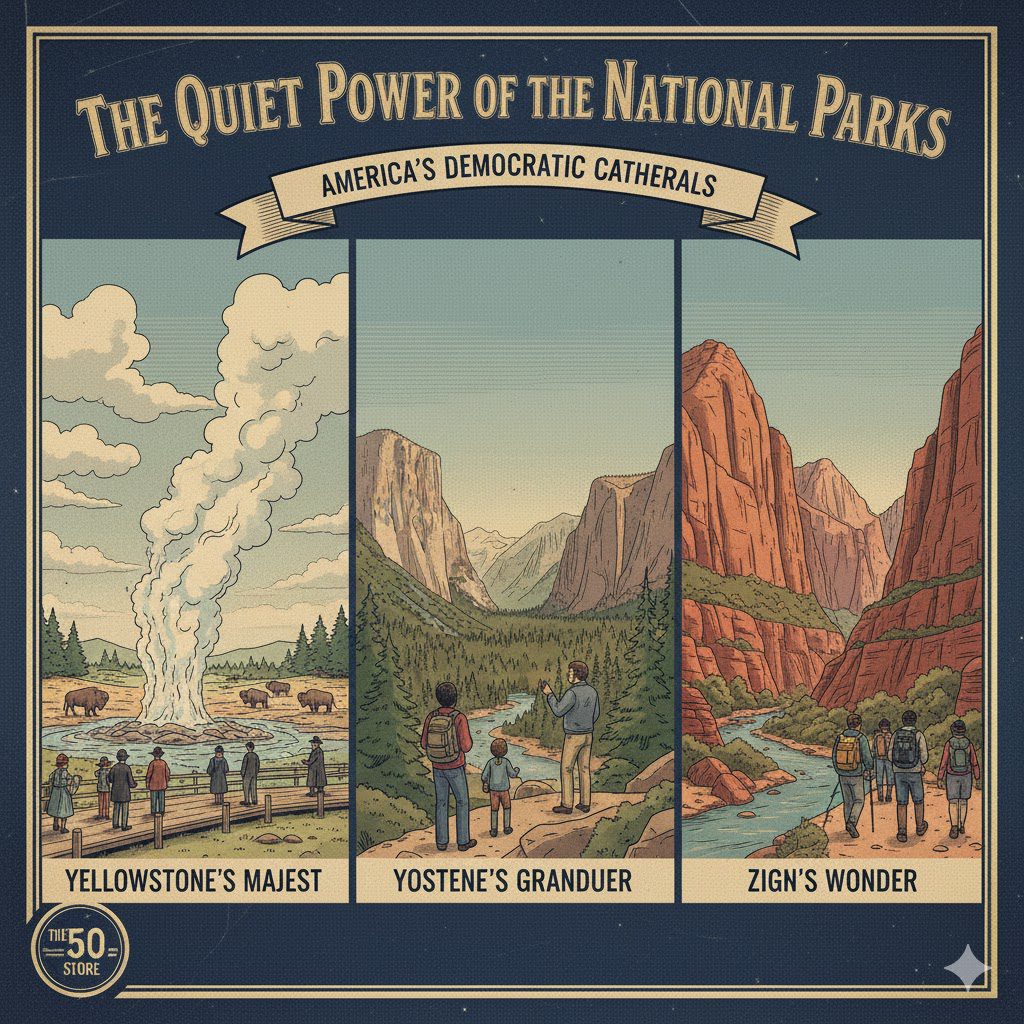
What are the true cathedrals of the American spirit? They aren’t found in city centers, adorned with stained glass and carved stone, but rather in the quiet, colossal majesty of our National Parks. These protected expanses—from the geysers of Yellowstone to the sheer granite walls of Yosemite—represent something profound and uniquely American. They are vast, sacred spaces of natural wonder, owned not by an individual, a corporation, or a church, but by every single citizen. They are, in the purest sense, America’s democratic cathedrals, places where social barriers dissolve and where the scale of nature places human concerns into humbling perspective.
For Americans, especially those of us over thirty who have witnessed the relentless pace of development, the National Parks stand as enduring testaments to foresight and deliberate conservation. Their story is not just about preserving beautiful landscapes; it is a foundational narrative about the nation’s capacity to declare certain resources off-limits to profit, dedicating them instead to the common good and the spiritual nourishment of generations.
The 1776 Winners History Premium Tee
Wear your story with pride! Celebrate classic American values, history, and heritage with our premium crafted apparel, designed for comfort and durability.

The 1776 Winners History Premium Tee
Wear your story with pride! Celebrate classic American values, history, and heritage with our premium crafted apparel, designed for comfort and durability.
The 1776 Winners History Premium Tee
Wear your story with pride! Celebrate classic American values, history, and heritage with our premium crafted apparel, designed for comfort and durability.
A Radical Idea: Conservation as a National Trust
The idea of the National Park was, at its inception, nothing short of revolutionary. When Yellowstone was established in 1872 by President Ulysses S. Grant, it was not merely a wilderness designation; it was the world’s first-ever creation of a national park—a land set aside “for the benefit and enjoyment of the people.” This was a radical departure from the European model, where vast tracts of land were typically held by royalty or private estates. In America, we declared that the most spectacular of our landscapes belonged to the public domain.
This early act of conservation was driven by a powerful confluence of scientists, artists, and influential figures who recognized that without protection, these wonders would inevitably be exploited and potentially destroyed. The photographs of Ansel Adams and the writings of John Muir didn’t just document the parks; they elevated them in the public imagination, framing them as essential elements of American identity, worthy of the same veneration as any historical document or monument.
The true system was solidified with the creation of the National Park Service (NPS) in 1916, under President Woodrow Wilson. The NPS was tasked with a dual, often contradictory mission: to conserve the scenery and the natural and historic objects and the wild life therein and to provide for the enjoyment of the same in such manner and by such means as will leave them unimpaired for the enjoyment of future generations. This mission—use but do not use up—is the philosophical backbone of the entire system.
The Social Equalizer: Access and Reflection
What makes the National Parks democratic is their accessibility and their profound equalizing effect. Regardless of one’s wealth, background, or social standing, entry to these cathedrals is generally affordable and open. Once inside, the individual is confronted not by the divisions of society, but by the overwhelming, indifferent majesty of the planet.
Whether standing on the rim of the Grand Canyon or hiking among the giant sequoias, the parks invite reflection and humility. The sheer scale of geologic time and natural power instantly minimizes human pretension and rivalry. The parks become rare, shared cultural ground where diverse Americans experience the same sense of awe, reinforcing a shared national identity rooted in the land.
The parks serve as vital reminders that the true wealth of America is not just economic; it is the inherited natural capital that offers spiritual and recreational reprieve from the pressures of modern life.
The Nuance of Stewardship and Regional Identity
The National Park system is not monolithic; it reflects the geographic and demographic diversity of the country.
- In the West, parks like Zion, Glacier, and Olympic are vast wilderness preserves, emphasizing monumental geology, ecological research, and adventure sports. They embody the frontier spirit—raw, expansive, and challenging.
- In the East and South, parks like Acadia, the Great Smoky Mountains, and Everglades are often defined by complex histories of human displacement, restoration, and intense biodiversity management. They tell a different story—one of land recovery, cultural history, and managing nature alongside dense human populations.
Furthermore, the NPS manages not only natural wonders but also National Historic Sites and National Seashores, ensuring that the system comprehensively preserves the nation’s environmental, historical, and cultural narrative. This comprehensive approach means the National Park system is constantly negotiating the tension between pure wilderness preservation and making our collective history and landscapes accessible to a diverse, mobile population.
The ongoing challenge is one of stewardship. As visitation surges—particularly in the most famous parks—the concept of unimpaired enjoyment is tested by traffic, infrastructure strain, and the pervasive effects of climate change. The Quiet Power of the parks now relies not just on their existence, but on the continued willingness of Americans to fund their protection, limit their impact, and ensure that these democratic cathedrals remain pristine, accessible spaces for all future pilgrims seeking awe. The Parks are our promise to ourselves—that some things are simply too vital to lose.