
Icons & Symbols of America
How the Open Road Became America’s Greatest Myth
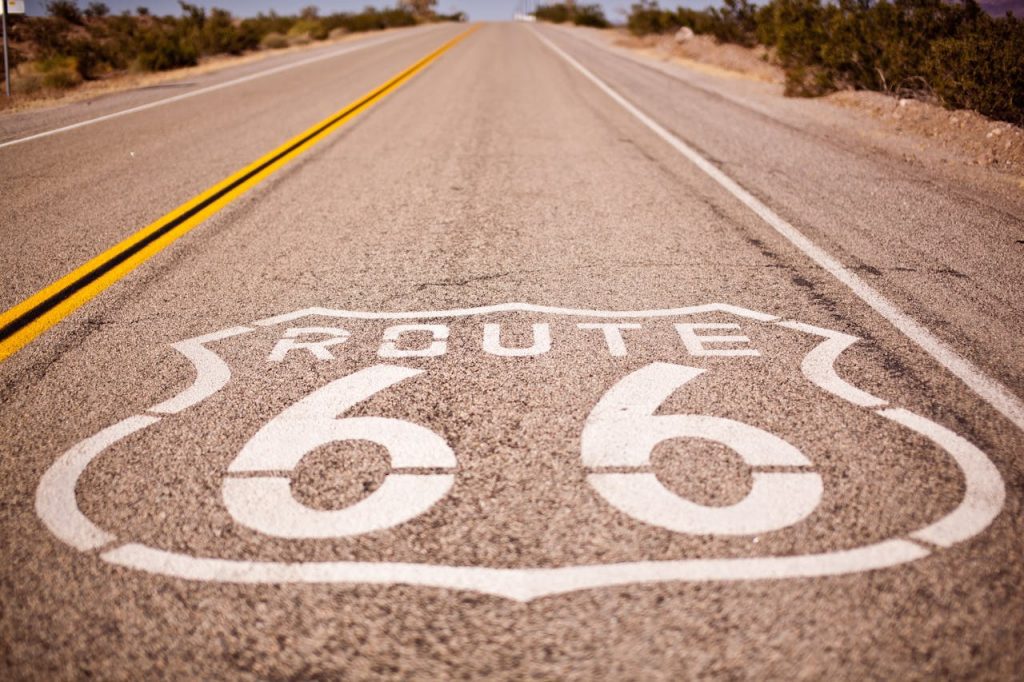
If you close your eyes and summon the feeling of pure, unadulterated American freedom, what image appears? Is it a majestic monument, or perhaps a crowded town square? For many of us, the answer is simpler, more elemental: a two-lane blacktop stretching unbroken toward a distant horizon. It is the feeling of the engine humming beneath the floorboards, the windows down, and the certainty that around the next bend lies not just a new town, but a new version of ourselves. This is the Open Road, and it is the single most enduring, evocative myth woven into the fabric of the American experience.
We, as Americans, have elevated the act of driving to a spiritual quest. We don’t just travel roads; we seek the Road Trip, a ritual of self-discovery that promises escape, reinvention, and a reconnection with the continent’s vast, unbridled spirit. Yet, like all powerful myths, the Open Road carries a complexity—a beautiful, layered history and a stark, necessary truth about access, privilege, and the very nature of movement in this nation.
American Freedom Soaring Eagle T Shirt
Wear your story with pride! Celebrate classic American values, history, and heritage with our premium crafted apparel, designed for comfort and durability.
American Freedom Soaring Eagle T Shirt
Wear your story with pride! Celebrate classic American values, history, and heritage with our premium crafted apparel, designed for comfort and durability.
American Freedom Soaring Eagle T Shirt
Wear your story with pride! Celebrate classic American values, history, and heritage with our premium crafted apparel, designed for comfort and durability.
The Unwritten American Declaration of Independence
The genesis of the Open Road myth is rooted in two distinct historical forces: the closing of the frontier and the rise of the affordable automobile.
By the early 20th century, the official narrative of Western expansion—the idea that any American could simply pick up and seek new land—had faded. The continent was mapped, the territories settled. However, the mass production of the Ford Model T in the 1910s offered a potent substitute for the physical frontier. Suddenly, personal, self-directed movement was democratized. The car provided a new, mechanical frontier, not of acreage, but of mobility. It promised the individual the power to circumvent the established social order and redefine their circumstances on their own terms.
This sentiment was codified in the romantic literature and poetry of the mid-century. Think of Jack Kerouac’s On the Road—a novel that, despite its underlying social critique and inherent chaos, cemented the image of the road as the ultimate escape from conformity. The myth suggests that American authenticity is found not in staying put and mastering one’s local environment, but in perpetual motion, in the search for something always just beyond the headlight beams.
The Concrete Artery: A System Built for Speed
The romance was solidified by monumental government projects, most notably the Interstate Highway System, initiated in 1956. While conceived primarily for defense purposes and logistical efficiency, the Interstates fundamentally reshaped the American geography and the travel experience.
It’s important to acknowledge the dual nature of this infrastructure:
- Efficiency: The Interstate system made long-distance travel remarkably swift and predictable, shrinking the perceived size of the continent. It facilitated modern commerce and family vacations alike.
- Exclusion: The massive project carved new lines through the American landscape, often disproportionately disrupting and dissecting low-income urban and minority neighborhoods. This disruption, coupled with the system’s tendency to bypass the small towns that once thrived on through-traffic, created a new landscape of “off-ramp America.”
This tension between progress and preservation is perfectly captured in popular culture. Consider the poignant, reflective narrative of the famous animated film Cars. That story serves as a nostalgic elegy for the Main Streets that were effectively choked off and forgotten once the superhighway prioritized speed over community. It highlights the bittersweet truth that the Interstate, while enabling fast travel, often severed the very heart of regional American life, turning the “open road” into a streamlined, but less textured, experience.
Furthermore, the Open Road has always been more accessible to some Americans than others. For decades, the experience of Black travelers navigating the segregated United States involved intense pre-planning, consulting resources like The Negro Motorist Green Book to find safe passage, accommodation, and fuel. Their road experience was not one of spontaneous freedom, but of calculated survival. The myth of the Open Road, therefore, carries a necessary asterisk, reminding us that freedom of movement has historically been a deeply stratified American privilege.
The Road as a Cultural Canvas
Today, the Open Road myth persists, manifesting in our music, film, and advertising. The sound of a rumbling engine, the shot of a convertible driving into a sunset—these are shorthand for Americana. Regional differences enrich the myth:
- In the West, the road is a desolate, existential challenge, a vast, empty space where an individual tests their limits against nature (think Route 66 or I-80 across Nevada).
- In the East, the road is often a connective, historic path, linking dense, older communities and reminding travelers of the nation’s layered past (think the Blue Ridge Parkway or US 1).
The Open Road is our nation’s greatest myth because it speaks to the core duality of the American identity: our radical individualism and our constant search for belonging. We drive alone to find ourselves, but we are seeking a story—a shared experience of exploration that links us, generationally and culturally, to those who have sought their fortune down the road before us.
It’s a beautiful contradiction: A nation built on static ideals—a Constitution, a flag, a fixed land—finds its soul in the dynamic, fluid, and often uncertain act of moving away from home. The freedom of the Open Road isn’t just the right to drive; it’s the profound, uniquely American right to choose your direction and, in doing so, to choose who you will become. The true journey, of course, is the one inward, but in America, we often need a couple thousand miles of asphalt beneath us to finally arrive there.