
Icons & Symbols of America
The American Flag: How a Piece of Fabric Became a Living Story
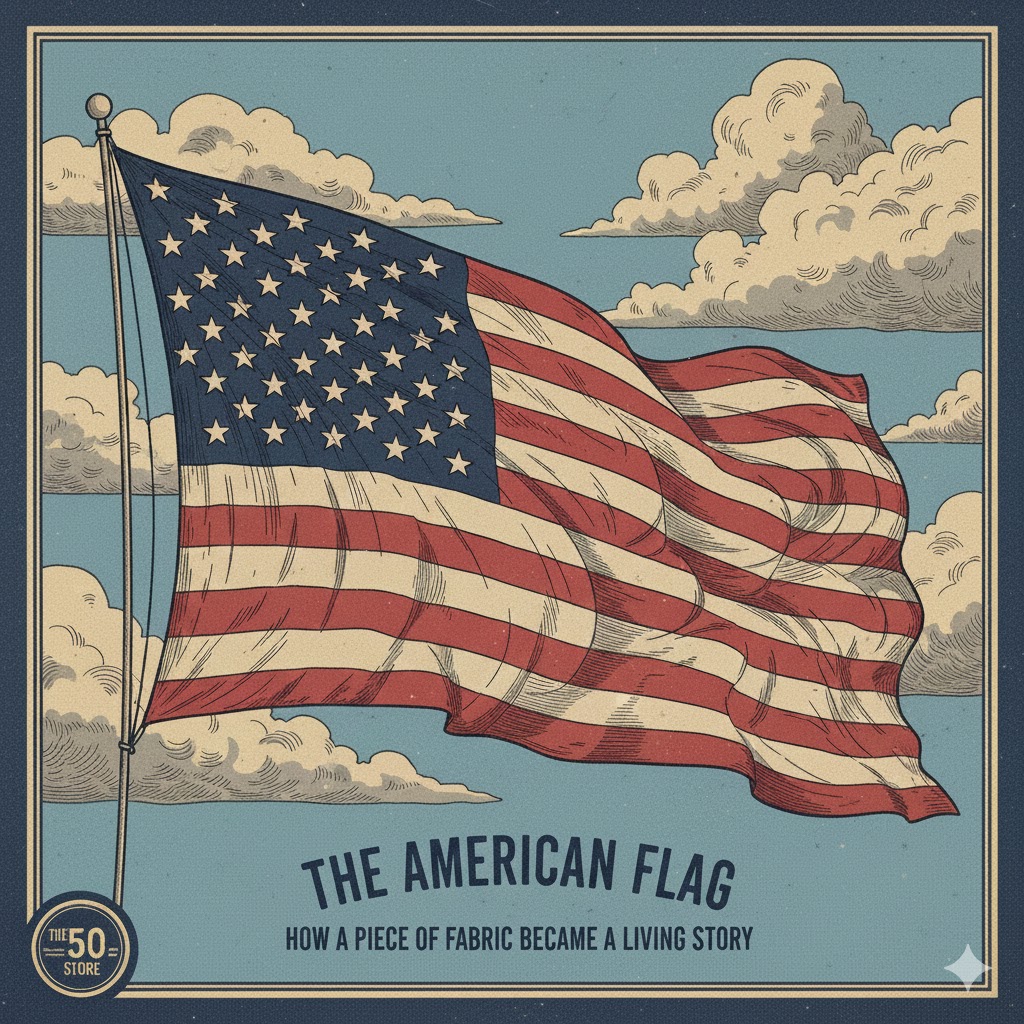
Every nation has its banners, but few pieces of cloth are charged with the sheer, contradictory weight of history, hope, and heartbreak as the American Flag. It is, in its simple geometry of stripes and stars, far more than a government emblem. It is a living story—a dynamic narrative that shifts its meaning depending on the city street, the time period, or the hand that holds it. It is saluted by soldiers and burned by protestors; it flies over local town halls and foreign battlefields. For the mature, discerning American, the flag is not a static symbol of allegiance, but a profound, often challenging, visual dialogue about what it means to belong to this vast, complex Republic.
To explore the flag’s enduring power is to trace the evolution of American identity itself—how a standardized piece of fabric became a mirror for our triumphs, our divisions, and our ceaseless pursuit of a “more perfect union.”
The Evolution of the Standard: From Betsy Ross to the 50th Star
The flag’s design, attributed to the Continental Congress in 1777, was initially a practical declaration of independence. Its key components were carefully chosen to reflect the nascent nation’s self-conception:
- Stars: Representing a “new constellation,” signifying the addition of new states to the union.
- Stripes: Representing the original thirteen colonies.
- Colors: While the 1777 resolution didn’t assign specific meaning, later governmental interpretations defined Red for valor and hardiness, White for purity and innocence, and Blue for vigilance, perseverance, and justice.
The most fascinating aspect of the flag’s design is its inherent instability. Unlike the fixed standards of monarchies, the American flag is a design built for change. It requires revision with every addition of a new state, making it a constant, visual ledger of the nation’s physical and political growth. The current design, with 50 stars, has been in use since 1960—a period of over six decades, making it the longest-serving flag design in our history. This evolution, often handled with great political solemnity, continually refreshes the narrative, ensuring that every generation has a design that visually includes them.
The Banner of Memory: War, Ritual, and Sacrifice
The flag’s power is deeply tied to ritual and sacrifice. It became truly sacrosanct during the 19th and 20th centuries, primarily through its association with military conflict. It is the backdrop to every presidential inauguration, every Olympic victory, and every soldier’s interment. These repeated rituals imbue the fabric with a cumulative emotional weight that transcends politics.
The iconic image of the flag at Fort McHenry in 1814, inspiring Francis Scott Key’s poem that became our National Anthem, solidified its status as a symbol of national survival against external threat. Similarly, the raising of the flag at Iwo Jima in 1945 became a universal emblem of perseverance and shared purpose during the nation’s greatest military mobilization. For millions of Americans, the flag is less a statement of current policy and more a tribute to collective memory and the enormous human cost paid to preserve the Republic.
The Contradictory Canvas: Protest and Patriotism
The ultimate depth of the American flag lies in its ability to be simultaneously embraced and contested. The flag does not belong exclusively to the government or the military; it belongs to the people, and the people have historically used it to express both unwavering patriotism and fierce dissent.
- During the Civil Rights Movement and the Vietnam War protests, the flag was frequently displayed by those fighting for equality and peace, demonstrating their claim to American ideals even as they challenged the nation’s current practices.
- The controversial act of flag burning, though deeply offensive to many, was repeatedly protected by the Supreme Court as a legitimate form of political speech under the First Amendment. This legal protection is the ultimate testament to the flag’s symbolic power: its defense is rooted not in physical protection, but in the protection of the very freedoms it is meant to represent.
This is the great, complex truth the discerning American understands: the flag is a canvas for dialogue. When flown by a community group celebrating the Fourth of July, it signifies unity and joy. When seen on the arm of a political dissident, it signifies a demand for the nation to live up to its founding promises. Both uses are profoundly American, demonstrating the tension between the ideal and the reality that defines our democracy.
The American flag, therefore, is not a simple answer; it is a profound question draped in red, white, and blue. It is a piece of fabric, yes, but one that is permanently woven into the nation’s living story, reminding us that to be an American is to continually negotiate the meanings of vigilance, justice, and the ongoing struggle for a truer, more inclusive union.