
Icons & Symbols of America
Baseball’s Enduring Spell: Why the National Pastime Still Matters
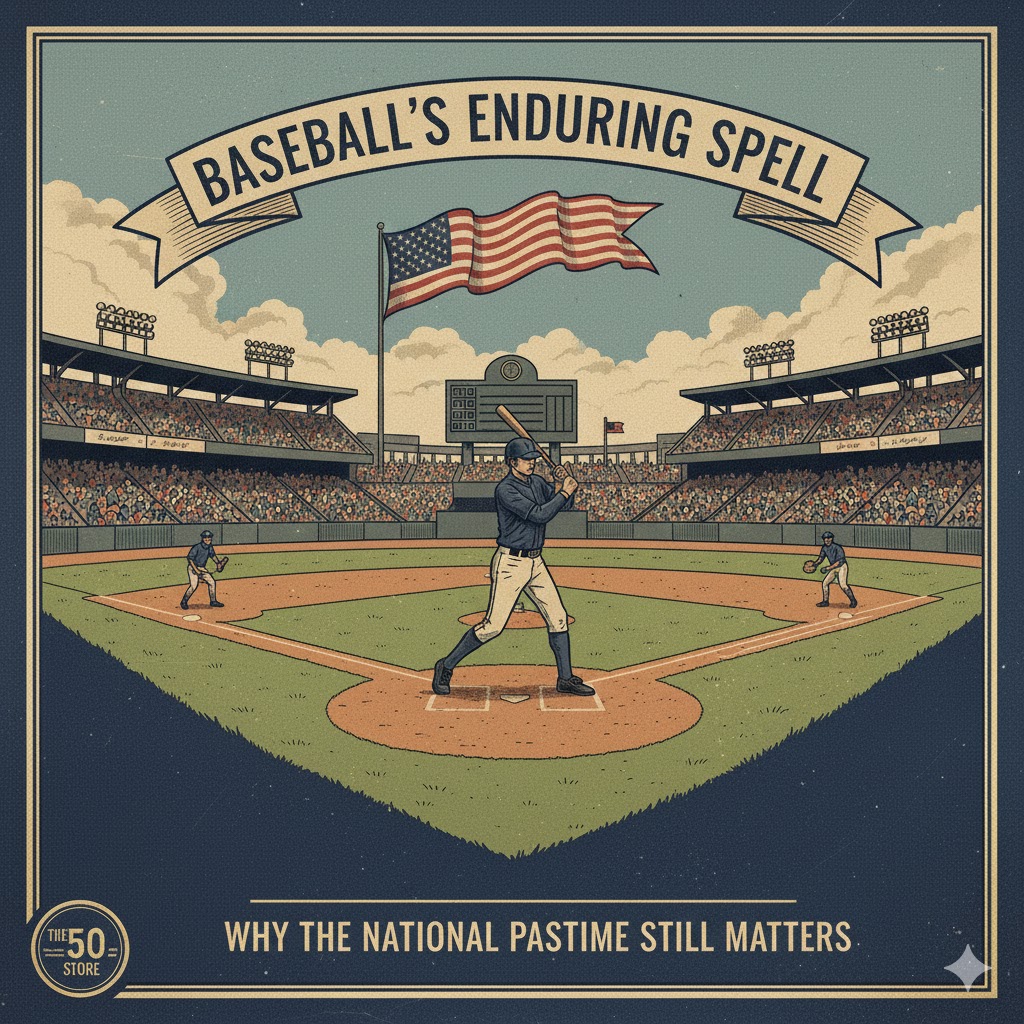
Why does a sport often defined by its slowness continue to cast such a powerful spell over a nation perpetually obsessed with speed? This is the central paradox of Baseball’s Enduring Spell, and the reason why this game, often called the National Pastime, still profoundly matters to the American experience. Baseball is more than a sport played on a diamond; it is a cultural repository, a narrative engine, and a genuine, tangible link to the past that no other American institution can quite replicate.
For those of us who appreciate depth and historical resonance, baseball offers a unique blend of timeless continuity and continuous change. It is a game steeped in melancholy and memory, a structure of familiar geometry that nonetheless allows for infinite dramatic variation. To understand why baseball endures is to understand the American need for ritual, nostalgia, and a shared story that transcends the chaos of the moment.
The Geometry of Memory: Time and Space
Unlike the clock-driven frenzy of football or basketball, baseball exists in an almost timeless dimension. Its field, the diamond, is a fixed stage—90 feet between bases—that has barely changed since the 19th century. This precise geometry is crucial to the game’s spell. It provides a constant, reliable framework against which all individual and generational achievements are measured.
The lack of a game clock means baseball unfolds on its own terms. It requires patience and allows for reflection between pitches and innings. This contemplative pace mirrors the slow, reflective rhythm of life in a bygone era, allowing the audience to engage in a unique form of narrative consumption. The long silences are as important as the sudden bursts of action; they are filled with anticipation, memory, and the ghosts of players past.
This emphasis on continuity is reinforced by the sheer volume of statistics. Baseball is perhaps the most numerically obsessed of all American sports. Every hit, strikeout, and error is recorded and compared across decades. The statistics don’t just measure performance; they create a statistical tapestry of history, making it entirely natural to compare a modern player’s numbers against those of Babe Ruth or Jackie Robinson. This constant, quantifiable connection to history makes the past feel immediately relevant, serving as a powerful anchor in a rapidly changing world.
A Mirror of American Society: Integration and Adaptation
Baseball’s history is inextricably linked to the American social journey, serving as both a mirror and a crucible for national change. Its most profound moment came with the integration of the sport in 1947, when Jackie Robinson broke the color barrier. This act of courage and conscience predated the widespread legal successes of the Civil Rights Movement by years, making the baseball diamond a highly visible, though often tumultuous, testing ground for racial equality in the public sphere.
The story of the Negro Leagues—the vibrant, innovative, and necessary parallel universe of Black baseball—adds a rich, complicated layer to the narrative. The modern recognition and incorporation of Negro League statistics into Major League Baseball records is a recent, deliberate effort to reclaim and repair history, acknowledging that the “National Pastime” was not always nationally inclusive.
Baseball’s adaptation has continued through the years, absorbing immigrants and different cultures. From the influx of Latin American and Asian players, the game has become a true global enterprise played on an American stage. These players bring new styles, flair, and passion, continually enriching the sport and reflecting the ever-diversifying face of the American public. The game proves its enduring power not by remaining static, but by constantly bending to include the narratives of those who now play and watch it.
The Unwritten Rules and the Local Bond
Baseball is uniquely tethered to local identity. While the Super Bowl creates one national champion, baseball culminates in a series that pits two geographic identities against each other. The bond between a fan and their local team—whether the historic Chicago Cubs or a newer expansion franchise—is often passed down through generations, becoming a fundamental part of regional and familial history. The ballpark, in this sense, is a sacred, communal space.
Moreover, the game is governed by a subtle layer of culture: the Unwritten Rules. These customs—about celebration, respect, and conduct—are constantly debated and often feel out-of-step with modern individualism. But the existence of these “rules” highlights baseball’s role as a guardian of traditional civility. The tension between modern player expression and traditional decorum is a metaphor for a broader national conversation about respect and tradition versus freedom and change.
Baseball’s enduring spell lies in its function as a cultural bridge. It is the sound of a summer evening, the scent of hot dogs, and the shared, often quiet, hope of a championship run. It is slow enough to absorb our memories, continuous enough to span our lifetimes, and rich enough in history to matter. The National Pastime endures because it reminds us that some of the greatest drama in life unfolds not in blinding speed, but in the patient waiting for the perfect moment.