
Culture & Traditions
Front Porches and the Architecture of American Neighborliness
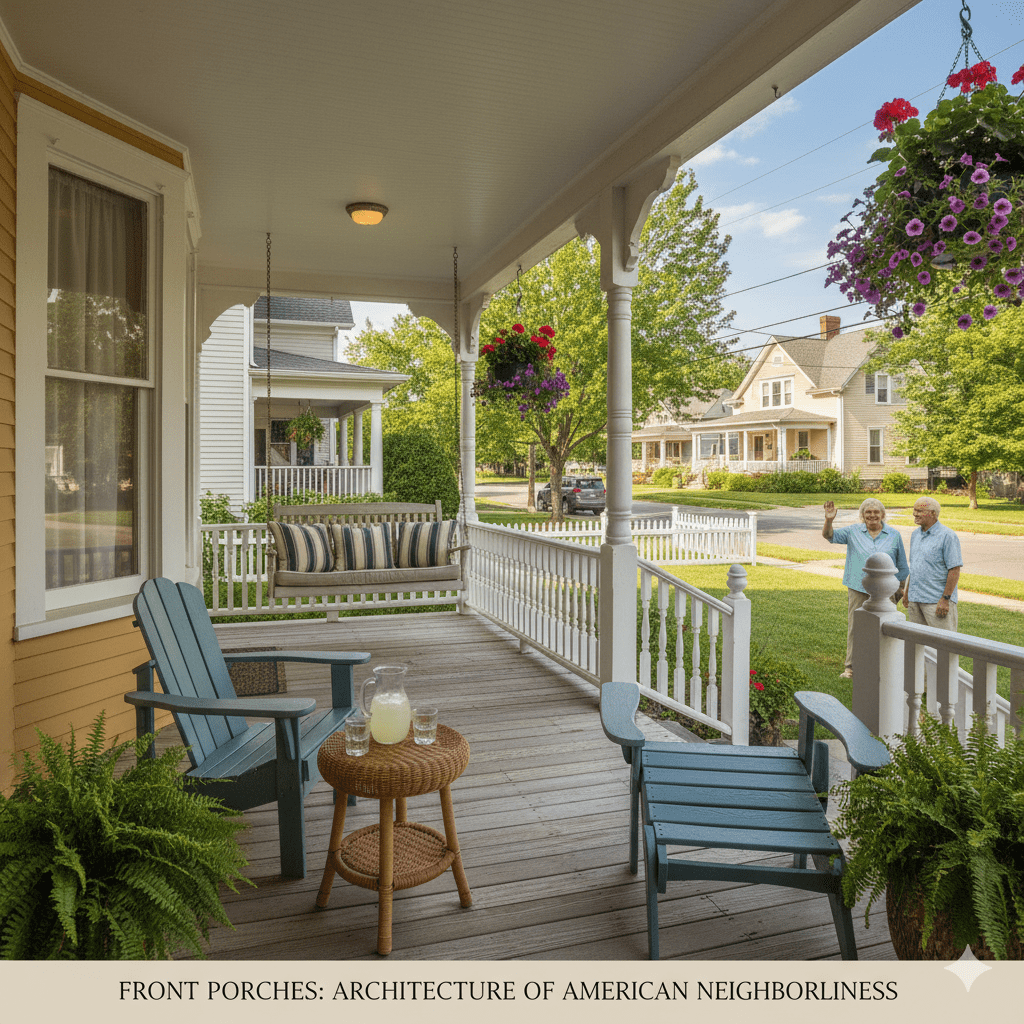
Think back to the rhythm of a summer evening, perhaps decades ago. Where did the neighborhood consensus take place? Where did the day’s dust settle, and the quiet ritual of community unfold? It wasn’t on a screen, nor was it behind a closed garage door. It was on the front porch—that quintessential American stage, suspended halfway between the private sanctuary of the home and the public flow of the street. For many of us, the front porch is more than just a transitional space of wood and railing; it is a repository of shared memory, a physical manifestation of a social contract that shaped American life for over a century. Yet, as our national architecture—and our habits—have evolved, this crucial threshold of neighborliness has largely vanished.
What does the slow disappearance of the front porch tell us about ourselves? It’s a profound architectural shift that mirrors an even deeper socio-cultural transformation in how we define community, privacy, and connection in modern America. This is the story of the porch: the simple, eloquent stage that facilitated the beautiful, messy, indispensable art of being American neighbors.
The Genesis of the Open Invitation
The American front porch truly came into its own during the late 19th and early 20th centuries. While classical homes had stoops, the widespread adoption of the generous, deep porch coincided with key shifts in American life. The rise of the Victorian and Craftsman architectural styles, coupled with a lack of universal air conditioning, made the shaded, breezy porch a necessary element of domestic comfort.
It served a dual purpose: practical and ceremonial. Practically, it was the family’s “cooling room,” a place to escape the heat of the interior kitchen. But ceremonially, it was an architectural invitation. The porch was the neighborhood’s living room. Conversations were begun with a simple, “Good evening,” evolving into complex discussions about town politics, school boards, and shared concerns. If someone was sitting on their porch, they were, quite literally, open for business—the business of community.
The regional variations of the porch are fascinating, reflecting America’s varied climate and pace of life:
- In the South, the porch often became a massive veranda or gallery, wrapping around the house to capture every possible cross-breeze, reflecting a culture that valued leisurely conversation and defense against the sun.
- In the Northeast and Midwest, porches were often smaller, more enclosed, or screened-in, serving as a seasonal refuge and a barrier against mosquitoes, but still fundamentally facing the street.
The Rise of the Automobile and the Retreat to the Rear
The golden age of the front porch began to fade after World War II, driven by two powerful, interconnected forces of progress: the automobile and climate control.
The car didn’t just change how we traveled; it profoundly changed how our homes were oriented. With the rise of the suburb and the ranch-style home, the garage, once a separate shed, began to move to the front of the house, often dominating the facade. The entrance ritual shifted from the polite conversation on the porch to the quick, shielded transition from car to house. As we became a nation of drivers, the focus of architectural design shifted from the pedestrian street to the vehicular driveway.
Simultaneously, the widespread adoption of air conditioning in the mid-20th century negated the porch’s primary functional purpose. Why sit outside in the heat and humidity when you could be inside in climate-controlled comfort? The technological solution to heat inadvertently created a profound social problem: it encouraged an internal focus, removing the spontaneous, necessary reason for Americans to inhabit the public-facing threshold of their homes.
The subsequent architectural evolution saw the rise of the rear deck and the fenced-in backyard. These spaces are wonderful for hosting planned, intimate gatherings—barbecues, family parties. But they are fundamentally private, designed to exclude the casual passerby. The backyard is for the known circle; the front porch was for the entire neighborhood.
The Architecture of Apathy and the Call for Reconnection
The decline of the front porch is more than just a sentimental loss; it represents a tangible loss in what urban sociologists call “organic surveillance” or “eyes on the street.” When people sat on their porches, they were naturally monitoring the neighborhood. This simple act provided an unspoken layer of safety, fostered trust, and encouraged mutual accountability.
Today, many modern American houses, particularly those built in the last three decades, have merely a decorative, vestigial stoop—a platform just large enough to keep the rain off packages. This trend suggests a cultural priority: efficiency and privacy over spontaneous, communal interaction.
The front porch was the American town square in miniature, the stage for democracy at its most granular level. Its removal created a cultural vacuum, leading to a profound sense of isolation that no amount of digital connectivity can truly fill.
The resurgence of older, walkable communities and the current popularity of “New Urbanism” are, in part, a yearning for the spatial conditions that fostered that older, simpler connection. They reflect a growing realization that our built environment dictates our social behavior.
Ultimately, the story of the front porch is a sophisticated cultural commentary on the American journey. It reminds us that community is not an accident; it must be designed. It requires a dedicated, physical space where the private self can intentionally and comfortably intersect with the public sphere.
As we mature as a nation, perhaps we should look back at the humble porch not just with nostalgia, but as a blueprint. It teaches us that the best forms of American neighborliness are often found in the deliberate, simple act of creating a welcoming space, a genuine invitation to sit down, stay a while, and maintain the vital, life-affirming tradition of watching the world go by, together.