
American Landscape
The Mississippi River: America’s Original Highway
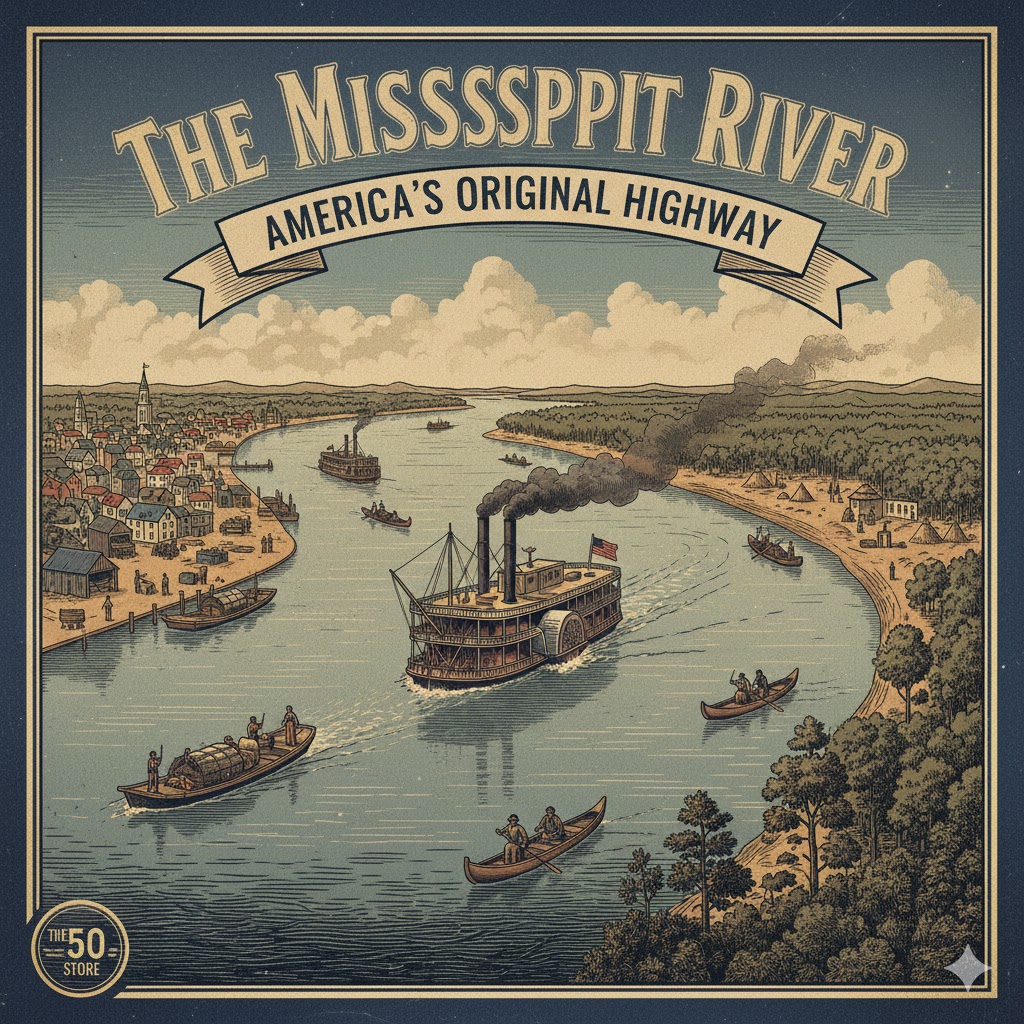
Long before highways cut across the landscape of the United States, before interstates connected coasts and regions, America already had a transportation system that defined its growth. The Mississippi River, stretching from northern Minnesota to the Gulf of Mexico, served as the nation’s first true highway—an artery of commerce, culture, and settlement that shaped the country state by state.
To understand American expansion, one must understand the Mississippi River not merely as geography, but as infrastructure.
The Mississippi River Before the United States Existed
The Mississippi River existed as a working corridor long before the United States took shape. Indigenous nations across what are now Minnesota, Wisconsin, Iowa, Illinois, Missouri, Kentucky, Tennessee, Arkansas, Mississippi, and Louisiana relied on the river as a trade route, food source, and cultural boundary.
These Mississippi River states were connected centuries before borders were drawn. Canoes and trading paths linked northern forests to southern wetlands, creating a continental network that later settlers would adopt rather than invent.
When European powers arrived, they quickly understood what Indigenous societies already knew: control of the Mississippi River meant control of the interior of North America.
How the Mississippi River Built the River States
During the 18th and 19th centuries, the Mississippi River became the backbone of economic life for the growing nation. Agricultural goods from Illinois, Iowa, Missouri, and Minnesota flowed south. Timber from Wisconsin and livestock from Kentucky and Tennessee moved efficiently along its currents.
Cities emerged precisely where the river made commerce inevitable:
- St. Louis, Missouri became a gateway to the West
- Memphis, Tennessee grew as a cotton and shipping hub
- Baton Rouge and New Orleans, Louisiana anchored global trade
For these Mississippi River states, prosperity followed the river’s bends. Roads were secondary. Rail came later. The river arrived first.
Steamboats and the Golden Age of the Mississippi River
The introduction of steamboats transformed the Mississippi River from a downstream-only passage into a two-way commercial highway. This innovation tied northern Mississippi River states directly to southern ports, collapsing distance and time.
Farmers in Illinois could reach global markets. Merchants in Arkansas and Mississippi gained reliable access to manufactured goods. The river unified regional economies long before political unity felt complete.
At its peak, the Mississippi River was the most important transportation system in the United States—far more vital than any early road network.
A Cultural Lifeline Across Mississippi River States
Beyond economics, the Mississippi River became a cultural corridor. Music, language, and tradition moved along its waters. Blues emerged from the Mississippi Delta. Jazz formed in Louisiana. Literature immortalized the river through voices like Mark Twain, who captured life along the Mississippi in Missouri and Illinois with unmatched clarity.
The river also carried America’s contradictions. It linked free states and slave states. It bore witness to prosperity alongside injustice. The Mississippi River did not create these tensions—but it exposed them.
The Mississippi River in Modern America
While highways and railroads eventually reduced the river’s visibility, they never replaced its importance. Today, the Mississippi River still moves hundreds of millions of tons of cargo annually through its network of locks and channels across ten states.
From Minnesota to Louisiana, the river remains one of the most efficient and environmentally responsible transportation systems in the nation. What changed was attention—not relevance.
Why the Mississippi River Still Matters to Americans
For many Americans over 30, the Mississippi River represents continuity. It is a reminder that the nation was shaped by patience, geography, and cooperation with natural systems rather than speed alone.
In a country defined by motion, the Mississippi River reminds us that America’s earliest progress followed water, not concrete.
America’s First Highway Still Running
The Mississippi River is not a relic of the past. It is a living system that continues to bind together the Mississippi River states—economically, culturally, and historically.
Before America paved its roads, it trusted its rivers. And among them all, the Mississippi River remains the original highway—still flowing, still working, still shaping the nation it helped build.